Mandatory Legal Standards Needed for Safe Drinking Water in India
Source:The Hindu ↗
Why It Matters
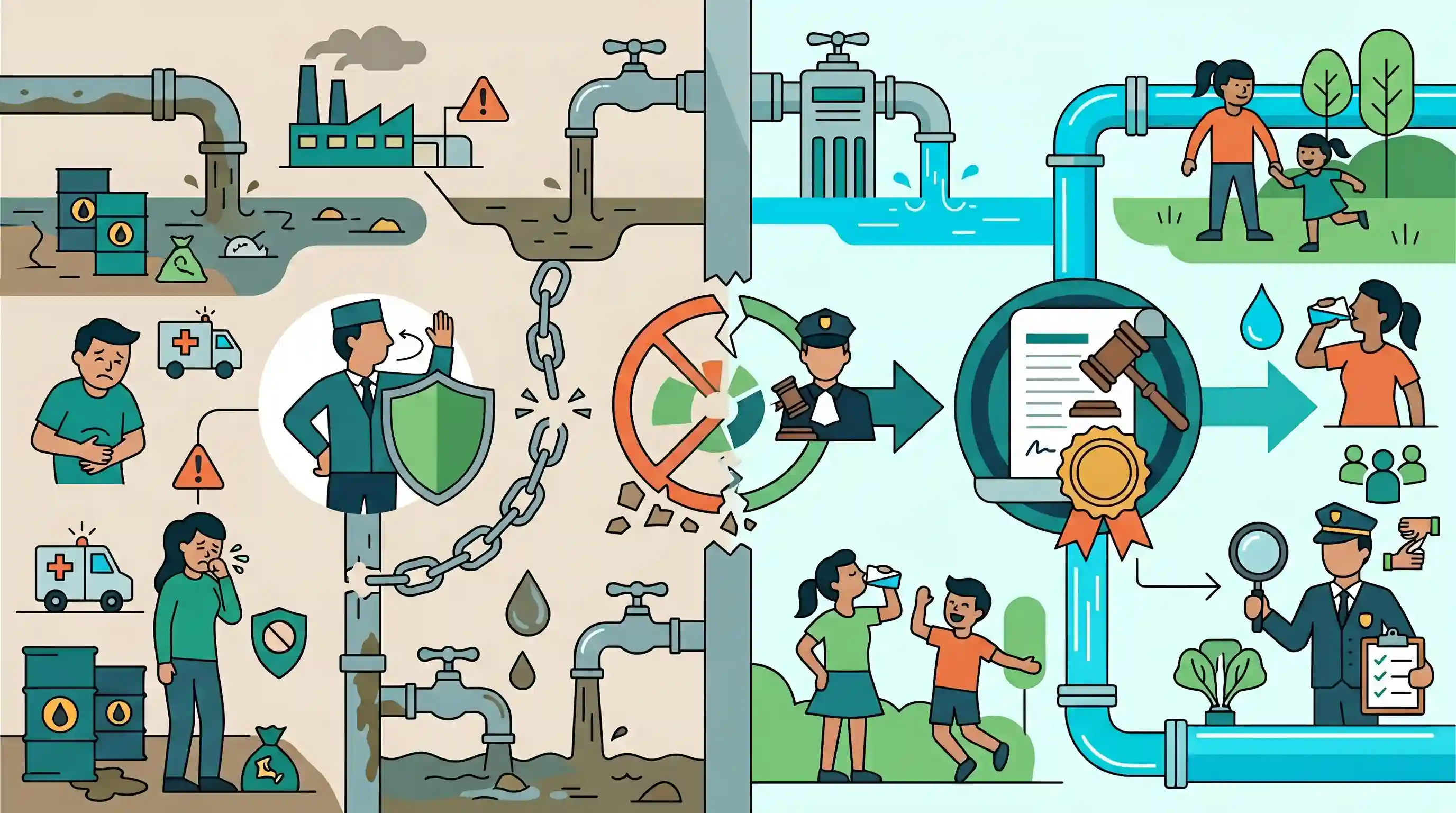
The lack of legally binding water quality standards directly impacts public health and limits the effectiveness of flagship schemes like the Jal Jeevan Mission. It is a vital issue for UPSC aspirants covering governance, regulatory bodies, and social justice (GS2), as well as environmental degradation and public health (GS3).
Summary
The article critically examines the governance and regulatory inadequacies surrounding India's drinking water standards. Despite widespread efforts to improve water access through initiatives like the Jal Jeevan Mission, the quality of municipal water often fails to meet safety benchmarks. The primary issue stems from the fact that Bureau of Indian Standards (BIS) norms for drinking water are not legally enforceable, allowing local authorities to evade accountability for supplying contaminated water. The author stresses that ensuring public health requires transitioning from merely providing water connections to strictly enforcing mandatory, legally binding water quality standards that uphold citizens' right to safe drinking water.
Key Points
- There is a significant gap between established drinking water quality standards (such as BIS IS 10500) and the actual water supplied by municipalities.
- While schemes like the Jal Jeevan Mission successfully expand tap water connectivity, ensuring the continuous potability and safety of the supplied water remains a critical challenge.
- A major regulatory flaw is that BIS drinking water standards are not legally binding for municipal water suppliers, which limits institutional accountability.
- Poor water quality exacerbates public health crises, leading to a high burden of water-borne diseases and chronic exposure to industrial and environmental contaminants.
- The article advocates for legally enforceable water quality standards and holding local bodies accountable to guarantee safe drinking water as a fundamental public right.
Important Terms
Jal Jeevan Mission (JJM)

A flagship Central scheme launched in 2019 to provide Functional Household Tap Connections (FHTC) of 55 litres per capita per day to every rural household by 2024 (extended to 2028).
UPSC context
GS Paper 2 (Policies) & GS Paper 3 (Water Resources); tests knowledge of decentralized governance and universal service delivery.
IS 10500 (BIS Drinking Water Specification)
The primary Indian standard specifying acceptable and permissible limits for physical, chemical, and biological contaminants in drinking water to ensure safety for human consumption.
UPSC context
GS Paper 2 (Governance) & GS Paper 3 (Pollution); critical for understanding the legal enforceability (or lack thereof) of municipal water quality.
Bureau of Indian Standards (BIS)
The National Standard Body of India, established under the BIS Act 2016, responsible for setting quality benchmarks and certification for goods to protect public health and safety.
UPSC context
GS Paper 2 (Statutory Bodies); tests understanding of the regulatory framework for national quality control and consumer protection.
World Health Organization (WHO)
The UN agency that provides global, evidence-based benchmarks for safe drinking water, which serve as the scientific foundation for national regulations like India’s BIS norms.
UPSC context
GS Paper 2 (International Institutions); tests knowledge of global health standards and their role in shaping national public health policies.
Prelims Trap
"BIS drinking water standards (IS 10500) are legally binding on all municipal water suppliers in India."
Aspirants assume national standards are mandatory. However, BIS drinking water norms are currently voluntary for municipal bodies, meaning citizens cannot easily hold them legally accountable.
Static Concepts Connected
How is drinking water governance structured under the Indian Constitution?
- Fundamental Right: SC interpreted Article 21 (Right to Life) to include access to pollution-free drinking water (Subhash Kumar v. State of Bihar, 1991).
- State List: Water, including water supplies, irrigation and canals, is listed as Entry 17 in the State List of the Seventh Schedule.
- Local Devolution: The 11th and 12th Schedules devolve the responsibility of drinking water management to Panchayats and Municipalities respectively.
What are the core parameters of the Jal Jeevan Mission (JJM)?
- The Target: Provide Functional Household Tap Connections (FHTCs) to every rural household by 2024, ensuring 'Har Ghar Jal'.
- Service Level: Ensure supply of 55 litres per capita per day (lpcd) of prescribed quality water on a regular, long-term basis.
- Community Ownership: Village Water & Sanitation Committees (VWSCs) or Pani Samitis plan, implement, and manage village water supply infrastructure.
Cross-Topic Patterns
AMR and untreated municipal water
Poor water quality not only causes traditional diseases but accelerates Antimicrobial Resistance (AMR) when pathogen-laden untreated sewage mixes with drinking water sources.
Geogenic contamination mapping
Voluntary enforcement of BIS standards exacerbates chronic exposure to natural geography-linked contaminants, like arsenic in the Ganga-Brahmaputra basin and fluoride in Rajasthan.

Expect a multi-statement Prelims question testing the voluntary nature of BIS water standards alongside Jal Jeevan Mission targets.
Linked PYQs · 4
Linked PYQs · 4
- 2024MainsGS3
The world is facing an acute shortage of clean and safe freshwater. What are the alternative technologies which can solve this crisis? Briefly discuss any three such technologies citing their key merits and demerits.
- 2024PrelimsGS1
With reference to perfluoroalkyl and polyfluoroalkyl substances (PFAS) that are used in making many consumer products, consider the following statements : 1. PFAS are found to be widespread in drinking water, food and food packaging materials. 2. PFAS are not easily degraded in the environment. 3. Persistent exposure to PFAS can lead to bioaccumulation in animal bodies. Which of the statements given above are correct?
- 2024MainsGS3
Industrial pollution of river water is a significant environmental issue in India. Discuss the various mitigation measures to deal with this problem and also the government's initiatives in this regard.
- 2025MainsGS3
Examine the factors responsible for depleting groundwater in India. What are the steps taken by the government to mitigate such depletion of groundwater?
