Parliamentary Accountability and Executive Oversight
Source:Indian Express ↗
কেন এটি গুরুত্বপূর্ণ
Directly addresses core GS2 themes regarding executive accountability, the health of parliamentary democracy, and the quality of legislative debate, which frequently feature in Mains examinations.
সারসংক্ষেপ
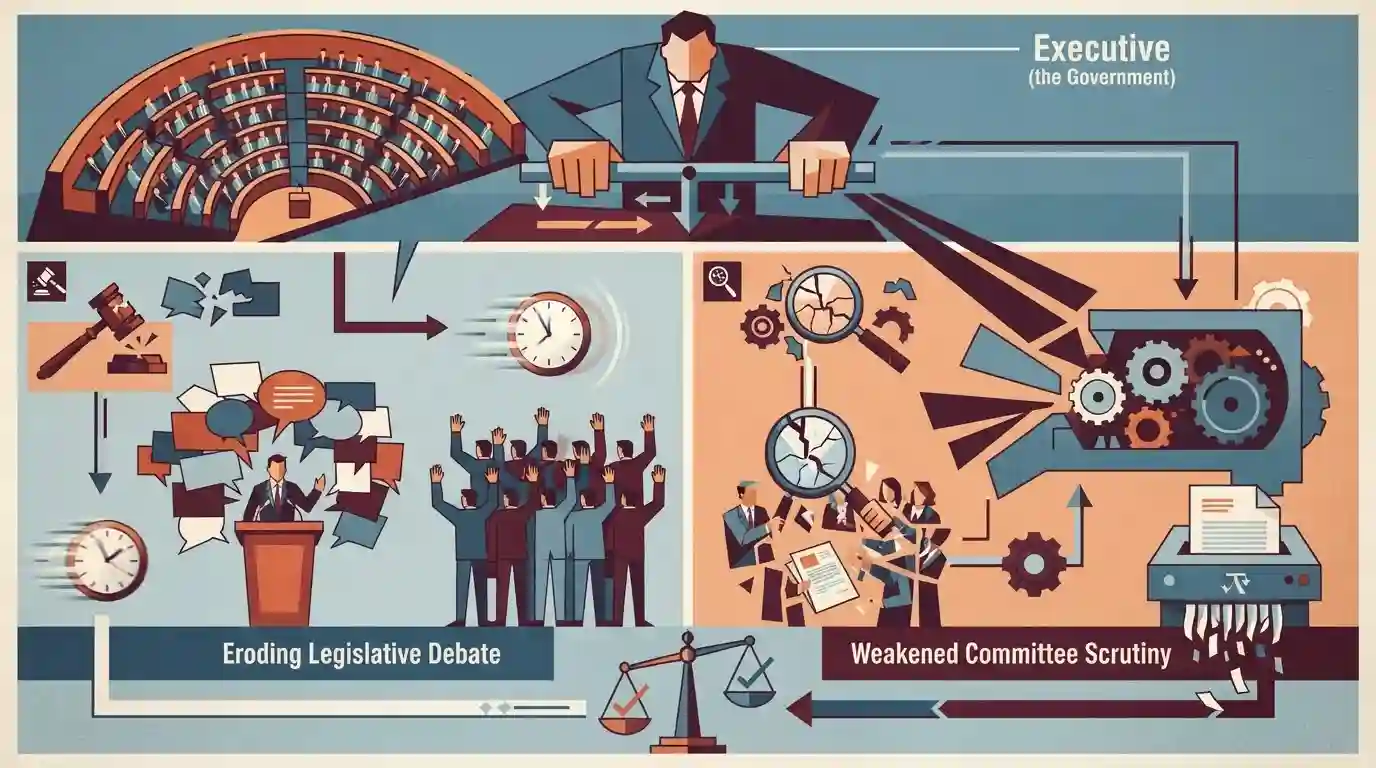
The article discusses the critical erosion of parliamentary oversight and accountability, highlighting how the House of the People (and Parliament at large) faces structural and political hurdles in holding the executive power accountable. It emphasizes the degradation of legislative debate and committee scrutiny.
মূল বিষয়
- Parliamentary accountability of the executive has seen a declining trend due to reduced debate time, bypassing of parliamentary committees, and rushed legislation.
- The role of individual parliamentarians as lawmakers has weakened, adversely impacting the quality of legislative scrutiny and democratic deliberation.
- Reinvigorating parliamentary democracy requires restoring the primacy of institutional mechanisms like committee scrutiny, Question Hour, and open debate.
গুরুত্বপূর্ণ শব্দ
Parliament

The supreme legislative body of India comprising the President, Lok Sabha, and Rajya Sabha, tasked with lawmaking, national deliberation, and keeping the executive branch accountable.
UPSC context
UPSC Prelims & Mains (GS Paper II): Core focus on structure, functioning, conduct of business, powers, privileges, and issues of parliamentary accountability.
Lok Sabha
The lower house of India's Parliament, whose members are directly elected by citizens; it holds primary constitutional responsibility for maintaining executive accountability and passing money bills.
UPSC context
UPSC Prelims & Mains (GS Paper II): Evaluates the constitutional mechanisms of executive responsibility under Article 75(3) and legislative oversight.
Rajya Sabha
The upper house of India's Parliament representing the states, participating in legislative scrutiny and possessing special constitutional powers under Articles 249 and 312.
UPSC context
UPSC Prelims & Mains (GS Paper II): Important for federal features, bicameralism, and the specific legislative powers of the Upper House.
প্রিলিমস ফাঁদ
Every major legislation introduced in Parliament must be referred to a Department-related Standing Committee before passing.
Aspirants often assume Parliamentary Standing Committees are mandatory for every bill, but referral is entirely discretionary and not constitutionally mandated.
সংযুক্ত স্থির ধারণা
What are the key institutional mechanisms and constitutional provisions ensuring executive accountability in Parliament?
- Constitutional Basis: Collective responsibility under Article 75(3) makes the Council of Ministers responsible to the Lok Sabha.
- Parliamentary Questions: Question Hour, Zero Hour, and half-hour discussions allow MPs to extract information and question ministers directly.
- Committee System: Standing Committees scrutinize departmental budgets, demands for grants, and bills in detail, operating away from political grandstanding.
- Motion Instruments: No-confidence motion, adjournment motion, and censure motion are direct instruments for censuring or testing the government's majority.
আন্তঃবিষয় প্যাটার্ন
Parliamentary Erosion vs. Judicial Review
Decline of legislative scrutiny directly undermines constitutional federalism and the checks-and-balances framework, mirroring judicial concerns over executive overreach.
Delegated Legislation and Administrative Accountability
Rushed legislation without committee scrutiny compromises the quality of statutory bodies and weakens accountability mechanisms built into administrative law.

Expect a mains question on the decline of parliamentary committees and its impact on the separation of powers and executive accountability.
সংযুক্ত PYQ · 2
সংযুক্ত PYQ · 2
- 2019MainsGS2
Individual Parliamentarian's role as the national law maker is on a decline, which in turn, has adversely impacted the quality of debates and their outcome. Discuss.
- 2021MainsGS2
To what extent, in your view, the Parliament is able to ensure accountability of the executive in India?
