Parliamentary Oversight and Executive Accountability in India
Source:Indian Express ↗
हे का महत्त्वाचे आहे
It directly addresses core GS2 syllabus requirements regarding the functioning of the Indian Parliament, executive-legislative dynamics, and the declining standards of legislative accountability and debate.
सारांश
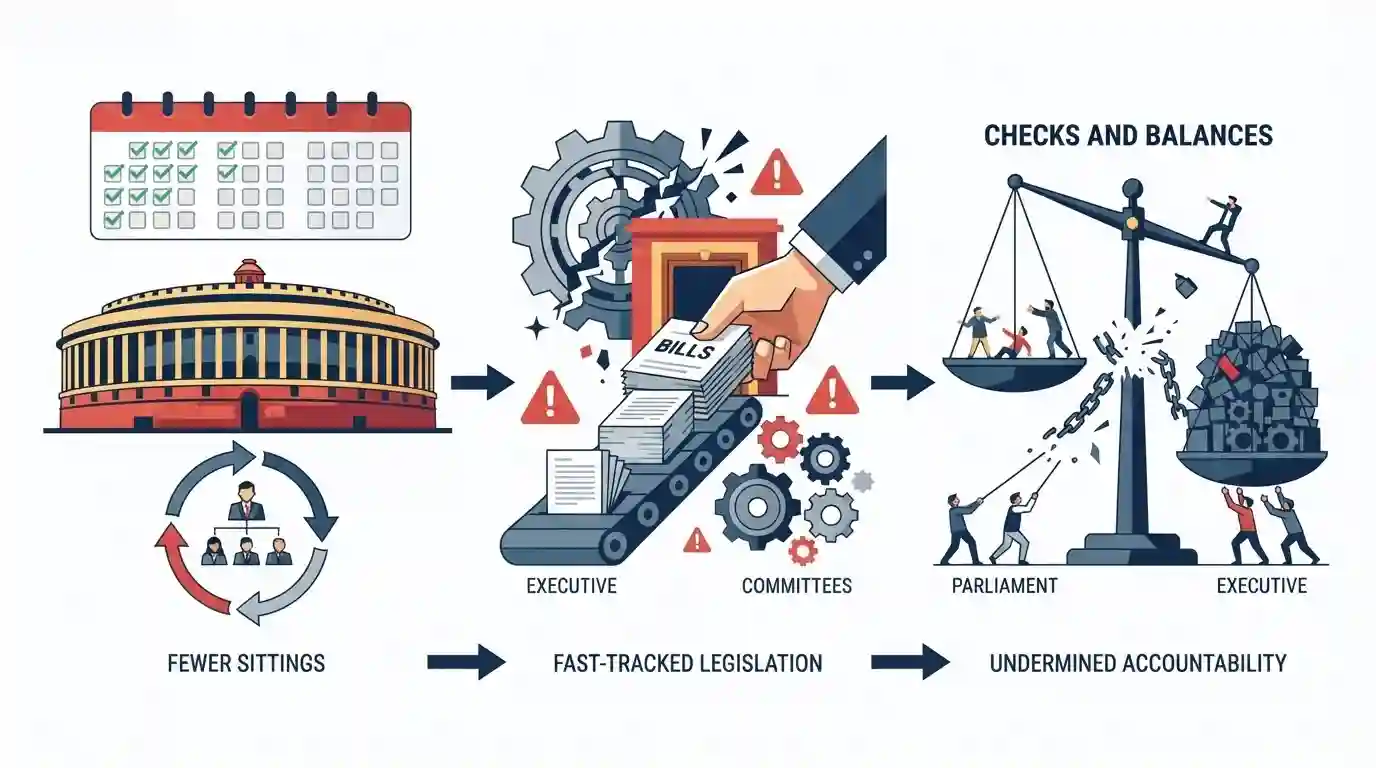
The article examines the gradual erosion of the Indian Parliament's capacity to hold the executive accountable, highlighting the decline in legislative sittings, bypassing of committees, and the fast-tracking of legislation without meaningful debate, which undermines democratic checks and balances.
मुख्य मुद्दे
- The Indian Parliament is facing a critical decline in its functioning as an effective institution for holding the executive accountable.
- Key issues include reduced number of sitting days, bypassing of parliamentary committees, and passing major legislation without adequate debate or scrutiny.
- The diminishing role of individual parliamentarians and the lack of robust opposition space weaken democratic checks and balances.
- Restoring the primacy of Parliament requires institutional reforms, greater transparency, and a commitment by the executive to respect legislative oversight.
महत्त्वाच्या संज्ञा
Parliament of India

The supreme legislative body of India, comprising the President, Lok Sabha, and Rajya Sabha, responsible for law-making, financial control, and holding the executive accountable.
UPSC context
UPSC GS Paper II (Polity): Structure, functioning, conduct of business, and executive-legislative accountability.
Lok Sabha
The lower house of India's bicameral parliament, consisting of directly elected representatives, holding ultimate financial authority and where the Council of Ministers is collectively responsible.
UPSC context
UPSC GS Paper II: Powers and privileges of Lok Sabha and executive accountability under Article 75(3).
Rajya Sabha
The upper house of India's parliament representing the states, possessing equal legislative power with Lok Sabha (except for money bills) and ensuring federal representation in law-making.
UPSC context
UPSC GS Paper II: Role of the upper house in federal checks and balances.
पूर्वपरीक्षा सापळा
Constitutionally mandated referral of all major legislations to Department-related Parliamentary Standing Committees...
Aspirants often assume Parliamentary Standing Committees are constitutionally mandated; in reality, they are functional committees regulated by rules of procedure.
संबंधित स्थिर संकल्पना
What are the types and functions of Parliamentary Committees in India?
- Financial Oversight: Financial committees (Estimates, Public Accounts, Public Undertakings) exercise post-expenditure oversight on government spending.
- Standing Committees: DRSCs examine bills, demand for grants, and policy documents, operating away from partisan floor politics.
- Permanent Nature: Unlike Select Committees, Standing Committees are permanent bodies constituted every year or periodically.
आंतर-विषय नमुने
Anti-Defection Law vs. Legislative Accountability
The Tenth Schedule (Anti-Defection Law) binds MPs to party whips, stifling legislative debate and merging accountability mechanisms with party discipline.
Standing Committees vs. Executive Dominance
Bypassing Parliamentary Standing Committees mirrors a broader global trend of executive dominance, weakening expert legislative scrutiny over complex technical bills.

Expect a multi-statement Prelims question combining Tenth Schedule provisions with declining Standing Committee referral rates.
संबंधित PYQ · 3
संबंधित PYQ · 3
- 2021MainsGS2
Do Department-related Parliamentary Standing Committees keep the administration on its toes and inspire reverence for parliamentary control? Evaluate the working of such committees with suitable examples.
- 2023MainsGS2
Explain the structure of the Parliamentary Committee system. How far have the financial committees helped in the institutionalisation of Indian Parliament?
- 2019MainsGS2
Individual Parliamentarian's role as the national law maker is on a decline, which in turn, has adversely impacted the quality of debates and their outcome. Discuss.
