Tiger Conservation and Political Dynamics in Rajasthan Reserves
Source:firstindia ↗
Why It Matters
Essential for understanding the governance, policy framework, and socio-political challenges surrounding wildlife conservation and tiger reserves in Rajasthan.
Summary
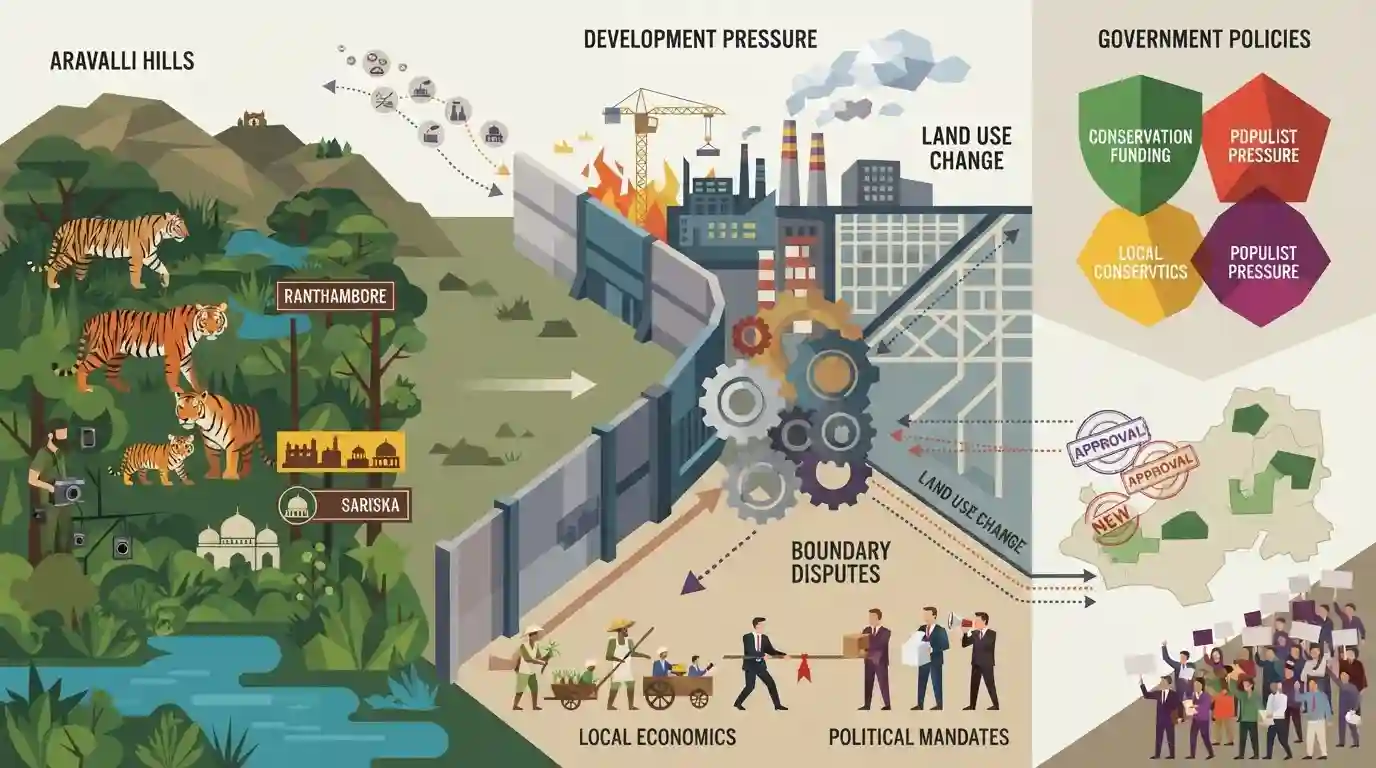
The article examines the intersection of wildlife conservation, specifically tiger protection initiatives, and political friction in Rajasthan. It highlights how managing tiger reserves such as Ranthambore, Sariska, and newer ones involves competing political and local economic interests, shedding light on the challenges of balancing conservation mandates with populist politics.
Key Points
- The intersection of wildlife conservation (specifically tiger reserves) and regional political debates in Rajasthan.
- Balancing ecological preservation, tourism, and local political/economic interests in tiger habitats like Ranthambore, Sariska, and newer reserves.
- The role of central bodies like the National Tiger Conservation Authority (NTCA) alongside state governance in managing protected areas.
Important Terms
Project Tiger

India's flagship tiger conservation program launched in 1973 to protect Bengal tigers and their habitats through a core-buffer strategy.
UPSC context
Important for RPSC and UPSC environment syllabus; evaluates species conservation, federal funding schemes, and protected area governance.
Wildlife Protection Act 1972
Comprehensive central legislation enacted in 1972 providing legal frameworks for protecting wildlife, establishing protected areas, and regulating trade.
UPSC context
Core statute for RPSC environment and ecology questions, testing legal provisions, schedules, and conservation mandates.
National Tiger Conservation Authority
A statutory body established under the Wildlife Protection Act, 1972, to provide regulatory oversight and legal backing to Project Tiger.
UPSC context
Important for governance and institutional frameworks in RPSC environment syllabus, focusing on statutory powers and center-state coordination.
Static Concepts Connected
What are the key statutory provisions and bodies governing Tiger Reserves in India under the Wildlife Protection Act, 1972?
- NTCA Status: Established in 2006 upon Tiger Task Force recommendation, replacing Project Tiger's erstwhile steering mechanism as a statutory body under WPA 1972.
- Core Zone: Strictly designated for ecological integrity where no human activity is permitted except for wildlife management and research.
- Buffer Zone: An area peripheral to the core zone ensuring co-existence with tribal/local interests, focused on sustainable use without harming tigers.
Cross-Topic Patterns
Tiger Reserves vs. Regional Land Politics
Rajasthan's expanding tiger network (Ranthambore to Dholpur-Karauli) intersects with land acquisition laws and Fifth Schedule regional rights, creating friction between state developmental priorities and central conservation mandates.

Expect a matching or statement-based question on Rajasthan's 5 tiger reserves, NTCA statutory status, and Wildlife Protection Act 1972 amendments.
Linked PYQs · 2
Linked PYQs · 2
- 2023RPSC_PRELIMSGS1
The National Tiger Conservation Authority has conferred the status of the fifth tiger sanctuary in Rajasthan, to which of the following sanctuaries?
- 2025RPSC_PRELIMSGS1
Choose the incorrect statement with respect to the Rajasthan Forestry and Biodiversity Project (Phase-2).
