Objectives Resolution and Evolutionary Nature of Indian Constitution
Source:Indian Express ↗
Why It Matters
Understanding the original intent of the Constitution's framers regarding flexibility is crucial for contemporary debates on constitutional amendments, the Basic Structure Doctrine, and the dynamic nature of constitutional governance.
Summary
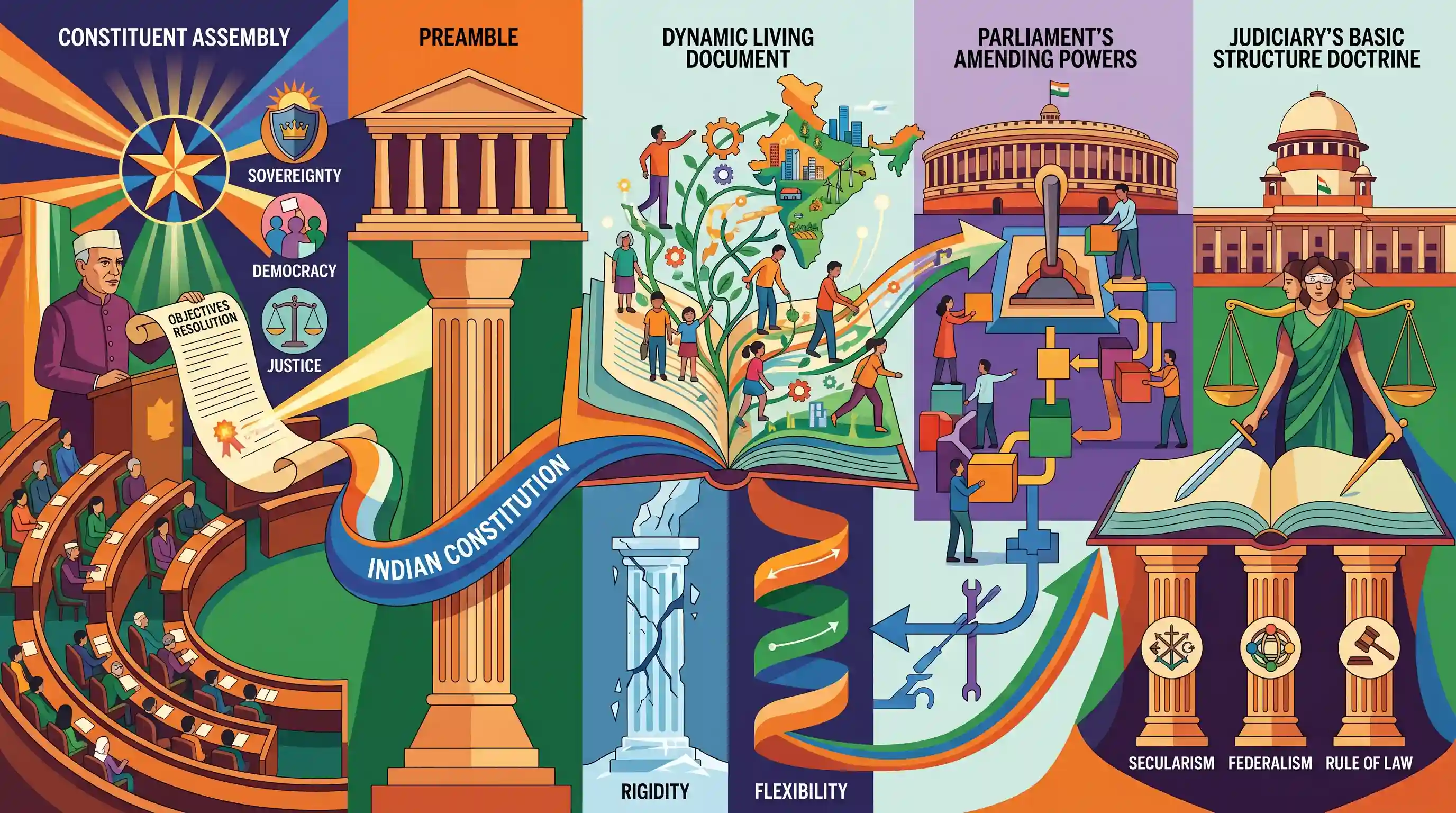
The article reflects on Jawaharlal Nehru's introduction of the Objectives Resolution in the Constituent Assembly, which served as the philosophical bedrock for the Preamble of the Indian Constitution. Highlighting Nehru's assertion that 'this House cannot bind down the next generation,' the piece underscores the framers' vision of a dynamic, 'living' Constitution. By rejecting absolute rigidity, Nehru advocated for a constitutional framework that future generations could amend and adapt to contemporary societal challenges. This foundational philosophy highlights the delicate balance between preserving core constitutional values and ensuring evolutionary flexibility—a principle later institutionalized through Parliament's amending powers under Article 368 and the judiciary's Basic Structure Doctrine.
Key Points
- Jawaharlal Nehru moved the Objectives Resolution in the Constituent Assembly in December 1946, laying down the fundamental philosophy and guiding principles for the Constitution.
- The Objectives Resolution eventually evolved into the Preamble of the Indian Constitution, reflecting the mind and ideals of the Constitution makers.
- Nehru famously asserted that 'this House cannot bind down the next generation,' emphasizing that the Constitution must not be an entirely rigid framework.
- This perspective underscores the framers' vision of the Constitution as a 'living document' capable of adapting to the progressive needs and changes of future generations.
- Nehru's stance prefigured the critical constitutional balance between flexibility (amendability) and rigidity (preservation of core ideals), which later culminated in the Basic Structure Doctrine.
Important Terms
Objectives Resolution

Introduced by Jawaharlal Nehru on December 13, 1946, this resolution outlined the guiding principles and philosophical goals for framing the Indian Constitution, emphasizing sovereignty, justice, and equality.
UPSC context
GS Paper II (Polity); essential for understanding the 'spirit' and historical evolution of the Constitution.
Preamble
The introductory statement of the Constitution that encapsulates its core values, objectives, and philosophy; it is based on the earlier Objectives Resolution.
UPSC context
GS Paper II; tested frequently regarding its amendability and status as part of the Basic Structure.
Constituent Assembly
A body of indirectly elected representatives formed in 1946 under the Cabinet Mission Plan to draft the Constitution of India; it also served as India's provisional Parliament.
UPSC context
GS Paper II; important for questions on the drafting process and ideological debates (CADs).
Basic Structure Doctrine
A judicial principle established in the 1973 Kesavananda Bharati case asserting that Parliament cannot amend certain 'fundamental features' (like secularism or democracy) of the Constitution.
UPSC context
GS Paper II; a critical concept for mains regarding the balance between parliamentary sovereignty and judicial review.
Article 368
The specific provision in the Indian Constitution that grants Parliament the power to amend the document and prescribes the procedure for doing so.
UPSC context
GS Paper II; tests knowledge of the amendment process and its limitations under judicial scrutiny.
Living Constitution
The concept that a constitution is a dynamic document that must evolve through interpretation and amendment to remain relevant to contemporary societal needs.
UPSC context
GS Paper II (Polity/Ethics); relevant for essays and mains questions on constitutional morality and adaptability.
Constitution of India
The supreme law of India, adopted on November 26, 1949, which defines the framework for political principles, procedures, and the duties of government institutions.
UPSC context
Foundation of GS Paper II; central to almost every administrative and legal question.
Parliament of India
The supreme legislative body of India, consisting of the President and two Houses, empowered to make laws and amend the Constitution within specific limits.
UPSC context
GS Paper II; tests understanding of the legislative process and its relationship with the executive and judiciary.
Prelims Trap
The Objectives Resolution was officially adopted by the Constituent Assembly after India attained independence.
The Resolution was adopted on Jan 22, 1947, months before independence. UPSC frequently tests the precise chronology of early Constituent Assembly milestones.
Static Concepts Connected
How did the Objectives Resolution shape the Constitution's Preamble?
- Philosophical Base: Moved by Nehru in Dec 1946, it laid down fundamental values (justice, equality, freedom) that the Drafting Committee later distilled into the introductory Preamble.
- Key Modifications: While adopting the Resolution's spirit, the Drafting Committee refined the language, prominently adding the concept of 'Fraternity' which was absent in the original 1946 text.
What makes the Indian Constitution a 'living document'?
- Amendability: Article 368 allows the Constitution to evolve alongside society, embodying Nehru's vision that past generations cannot absolutely restrict future ones.
- Judicial Evolution: Courts continuously reinterpret constitutional provisions (e.g., expanding Article 21) to address contemporary challenges, maintaining constitutional relevance without needing formal amendments.
- Basic Structure Checks: Introduced in 1973, this doctrine balances 'living document' flexibility with essential rigidity, ensuring Parliament's amendments cannot destroy foundational ideals.
Cross-Topic Patterns
Generational Sovereignty & Enlightenment Philosophy
Nehru's 'cannot bind the next generation' directly mirrors Thomas Jefferson's philosophical stance that 'the earth belongs to the living,' linking Indian constitutionalism to global Enlightenment political theory.
Living Constitution vs. Basic Structure Doctrine
Nehru’s plea against absolute rigidity offers a critical contrast to the judiciary's Basic Structure Doctrine, which deliberately 'binds' future Parliaments from altering the Constitution's core identity.

Mains GS2 may ask to critically analyze the tension between Nehru's 'living document' vision and the rigid Basic Structure Doctrine.
Linked PYQs · 4
Linked PYQs · 4
- 2017PrelimsGS1
The mind of the makers of the Constitution of India is reflected in which of the following?
- 2024PrelimsGS1
Who was the Provisional President of the Constituent Assembly before Dr. Rajendra Prasad took over?
- 2023MainsGS2
“The Constitution of India is a living instrument with capabilities of enormous dynamism. It is a constitution made for a progressive society.” Illustrate with special reference to the expanding horizons of the right to life and personal liberty.
- 2025MainsGS2
Indian Constitution has conferred the amending power on the ordinary legislative institutions with a few procedural hurdles. In view of this statement, examine the procedural and substantive limitations on the amending power of the Parliament to change the Constitution.
