Climate Change Impacts on Regional Tourism and Economy
Source:The Hindu ↗
Why It Matters
This article provides a tangible, regional example of how global climate change translates into direct economic impacts (loss of tourism revenue) for coastal communities. It is highly relevant for GS3 questions addressing the socioeconomic fallouts of climate change, disaster management (extreme weather warnings), and the sustainable management of wetland ecosystems.
Summary
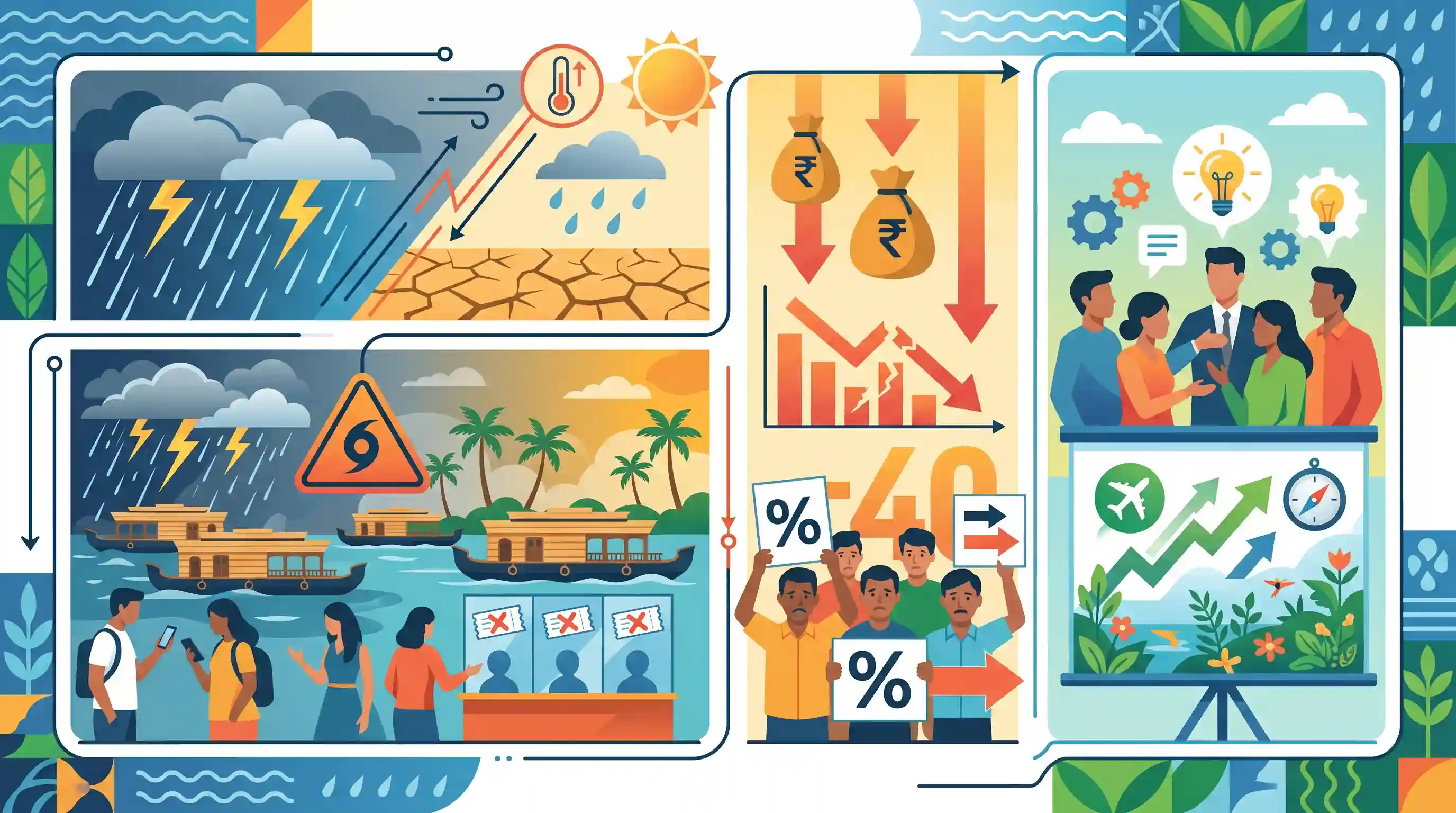
The article discusses the detrimental impact of climate change on monsoon tourism in Kerala, focusing on the houseboat industry in Alappuzha. Unpredictable weather patterns, characterized by erratic downpours and sudden dry spells since the 2018 floods, have disrupted the steady monsoon rains that previously attracted tourists to the state's backwaters. Consequently, frequent weather warnings have led to increased booking cancellations, severely affecting the local economy. Houseboat operators are now compelled to offer heavy discounts of up to 40% to attract visitors, while stakeholders urge for strategic marketing to revive the struggling sector.
Key Points
- Climate change has significantly disrupted the 'monsoon tourism' sector in Kerala, particularly the houseboat business in Alappuzha.
- Erratic weather patterns, including unexpected dry spells and extreme downpours post the 2018 floods, have replaced the previously steady monsoon rains.
- The unpredictability has led to widespread booking cancellations, exacerbated by frequent official weather alerts that deter domestic tourists.
- Houseboat operators are experiencing substantial economic losses, forcing them to offer steep discounts of 30-40% to sustain business.
- Local stakeholders emphasize the need for effective marketing strategies to revive monsoon tourism and support the regional economy reliant on backwater tourism.
Important Terms
All Kerala Houseboat Owners Association (AKHOA)

The leading industry body representing houseboat operators in Kerala. It coordinates operational logistics, advocates for government relief, and implements sustainable waste management systems like bio-digesters to protect the backwaters.
UPSC context
GS-III (Economics/Environment). Relevant for discussions on sector-specific associations and their role in sustainable tourism and disaster-impacted livelihoods.
Vembanad Lake
India's longest lake and a critical Ramsar wetland in Kerala. It supports the state's houseboat industry but faces severe ecological threats from pollution, carrying-capacity issues, and erratic climate patterns.
UPSC context
GS-I (Geography) and GS-III (Environment). Key Ramsar site; central to discussions on wetland conservation and the 'Venice of the East' economy.
Blue Economy
A sustainable development framework for utilizing ocean and coastal resources for economic growth while ensuring ecosystem health. It includes sectors like maritime transport, fisheries, and coastal tourism.
UPSC context
GS-III (Economy/Environment). Vital for India’s 'Blue Economy 2.0' initiative and achieving SDG 14 (Life Below Water) through sustainable tourism.
IMD Color-coded Warnings
A weather alert system used by the India Meteorological Department: Green (No warning), Yellow (Be updated), Orange (Be prepared), and Red (Take action) based on severity.
UPSC context
GS-III (Disaster Management). Crucial for understanding disaster preparedness and the economic impact of 'precautionary' alerts on regional tourism.
Ramsar Site
A wetland designated of international importance under the 1971 Ramsar Convention. These sites require conservation and 'wise use' of resources to maintain their ecological character.
UPSC context
GS-III (Environment/Biodiversity). High-frequency topic for Prelims and Mains regarding international environmental treaties and domestic wetland management.
Climate Resilience
The capacity of socio-economic systems to absorb climatic shocks, such as erratic monsoons, and adapt through strategic marketing, infrastructure upgrades, and sustainable practices.
UPSC context
GS-III (Environment/Disaster Management). Tests strategies for adapting regional economies (like Kerala's tourism) to increasingly unpredictable monsoon patterns.
Prelims Trap
"Vembanad-Kol Wetland is the largest Ramsar site in India."
While it is the longest lake in India, it is the second-largest Ramsar site. The Sundarbans wetland in West Bengal is the largest.
Static Concepts Connected
What are the key geographical features of the Vembanad-Kol Wetland?
- Longest lake: It is the longest lake in India, spanning several districts parallel to the Kerala coast.
- Ramsar status: Designated as a wetland of international importance, it is the second-largest Ramsar site in India after the Sundarbans.
- Feeder rivers: The estuarine system is fed by multiple rivers, most notably the Pampa and Meenachil.
What do the IMD's colour-coded weather warnings signify?
- Yellow (Watch): Indicates severely bad weather spanning a few days. Advises authorities and the public to 'be updated'.
- Orange (Alert): Signifies extremely bad weather with potential transport and power disruptions. Advises citizens to 'be prepared'.
- Red (Warning): Extremely severe weather posing a risk to life and property. Demands immediate action and adherence to official orders.
Cross-Topic Patterns
Climate extremes and niche tourism
Shifting monsoon patterns from steady rainfall to extreme downpours threaten specialized regional economies, linking GS1 Geography (monsoons) with GS3 Economy (services vulnerability).
IMD warnings as economic shocks
Early warning systems meant for disaster preparedness (like IMD colour codes) inadvertently trigger local economic distress, a nuanced angle for GS3 Disaster Management.

Expect a multi-statement Prelims question integrating shifting Southwest Monsoon patterns, IMD colour codes, and West Coast wetland geography.
Linked PYQs · 4
Linked PYQs · 4
- 2017MainsGS3
'Climate change' is a global problem. How India will be affected by climate change? How Himalayan and coastal states of India will be affected by climate change?
- 2022MainsGS1
Discuss the meaning of colour-coded weather warnings for cyclone prone areas given by India Meteorological Department.
- 2018MainsGS3
What is wetland? Explain the Ramsar concept of 'wise use' in the context of wetland conservation. Cite two examples of Ramsar sites from India.
- 2023MainsGS3
Comment on the National Wetland Conservation Programme initiated by the Government of India and name a few India's wetlands of international importance included in the Ramsar Sites.
