Police Accountability and Rule of Law Violations in India
Source:The Hindu ↗
Why It Matters
It addresses core constitutional principles of due process, rule of law, and police accountability, which are recurrent themes in GS Paper II (Polity, Governance, and Human Rights).
Summary
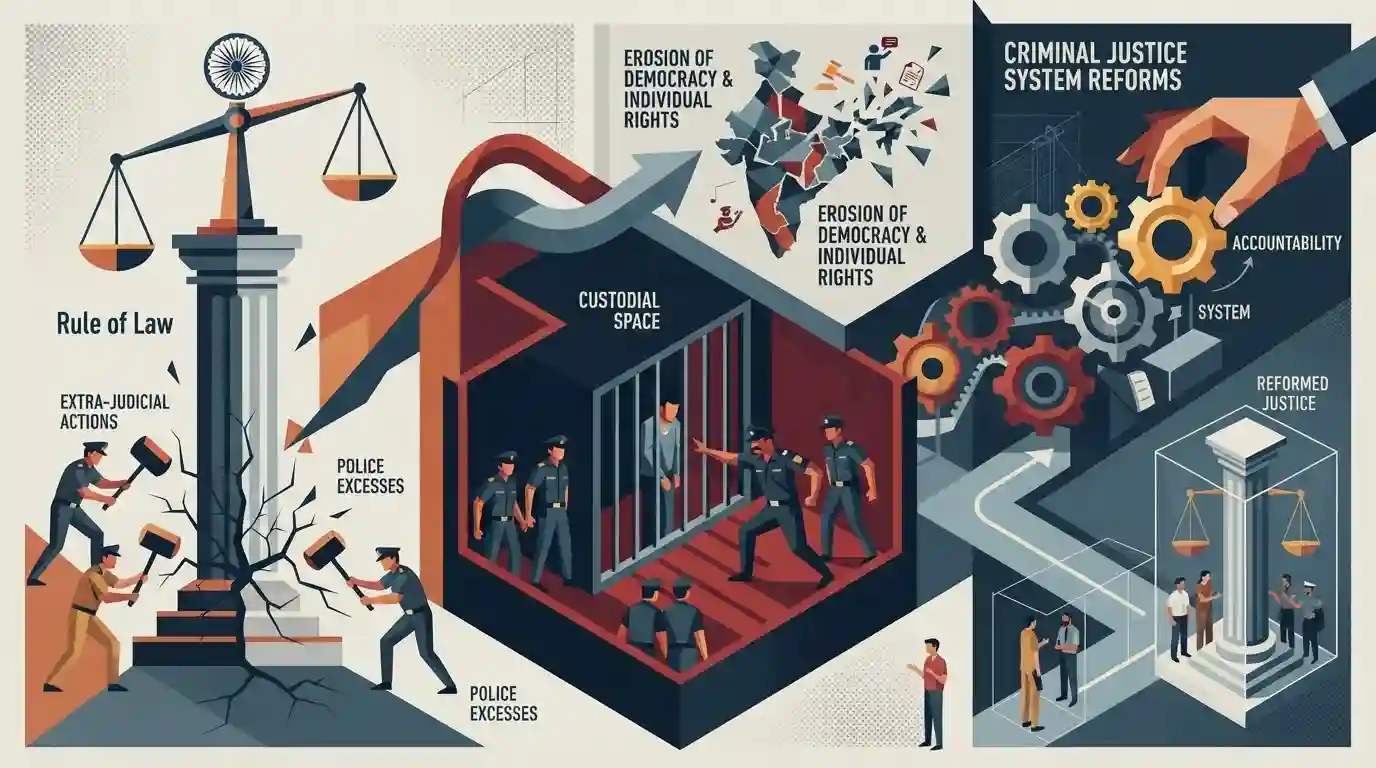
The article discusses the critical issue of law enforcers operating outside the discipline of the law, highlighting how extra-judicial actions, police excesses, and the erosion of due process threaten the rule of law, democracy, and individual rights in India.
Key Points
- The article examines the dangerous trend of law enforcement agencies operating outside the strict boundaries of constitutional and statutory laws.
- Extra-legal actions, custodial violence, and shortcuts to justice undermine the rule of law and democratic fabric.
- The erosion of due process weakens public trust in the criminal justice system and shifts the state toward authoritarian tendencies.
- Urgent need for structural police reforms, stringent accountability mechanisms, and strict adherence to Supreme Court guidelines regarding arrest and detention.
Important Terms
Bharatiya Nagarik Suraksha Sanhita (BNSS)

The new procedural law replacing the colonial-era CrPC, governing criminal investigations, trials, and safeguards in India's overhauled criminal justice system.
UPSC context
GS Paper II (Polity & Governance) - Important statutes, criminal justice reforms, and changing legal frameworks.
Code of Criminal Procedure (CrPC)
The historic statute that regulated criminal procedure in India since 1973, recently superseded by the BNSS to modernize justice delivery.
UPSC context
GS Paper II (Governance) - Evolution of procedural law, police powers, and due process.
Supreme Court of India
The apex judicial body in India responsible for interpreting the Constitution, upholding the rule of law, and protecting fundamental rights against executive excesses.
UPSC context
GS Paper II (Polity) - Structure, jurisdiction, and judicial review powers in checking extra-judicial actions.
Police
The primary state apparatus tasked with maintaining public order and enforcing laws, whose accountability and adherence to due process are central to democratic governance.
UPSC context
GS Paper II & III - Police reforms, custodial violence, human rights, and internal security challenges.
Prelims Trap
Prakash Singh guidelines and D.K. Basu safeguards are fully implemented nationwide across all state police forces automatically.
Aspirants often confuse executive compliance with Supreme Court structural directives as legally self-enforcing across all states without legislative or administrative follow-through.
Static Concepts Connected
What are the core directives mandated in the Prakash Singh v. Union of India (2006) judgment for police reforms?
- DGP Tenure: Fixed tenure providing a minimum stable tenure of two years for the DGP and other key police officers to prevent political interference.
- Security Commission: Establishment of a State Security Commission (SSC) to ensure that the state government does not exercise unwarranted influence over the police.
- Work Separation: Separation of investigation work from law and order duties to ensure speedier investigation and better expertise.
- Complaints Authority: Creation of independent Police Complaints Authorities (PCAs) at state and district levels to inquire into public complaints against police officers.
Cross-Topic Patterns
Police Reforms & Constitutional Due Process
Police excesses and procedural shortcuts directly intersect with Article 21 jurisprudence, judicial review, and the doctrine of separation of powers in Indian polity.
Custodial Violence & Criminal Justice Overhaul
The erosion of custodial accountability mirrors institutional challenges in prison overcrowding, speedy trial bottlenecks, and criminal law codification under the new criminal codes.

Expect a multi-statement Mains or Prelims question pairing Prakash Singh guidelines with D.K. Basu procedural safeguards on Article 21.
