Domestic patriarchy and nutritional gender disparities in India
Source:Indian Express ↗
Why It Matters
This article is critical for UPSC candidates preparing for GS1 (Society) and GS2 (Social Justice), as it moves beyond economic definitions of women's empowerment to address the persistent patriarchal norms within Indian families, unpaid care work, and intra-household nutritional disparities.
Summary
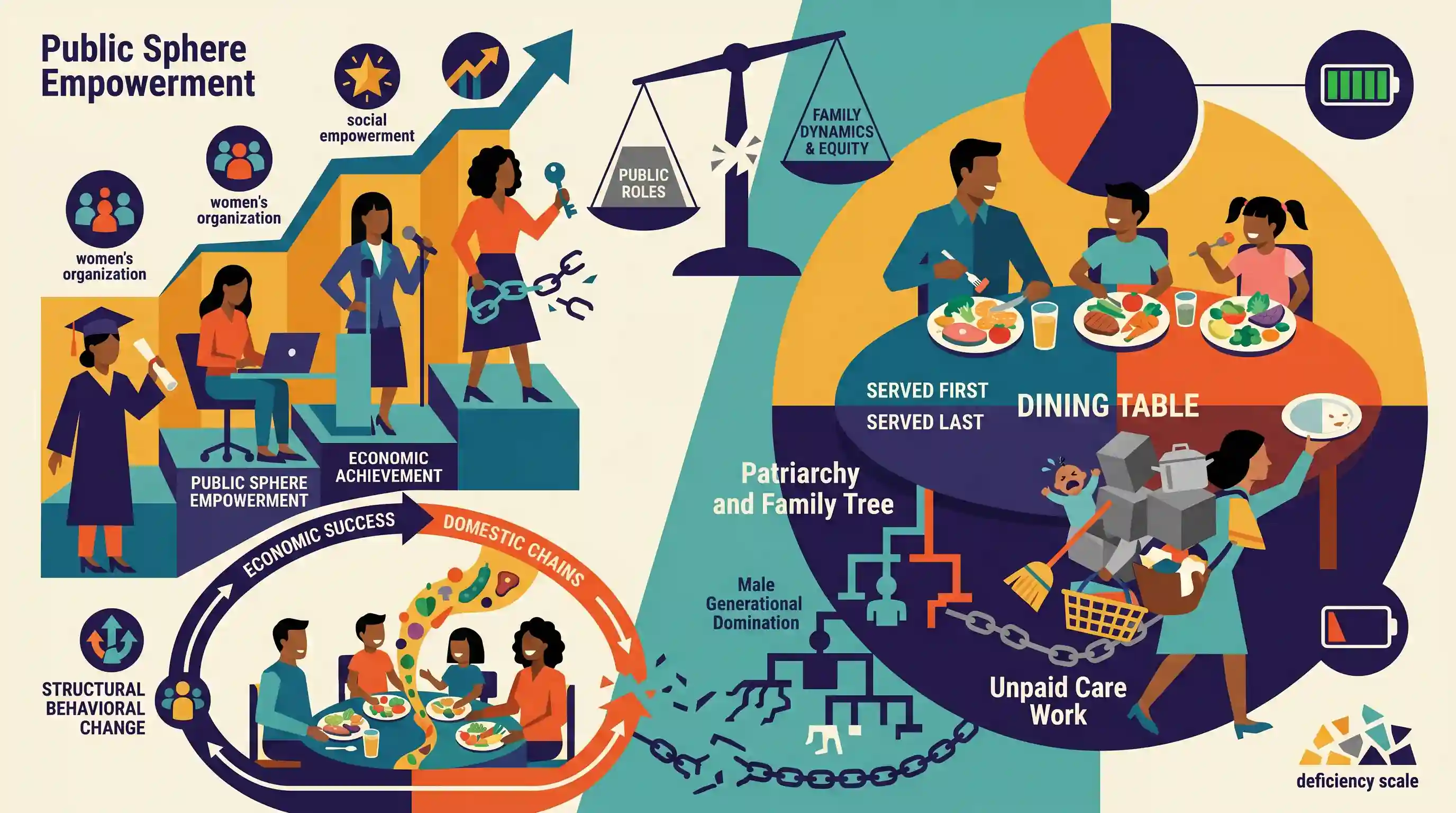
The article explores the paradox of women's empowerment in India, highlighting that while women have made significant strides in education and the workforce, this empowerment often halts at the household level. Using the 'dining table' as a metaphor, it underscores how middle-class working women continue to shoulder the burden of unpaid care work and domestic chores, while also falling victim to nutritional disparities caused by the patriarchal tradition of eating last. It argues that genuine gender equity requires structural behavioral changes within the family to complement economic and public sphere achievements.
Key Points
- The dichotomy of empowerment: Women in India increasingly achieve financial independence and professional success in the public sphere, but continue to face patriarchal subjugation in the private sphere.
- The burden of unpaid care work: The 'dining table' serves as a metaphor for traditional gender roles, where working women still bear the disproportionate burden of cooking, serving, and domestic chores (the 'second shift').
- Nutritional gender disparity: The persistent cultural norm of women eating last and least in many households highlights how traditional patriarchal values continue to undermine women's health and nutritional security despite economic gains.
- Need for holistic empowerment: True gender equity requires dismantling ingrained patriarchal structures within the family unit and ensuring an equitable distribution of household responsibilities, not just economic participation.
Prelims Trap
An increase in female workforce participation directly guarantees improved nutritional outcomes for women.
Working women often lack financial agency over their income and still face patriarchal norms like 'eating last', keeping intra-household nutritional disparities high.
Static Concepts Connected
What is the Time Use Survey (TUS) and its role in measuring unpaid labor?
- NSO Mandate: Conducted by the National Statistical Office (NSO) to measure the time individuals spend on paid, unpaid, and leisure activities across demographic groups.
- Invisible Economy: Quantifies the 'invisible' care economy and domestic labor, exposing the 'second shift' and the disproportionate burden of unpaid chores borne by women.
How does intra-household resource allocation impact women's nutritional security?
- Unequal Distribution: Patriarchal norms often dictate unequal sharing of food, finances, and healthcare within families, independent of the overall household's wealth or food security status.
- The Nutrition Trap: Cultural practices like eating last or least result in high anaemia rates (57% in NFHS-5), separating broad household food security from individual female nutrition.
Cross-Topic Patterns
Unpaid care work and GDP accounting
Excluding women's unpaid labor from the System of National Accounts distorts macroeconomic indicators. Recognizing this (est. 7.5% of GDP) bridges GS1 Society with GS3 Economy.
Hidden hunger and patriarchal norms
Linking biological health issues (anaemia/hidden hunger) to sociological norms shows how national food security schemes fail without intra-household behavioral changes.

Expect a GS1 or GS2 Mains question linking rising FLFPR with the 'double burden', examining how unpaid care work limits true empowerment.
Linked PYQs · 3
Linked PYQs · 3
- 2014MainsGS1
How does patriarchy impact the position of a middle class working woman in India?
- 2024MainsGS1
Distinguish between gender equality, gender equity and women's empowerment. Why is it important to take gender concerns into account in programme design and implementation?
- 2021MainsGS2
Can the vicious cycle of gender inequality, poverty and malnutrition be broken through microfinancing of women SHGs? Explain with examples.
