Kerala Data Integration Challenges for Reservoir Flood Control
Source:The Hindu ↗
ఇది ఎందుకు ముఖ్యం
It addresses core issues in India's disaster management framework, specifically focusing on proactive flood mitigation, dam safety, and the synergy required between technology, data systems, and institutional coordination.
సారాంశం
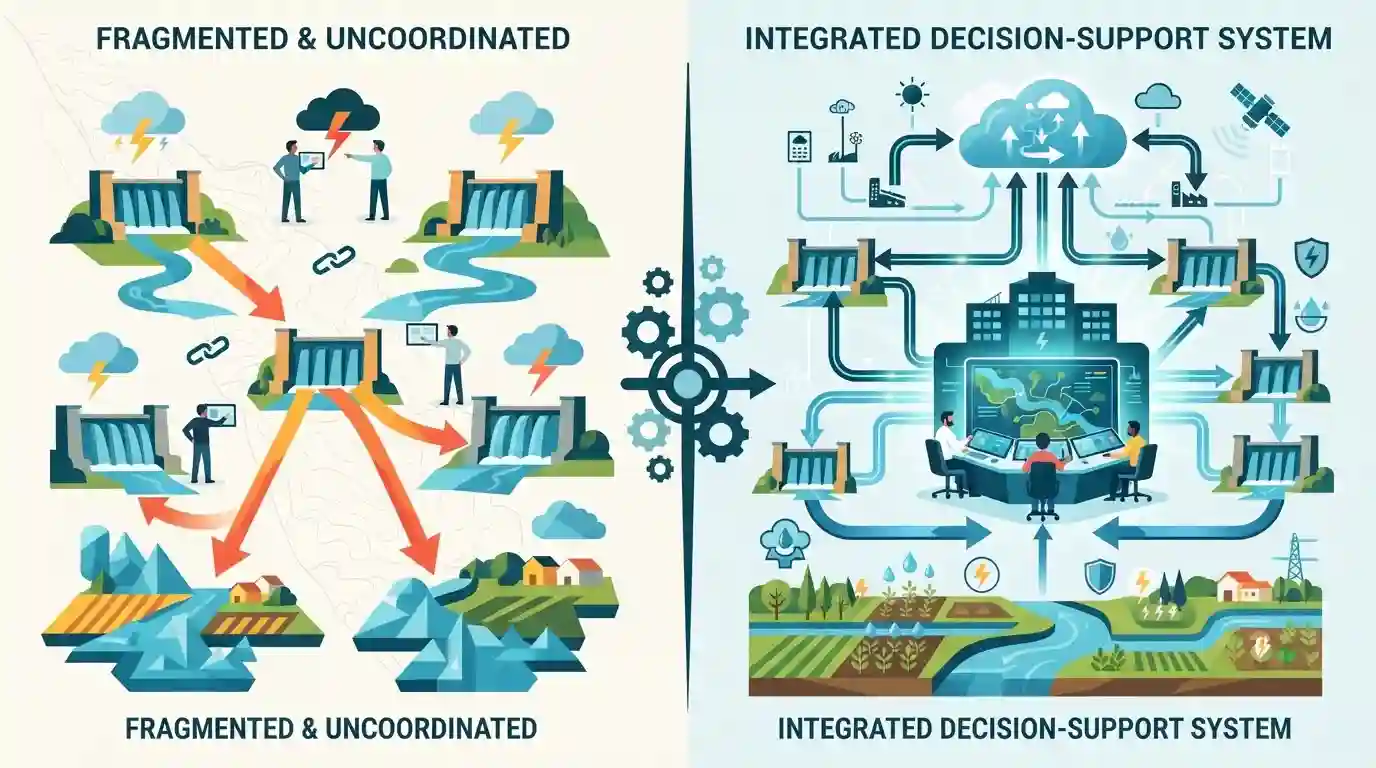
The article discusses the critical need for robust data integration and advanced technological frameworks for dam management and flood control in Kerala. It highlights how fragmented data sharing and uncoordinated reservoir operations worsen flood vulnerabilities, advocating for an integrated decision-support system to balance power generation, irrigation, and flood mitigation.
ముఖ్య అంశాలు
- Kerala faces massive flood control challenges due to a lack of real-time data integration between various reservoirs, meteorological departments, and state agencies.
- Uncoordinated release of water from multiple dams simultaneously exacerbates downstream flooding, as witnessed during past Kerala floods.
- Effective flood management requires a shift from reactive disaster response to proactive, data-driven decision support systems integrating rainfall forecasts, catchment soil moisture, and reservoir capacity.
- Institutional silos between power generation authorities, irrigation departments, and disaster management bodies hinder optimal water resource management.
ముఖ్యమైన పదాలు
Central Water Commission (CWC)

India's premier technical agency for water resources, responsible for coordinating river basin development, flood forecasting, and monitoring dam safety and reservoir storage nationwide.
UPSC context
Relevant for GS Paper III (Water Resources, Flood Management, Disaster Infrastructure). Tests understanding of institutional water governance and flood forecasting.
Kerala State Disaster Management Authority (KSDMA)
A statutory body constituted under the Disaster Management Act, 2005, headed by the Chief Minister, responsible for state-level disaster mitigation, preparedness, and emergency response.
UPSC context
Relevant for GS Paper III (Disaster Management Frameworks) and GS Paper II (State Governance). Evaluates decentralised risk reduction and early warning mechanisms.
Dam Safety Act
Enacted in 2021, this legislation provides a uniform national framework for the surveillance, inspection, operation, and maintenance of specified dams to prevent dam-failure disasters.
UPSC context
Relevant for GS Paper III (Infrastructure and Disaster Management). Assesses legislative measures for critical asset safety, multi-state coordination, and flood risk regulation.
ప్రిలిమ్స్ ఉచ్చు
The Dam Safety Act empowers the Central Government to directly operate and manage all inter-state river dams across India.
Aspirants assume the Dam Safety Act allows the Centre to operate state dams, whereas it focuses primarily on surveillance, inspection, operation, and maintenance standards through statutory bodies.
అనుసంధానమైన స్థిర భావనలు
What are the key institutional mechanisms and mandates under the Dam Safety Act, 2021?
- NCSC role:: Statutory body established to maintain nationwide standards for dam safety, surveillance, and hazard classification.
- State Dam Safety:: Mandates creation of state-level organizations for surveillance, inspection, and maintenance of specified dams.
- Emergency plans:: Requires all dam owners to formulate Emergency Action Plans (EAPs) and conduct risk-assessment studies periodically.
అంతర-అంశ నమూనాలు
Urban Flooding + Dam Management Governance
Uncoordinated dam releases intersect with urban planning failures and poor catchment zoning, turning natural weather extremes into preventable civic disasters.
Dam Safety Act + Federal-State Water Governance
The Dam Safety Act highlights the tension between federal regulatory frameworks and state-level operational control over water resources under the Seventh Schedule.

Expect a multi-statement question combining the Dam Safety Act's mandate with IWRM principles and real-time data-integration challenges.
అనుసంధాన PYQలు · 2
అనుసంధాన PYQలు · 2
- 2023MainsGS3
Dam failures are always catastrophic, especially on the downstream side, resulting in a colossal loss of life and property. Analyze the various causes of dam failures. Give two examples of large dam failures.
- 2024MainsGS3
Flooding in urban areas is an emerging climate-induced disaster. Discuss the causes of this disaster. Mention the features of two such major floods in the last two decades in India. Describe the policies and frameworks in India that aim at tackling such floods.
