Allahabad High Court 1975 Judgment Set Stage for National Emergency
Source:Indian Express ↗
Why It Matters
The 1975 Allahabad High Court judgment is a pivotal milestone in Indian constitutional history, often cited to illustrate the concepts of judicial independence, the rule of law, and electoral integrity. It provides critical context for understanding the Representation of the People Act's provisions on disqualification and the historical backdrop of the 1975 National Emergency and subsequent constitutional amendments (like the 42nd and 44th Amendments).
Summary
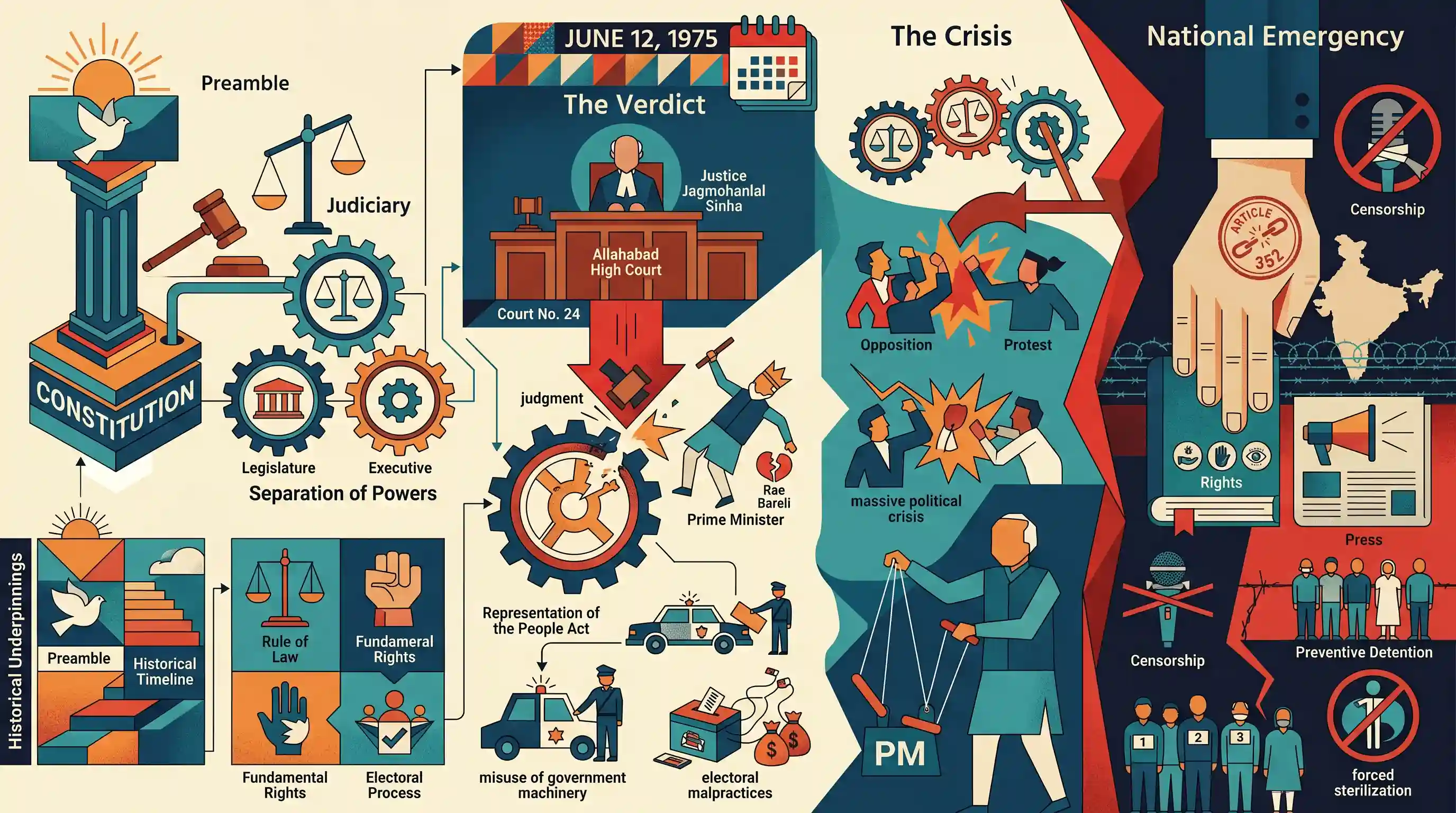
The article revisits the historic events surrounding the June 12, 1975 verdict delivered by Justice Jagmohanlal Sinha in Court No. 24 of the Allahabad High Court. The judgment, which unseated then Prime Minister Indira Gandhi for electoral malpractices under the Representation of the People Act, stands as a hallmark of judicial independence. It triggered a massive political crisis that ultimately led to the imposition of the National Emergency, profoundly altering the trajectory of Indian democracy and constitutionalism.
Key Points
- On June 12, 1975, Justice Jagmohanlal Sinha of the Allahabad High Court unseated Prime Minister Indira Gandhi by declaring her 1971 election from Rae Bareli void.
- The judgment convicted her of corrupt electoral practices under the Representation of the People Act, 1951, and disqualified her from contesting elections for six years.
- The verdict remains one of the most powerful examples of judicial independence and the assertion of constitutional law over executive power in Indian history.
- The political crisis sparked by the judgment and the subsequent Supreme Court conditional stay culminated in the declaration of the National Emergency on June 25, 1975.
Important Terms
Representation of the People Act, 1951

Enacted under Article 327, this law governs the actual conduct of elections in India, including the registration of political parties, qualifications for membership, and grounds for disqualification.
UPSC context
GS Paper II: Salient features of the RPA; tests understanding of electoral integrity and democratic processes.
Article 352
Constitutional provision empowering the President to declare a National Emergency on grounds of war, external aggression, or armed rebellion (formerly 'internal disturbance').
UPSC context
GS Paper II: Emergency Provisions; crucial for understanding federalism and the impact on fundamental rights.
Indira Nehru Gandhi v. Raj Narain (1975)
A landmark case where the Supreme Court struck down the 39th Amendment, reaffirming the 'Basic Structure Doctrine' and the principle of free and fair elections.
UPSC context
GS Paper II: Landmark Judgments; tests judicial review, separation of powers, and the Basic Structure doctrine.
Corrupt Practices
Specific illegal activities defined under Section 123 of the RPA 1951, such as bribery, undue influence, or using government machinery for electioneering.
UPSC context
GS Paper II: Electoral reforms; tests knowledge of legal safeguards against electoral malpractice.
Judicial Review
The constitutional power of the judiciary to examine the actions of the legislative and executive to ensure they conform to the Constitution.
UPSC context
GS Paper II: Judiciary; a core constitutional principle often tested regarding the limits of parliamentary power.
44th Constitutional Amendment Act, 1978
Post-Emergency legislation that introduced safeguards against the misuse of Article 352, replacing 'internal disturbance' with 'armed rebellion' and protecting Articles 20 and 21.
UPSC context
GS Paper II: Constitutional Amendments; vital for understanding the evolution of civil liberties and emergency laws.
Prelims Trap
"The Supreme Court holds exclusive original jurisdiction over election disputes involving the Prime Minister."
False. Under the RPA 1951, election petitions for all MPs (including the PM) are heard by High Courts. The SC has exclusive jurisdiction only for President/VP elections.
Static Concepts Connected
How are election disputes of Members of Parliament adjudicated in India?
- High Court Jurisdiction: Under the Representation of the People Act 1951, election petitions challenging an MP's election must be filed directly in the relevant High Court.
- Corrupt Practices: High Courts can void an election and disqualify candidates for 'corrupt practices' defined under Section 123 of the RPA 1951.
- Supreme Court Appeals: Appeals against the High Court's decision lie with the Supreme Court, which can grant conditional or absolute stays on the verdict.
Why was the 39th Constitutional Amendment Act struck down by the Supreme Court?
- Article 329A: Passed during the Emergency, it inserted Article 329A to place the election disputes of the PM and Lok Sabha Speaker beyond judicial review.
- Raj Narain Case: In the Indira Nehru Gandhi v. Raj Narain case (1975), the Supreme Court struck down this clause using the Basic Structure Doctrine.
- Violated Basic Features: The Court ruled that 'free and fair elections', 'judicial review', and the 'Rule of Law' are unalterable basic features of the Constitution.
Cross-Topic Patterns
Basic Structure's first practical test
The Indira Nehru Gandhi v. Raj Narain case marks the first practical application of the Basic Structure Doctrine (formulated in Kesavananda Bharati) to strike down a constitutional amendment (the 39th Amendment).
Disqualification: RPA vs Tenth Schedule
UPSC frequently tests the difference between statutory disqualification (under RPA 1951, where courts adjudicate) and constitutional anti-defection disqualification (under the Tenth Schedule, decided by the presiding officer).

Expect a 2026 Prelims statement contrasting High Court jurisdiction over PM election disputes (RPA) vs SC jurisdiction for President/VP.
Linked PYQs · 3
Linked PYQs · 3
- 2019MainsGS2
On what grounds a people's representative can be disqualified under the Representation of Peoples Act, 1951? Also mention the remedies available to such person against his disqualification.
- 2020MainsGS2
There is a need for simplification of procedure for disqualification of persons found guilty of corrupt practices under the Representation of Peoples Act". Comment.
- 2025MainsGS2
Indian Constitution has conferred the amending power on the ordinary legislative institutions with a few procedural hurdles. In view of this statement, examine the procedural and substantive limitations on the amending power of the Parliament to change the Constitution.
