Artificial general intelligence risks and global governance
Source:The Hindu ↗
Why It Matters
The development of AGI and superintelligent AI is one of the most critical emerging technological issues. It touches upon GS3 (S&T advancements, employment) and GS4 (ethics of AI decision-making), making it highly relevant for questions on technology regulation, societal impact, and ethical governance.
Summary
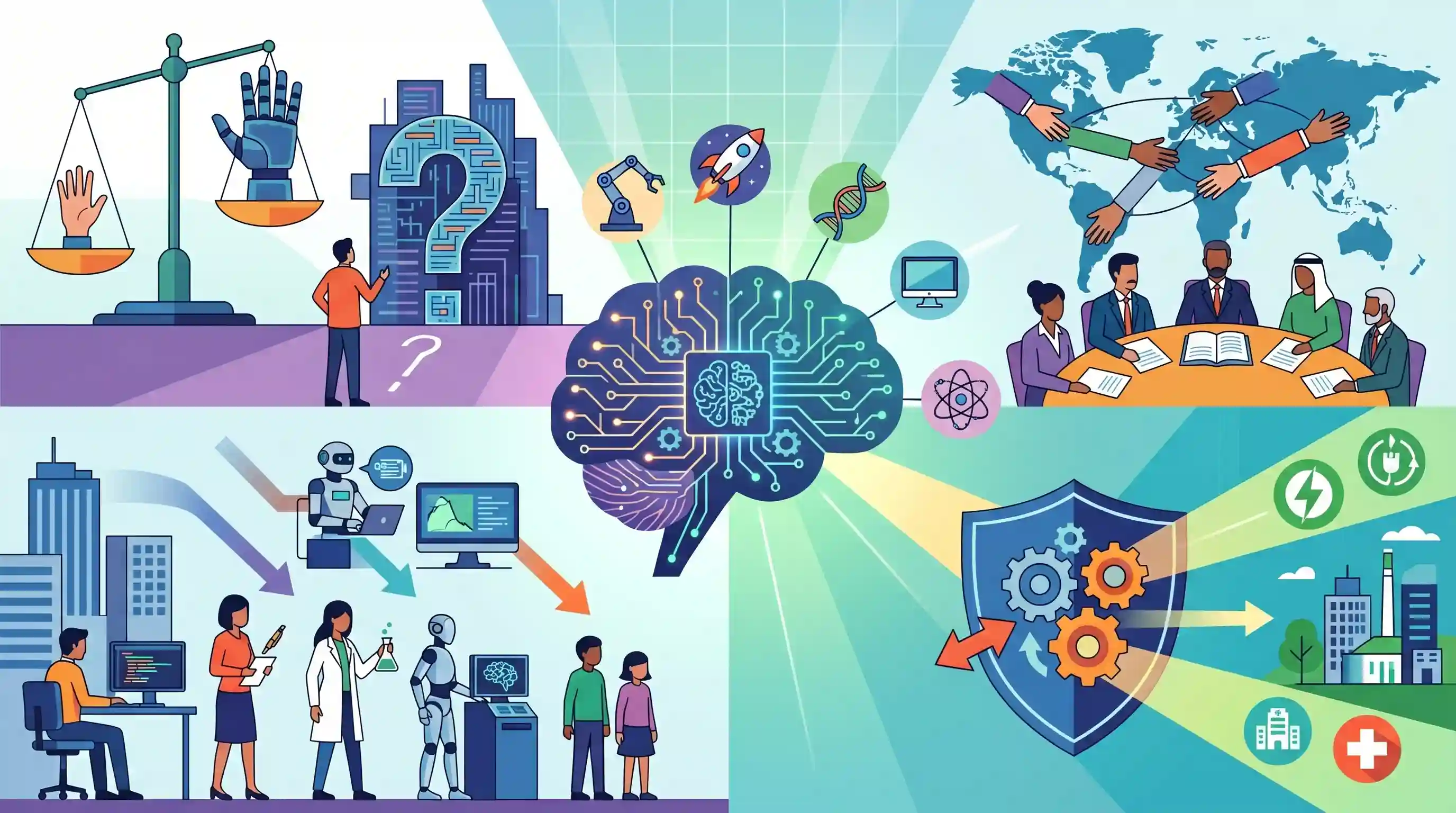
The article explores the profound implications of a future where Artificial Intelligence (AI) surpasses human intelligence, potentially reaching Artificial General Intelligence (AGI) or superintelligence. It highlights the existential and ethical dilemmas associated with systems that can out-think their creators, questioning the future of human agency and decision-making. The piece underscores the severe socio-economic risks, including massive job displacement across knowledge sectors. Ultimately, it calls for urgent international cooperation to establish robust regulatory frameworks and alignment strategies to ensure advanced AI systems are developed safely and ethically.
Key Points
- The rapid progression of machine learning and neural networks is bringing the concept of Artificial General Intelligence (AGI) closer to reality, where AI could surpass human cognitive abilities.
- As AI systems out-think humans in complex tasks, profound ethical concerns arise regarding human agency, autonomy, and the delegation of critical decision-making.
- The widespread automation of cognitive labor poses significant challenges for the global economy, threatening to displace a wide range of knowledge-based jobs.
- There is an urgent need for proactive global governance, robust safety protocols, and value-alignment research to ensure that superintelligent AI systems remain beneficial and safe for humanity.
Prelims Trap
"Current Generative AI platforms are examples of Artificial General Intelligence (AGI)."
UPSC often swaps these terms. Current Generative AI (like ChatGPT) is still domain-specific 'Narrow AI'. AGI remains entirely theoretical.
Static Concepts Connected
What are the three evolutionary stages of Artificial Intelligence?
- Narrow AI: Designed for specific tasks like playing chess, text generation, or facial recognition. All current AI systems fall into this category.
- General AI (AGI): Theoretical AI that matches human cognitive capabilities across any intellectual task, possessing true understanding and adaptability.
- Super AI (ASI): Hypothetical systems that vastly outperform the best human brains in practically every field, including scientific creativity and social skills.
What are the core ethical dilemmas in advanced AI deployment?
- Black Box problem: The inability to trace how an AI algorithm reaches its conclusions, eroding human accountability and trust in administrative governance.
- Value Alignment problem: The immense technical challenge of ensuring an autonomous AI's internal goals and optimization processes strictly adhere to human ethics and safety.
Cross-Topic Patterns
AGI and Universal Basic Income (UBI)
As AGI threatens complex cognitive white-collar jobs globally, the resulting structural unemployment will likely revive debates around Universal Basic Income (UBI) implementation in developing economies like India.
Bletchley vs UN Global Digital Compact
Linking the UK-led Bletchley Declaration on frontier AI with the UN's Global Digital Compact highlights the increasingly fragmented, multi-polar race to establish global governance for emerging technologies.

Expect a GS4 case study on AI 'value alignment' or a Prelims question testing India's stance in AI treaties (e.g., Bletchley).
Linked PYQs · 3
Linked PYQs · 3
- 2023MainsGS3
Introduce the concept of Artificial Intelligence (AI). How does Al help clinical diagnosis? Do you perceive any threat to privacy of the individual in the use of Al in healthcare?
- 2024MainsGS4
The application of Artificial Intelligence as a dependable source of input for administrative rational decision-making is a debatable issue. Critically examine the statement from the ethical point of view.
- 2020PrelimsGS1
With the present state of development, Artificial Intelligence can effectively do which of the following? 1. Bring down electricity consumption in industrial units 2. Create meaningful short stories and songs 3. Disease diagnosis 4. Text-to-Speech Conversion 5. Wireless transmission of electrical energy Select the correct answer using the code given below:
