Crop Residue Management and Pink Stem Borer Control in Wheat
Source:Indian Express ↗
Why It Matters
Stubble burning is a recurring environmental and agricultural crisis in North India. Understanding the scientific nuances of pest behavior versus traditional farmer practices is crucial for policymakers designing effective interventions and promoting sustainable agricultural technologies.
Summary
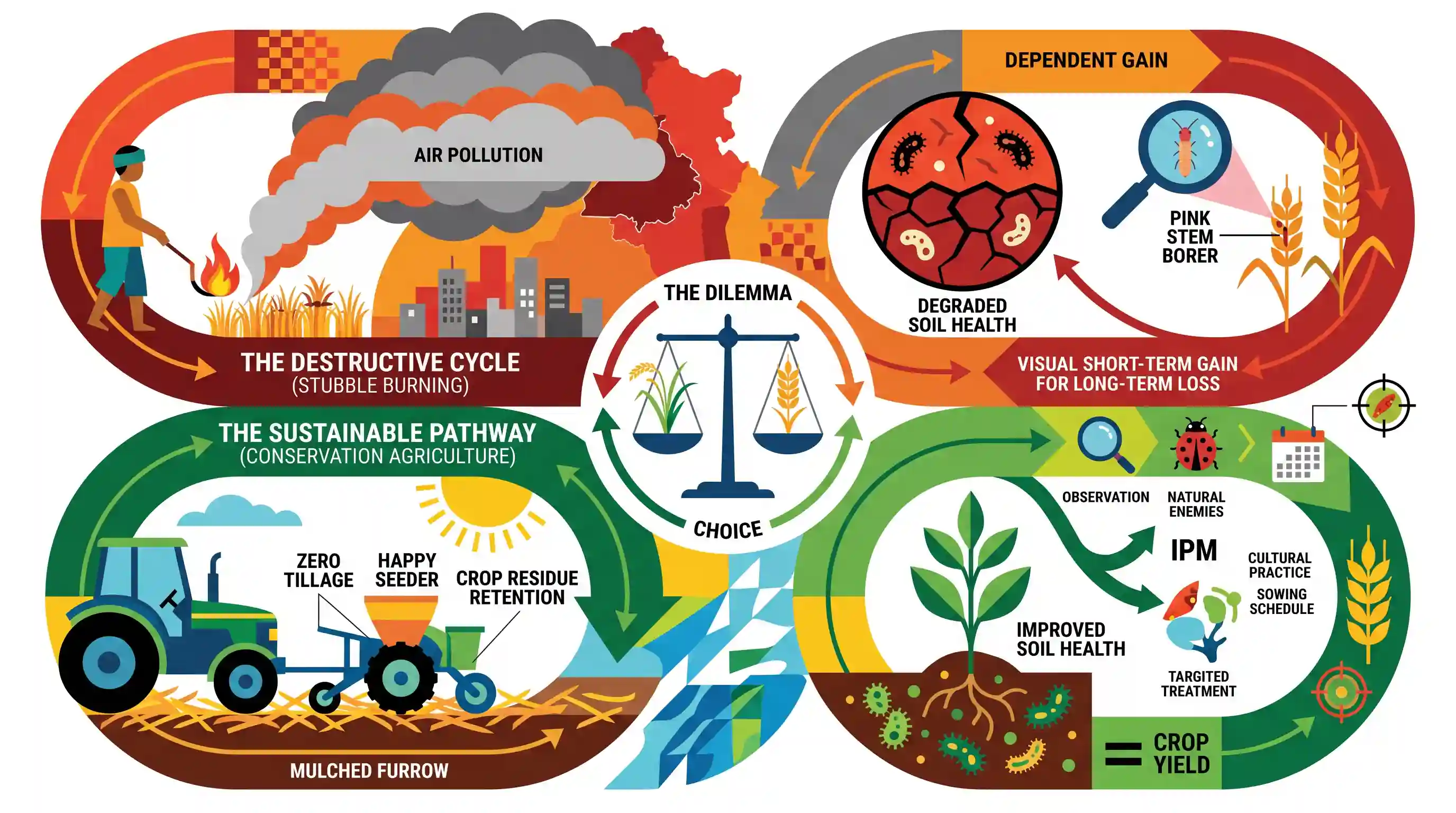
The article delves into the agricultural dilemma surrounding stubble burning, specifically addressing the farmers' claim that burning paddy residue is necessary to prevent Pink Stem Borer infestations in the subsequent wheat crop. While retaining stubble on the surface through zero-tillage methods can occasionally create a micro-environment for pests, agricultural scientists emphasize that burning is not a sustainable solution. Stubble burning severely degrades soil health, destroys beneficial microorganisms, and causes severe air pollution across Northern India. The piece advocates for addressing pest challenges through Integrated Pest Management (IPM), proper sowing schedules, and targeted treatments, thereby allowing farmers to adopt sustainable Conservation Agriculture practices without compromising crop yields.
Key Points
- Explores the farmer concern that retaining paddy stubble (instead of burning it) leads to increased Pink Stem Borer infestation in the subsequent wheat crop.
- While unburnt residue can sometimes harbor pests, agricultural experts strongly advise against stubble burning due to its catastrophic impact on air quality, soil organic carbon, and beneficial microbes.
- Pest management in zero-tillage wheat should rely on integrated pest management (IPM), timely sowing, and appropriate chemical treatments rather than reverting to destructive stubble burning.
- Highlights the critical need to promote Conservation Agriculture practices and machinery (like the Happy Seeder) alongside proper agronomic guidance to ensure a smooth transition away from crop residue burning.
Important Terms
Crop Residue Management (CRM) Scheme

Central Sector Scheme promoting agricultural mechanization for in-situ residue management. It provides 50-80% subsidies for machinery like Happy Seeders to curb stubble burning and air pollution in Northern India.
UPSC context
GS Paper 3: Agriculture and Environment; tests knowledge of government interventions for air pollution and sustainable farming.
Pink Stem Borer
An emerging cereal pest (*Sesamia inferens*) whose larvae bore into stems, causing 'dead hearts.' It survives in paddy residue, leading farmers to burn stubble as a perceived preventive measure.
UPSC context
GS Paper 3: Agriculture; focuses on pest challenges and the ecological impact of traditional vs. modern farming.
Zero Tillage
A farming method of sowing seeds directly into untilled soil, retaining previous crop residue as mulch. It improves soil health, enhances carbon sequestration, and reduces fuel and labor costs.
UPSC context
GS Paper 3: Agriculture; frequently tested in Prelims (e.g., 2020) regarding resource conservation technologies.
Integrated Pest Management (IPM)
A holistic, ecosystem-based strategy for long-term pest prevention. It integrates biological, cultural, and chemical tools to keep pest populations below economic damage levels while minimizing environmental and health risks.
UPSC context
GS Paper 3: Agriculture; relevant for sustainable crop protection and reducing chemical pesticide reliance.
Conservation Agriculture (CA)
A sustainable farming system based on three pillars: minimal mechanical soil disturbance, permanent organic soil cover (mulching), and diversified crop rotations to enhance biodiversity and soil fertility.
UPSC context
GS Paper 3: Environment and Agriculture; tests concepts of climate-resilient farming and land degradation neutrality.
Indian Council of Agricultural Research (ICAR)
India’s apex autonomous body under the Ministry of Agriculture responsible for coordinating agricultural research and education. It monitors stubble burning and developed the Pusa Bio-decomposer technology.
UPSC context
GS Paper 3: Science & Technology/Agriculture; key institution for policy implementation and research-driven agricultural solutions.
Prelims Trap
"Adopting zero tillage and retaining crop residue on fields naturally prevents all pest infestations in subsequent crops."
Aspirants often assume sustainable methods automatically eliminate pests. In reality, retaining crop residue creates a micro-environment that allows pests like the Pink Stem Borer to hibernate and infest the next crop.
Static Concepts Connected
What are the three core principles of Conservation Agriculture?
- Minimum Soil Disturbance: Adopting zero or reduced tillage practices to maintain soil structure, save fuel, and prevent topsoil erosion.
- Continuous Soil Cover: Retaining crop residues (stubble) or planting cover crops to protect soil, reduce evaporation, and improve moisture retention.
- Crop Diversification: Practicing diverse crop rotations or associations to naturally break pest cycles and enhance soil nutrient profiles.
How does stubble burning physically and chemically degrade soil health?
- Carbon Depletion: Burning rapidly oxidizes and destroys Soil Organic Carbon (SOC), degrading long-term soil fertility and reducing water-holding capacity.
- Nutrient Loss: The intense surface heat destroys essential macronutrients, leading to a significant loss of topsoil Nitrogen, Phosphorus, and Sulphur.
- Microbial Death: High temperatures kill beneficial soil microorganisms, earthworms, and fungal populations that are crucial for natural nutrient cycling.
Cross-Topic Patterns
Zero Tillage trade-offs & IPM
The Pink Stem Borer issue highlights that sustainable transitions like zero-tillage are not friction-free, necessitating a shift from purely mechanical or prohibitive fixes to ecological ones like Integrated Pest Management.
Agriculture practices & Winter Smog
The persistence of stubble burning directly links northern agronomic practices to the climatological phenomenon of winter temperature inversions and severe AQI spikes in the Delhi NCR region.
Farm Mechanization & Environmental Subsidies
The Crop Residue Management scheme subsidizes machinery like Happy Seeders, bridging environmental mandates with agricultural economics, farm mechanization, and subsidy rationalization.

Expect a 2026 Prelims question testing the ecological trade-offs of zero-tillage, pairing soil carbon gains against pest hibernation risks.
Linked PYQs · 3
Linked PYQs · 3
- 2020PrelimsGS1
What is/are the advantage/advantages of zero tillage in agriculture ? 1. Sowing of wheat is possible without burning the residue of previous crop. 2. Without the need for nursery of rice saplings, direct planting of paddy seeds in the wet soil is possible. 3. Carbon sequestration in the soil is possible. Select the correct answer using the code given below:
- 2018PrelimsGS1
With reference to the circumstances in Indian agriculture, the concept of "Conservation Agriculture" assumes significance. Which of the following fall under the Conservation Agriculture? 1. Avoiding the monoculture practices 2. Adopting minimum tillage 3. Avoiding the cultivation of plantation crops 4. Using crop residues to cover soil surface 5. Adopting spatial and temporal crop sequencing/crop rotations Select the correct answer using the code given below:
- 2017PrelimsGS1
Which of the following practices can help in water conservation in agriculture? 1. Reduced or zero tillage of the land 2. Applying gypsum before irrigating the field 3. Allowing crop residue to remain in the field Select the correct answer using the code given below:
