FCI Wheat Procurement Surge and Minimum Support Price Dynamics
Source:The Hindu ↗
Why It Matters
Understanding the scale and functioning of government procurement systems is critical for UPSC aspirants. It illustrates the practical application of the MSP and the logistical framework managed by the FCI, which ultimately secures the nation's food supply via the NFSA while ensuring remunerative prices for farmers.
Summary
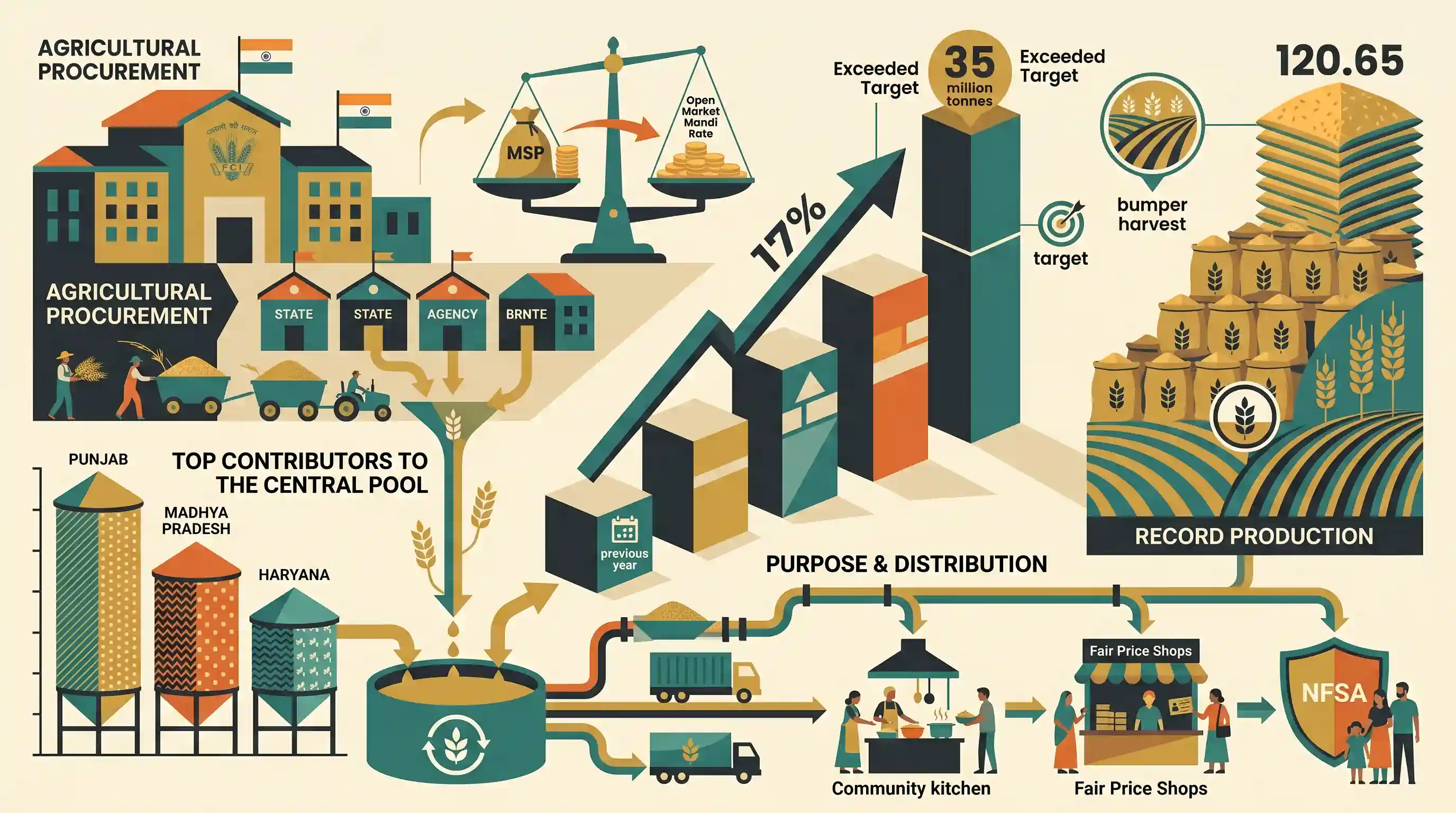
India's wheat procurement for the 2026-27 rabi marketing season has surged by 17% to reach 35 million tonnes, successfully exceeding the government's target of 34.5 million tonnes. Executed by the Food Corporation of India (FCI) and respective state agencies at the Minimum Support Price (MSP), this procurement is essential to fulfill the requirements of the National Food Security Act and other welfare schemes. The surge is primarily attributed to high domestic wheat production, estimated at a record 120.65 million tonnes, which resulted in open market mandi rates dropping below the government's MSP. Punjab, Madhya Pradesh, and Haryana were the top contributors to the central pool.
Key Points
- Government wheat procurement surged 17% to 35 million tonnes in the 2026-27 rabi marketing season, exceeding the target of 34.5 million tonnes.
- The Food Corporation of India (FCI) and state agencies procure wheat at the Minimum Support Price (MSP) to maintain buffer stocks for the National Food Security Act and other welfare schemes.
- The increase in procurement was driven by a robust domestic wheat production of 120.65 million tonnes and mandi market rates falling below the MSP.
- Punjab led the state-wise procurement with 12.1 MT, followed by Madhya Pradesh at 10.4 MT and Haryana at 8.1 MT.
Important Terms
Minimum Support Price (MSP)

The 'floor price' announced by the government before sowing to protect farmers from distress sales. If market prices fall below this level, government agencies purchase the crop to ensure price assurance.
UPSC context
GS-III (Agriculture); vital for issues related to direct farm subsidies, crop diversification, and farmer income security.
Food Corporation of India (FCI)
A statutory body established in 1965 responsible for the procurement, storage, and distribution of foodgrains. It acts as the main agency for maintaining the Central Pool and executing food security schemes.
UPSC context
GS-III (PDS and Food Security); tests knowledge of logistical management, storage infrastructure, and fiscal food subsidy burdens.
National Food Security Act (NFSA), 2013
Landmark 2013 legislation granting legal entitlement for subsidized foodgrains to ~67% of India's population. It covers Priority Households (5kg/person/month) and Antyodaya Anna Yojana families (35kg/household/month) via the PDS.
UPSC context
GS-II (Social Justice) and GS-III (Food Security); examines the rights-based approach to hunger and welfare implementation.
Buffer Stocks
Strategic foodgrain reserves maintained to meet quarterly stocking norms, stabilize market prices, and ensure food availability during emergencies like droughts. Norms are fixed quarterly by the Cabinet Committee on Economic Affairs.
UPSC context
GS-III (Food Security); focuses on minimum stocking norms, carrying costs, and recommendations like the Shanta Kumar Committee report.
Central Pool
The total stock of foodgrains (wheat, rice, and coarse grains) procured by the FCI and state agencies. It is the logistical source for PDS distribution and maintaining strategic reserves.
UPSC context
GS-III (Agricultural Procurement); relevant for understanding surplus-to-deficit distribution and the decentralized procurement (DCP) model.
Rabi Marketing Season (RMS)
The period (typically April–June) dedicated to the government procurement of winter-sown crops like wheat. It follows the Rabi harvest and is critical for replenishing central foodgrain stocks.
UPSC context
GS-III (Agriculture); essential for understanding agricultural cycles and the timing of government market interventions.
Prelims Trap
"FCI procurement targets act as an absolute upper cap or statutory ceiling."
FCI follows an "open-ended procurement policy." Targets are mere estimates for logistical planning. FCI is obligated to buy all FAQ-grade wheat offered at MSP.
Static Concepts Connected
What constitutes the "Economic Cost" of food grains for the FCI?
- MSP & Bonuses: The base Minimum Support Price (MSP) paid to the farmers along with any state-specific bonuses.
- Procurement Incidentals: Mandi taxes, labor, packaging, and short-term storage costs incurred during the buying process.
- Distribution Costs: Freight charges, handling, storage, and transit losses to move grains to fair price shops.
What is the Decentralized Procurement Scheme (DCP)?
- Direct State Action: State governments directly procure, store, and distribute grains for TPDS/welfare schemes on behalf of the Central Government.
- Objective: It aims to reduce transit costs, curtail storage losses, and promote local procurement in non-traditional states.
- Surplus Management: States retain grains for their own PDS needs and hand over only the surplus to the FCI central pool.
Cross-Topic Patterns
Food Security + RBI Monetary Policy
High wheat procurement and record production ease cereal inflation, directly aiding the RBI's efforts to keep headline CPI within the 4% target band without aggressive monetary tightening.
Procurement Bias + Groundwater Depletion
The continued dominance of Punjab and Haryana in central procurement perpetuates the water-energy-agriculture nexus crisis, defying crop diversification goals and exacerbating groundwater depletion.

Expect a multi-statement Prelims question mixing FCI's open-ended procurement policy with the components of the Economic Cost of food grains.
Linked PYQs · 5
Linked PYQs · 5
- 2020PrelimsGS1
Which of the following factors/policies were affecting the price of rice in India in the recent past? 1. Minimum Support Price 2. Government's trading 3. Government's stockpiling 4. Consumer subsidies Select the correct answer using the code given below:
- 2019PrelimsGS1
The economic cost of food grains to the Food Corporation of India is Minimum Support Price and bonus (if any) paid to the farmers plus
- 2018MainsGS3
What do you mean by Minimum Support Price (MSP)? How will MSP rescue the farmers from the low income trap?
- 2017MainsGS3
How do subsidies affect the cropping pattern, crop diversity and economy of farmers? What is the significance of crop insurance, minimum support price and food processing for small and marginal farmers?
- 2022MainsGS3
What are the major challenges of Public Distribution System (PDS) in India ? How can it be made effective and transparent ?
