WhatsApp Username Feature and Government Cybersecurity Concerns
Source:Indian Express ↗
Why It Matters
This development illustrates the complex governance challenge of balancing user privacy (masking phone numbers) with cyber security and public safety (preventing digital fraud and impersonation). It directly highlights the government's active regulatory interventions under the IT framework to preempt potential vulnerabilities created by global big-tech updates, a core area of focus under internal security and technology policy.
Summary
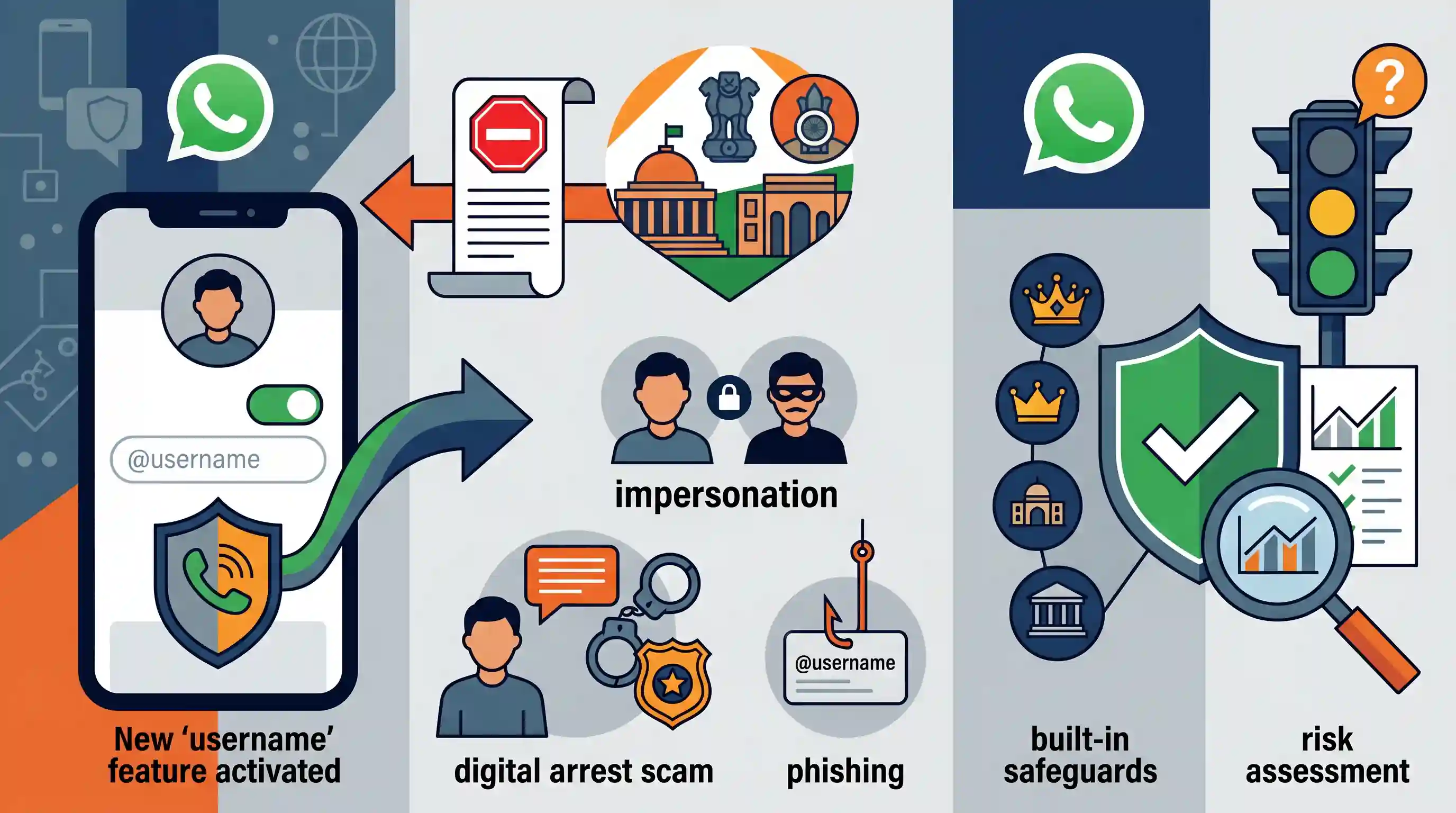
The Indian Ministry of Electronics and Information Technology (MeitY), following inputs from the Ministry of Home Affairs (MHA), has issued a notice to Meta-owned WhatsApp, directing it to delay or explain its upcoming optional 'username' feature. While WhatsApp presents the feature as a privacy enhancement to mask phone numbers during initial chats, the government is concerned it could lead to an increase in impersonation-linked cyber crimes, digital arrest scams, and phishing. Although WhatsApp has highlighted built-in safeguards such as reserving prominent public and official usernames, the government is conducting a risk assessment to determine if these guardrails are sufficient before allowing the rollout in India.
Key Points
- The Ministry of Electronics and Information Technology (MeitY), prompted by the Ministry of Home Affairs (MHA), has issued a notice to WhatsApp to halt or explain its proposed optional 'username' feature.
- The government fears the feature will exacerbate online fraud, digital arrest scams, phishing, and impersonation attacks by allowing bad actors to use similar-sounding usernames of public officials, financial institutions, and government agencies.
- Tech community leaders, including Paytm's Vijay Shekhar Sharma and Mobikwik's Bipin Preet Singh, have echoed these concerns, warning that look-alike usernames could become major vectors for financial fraud.
- WhatsApp defended the feature as a major privacy upgrade that hides users' phone numbers on initial contact (similar to Telegram and Signal), claiming that safeguards are in place.
- WhatsApp's proposed safeguards include reserving high-profile usernames (government entities, public figures, verified Meta accounts), limiting new contact frequency, blocking repeated username guess attempts, and using pattern-detection systems to remove abusers.
- The government is currently conducting a risk assessment of the proposed feature and may block its rollout entirely if the built-in safeguards are deemed inadequate under the current cyber legal framework.
Important Terms
Ministry of Electronics and Information Technology (MeitY)

The nodal ministry of the Government of India responsible for IT policy, electronics manufacturing, internet governance, cyber security, and administering the Information Technology Act.
UPSC context
GS Paper 2 (Governance) & GS Paper 3 (Cyber Security). Evaluates regulatory frameworks, digital public infrastructure, and national IT policies.
Ministry of Home Affairs (MHA)
The Union ministry responsible for maintaining internal security, law and order, and coordinating national disaster management, border management, and cyber crime threat intelligence in India.
UPSC context
GS Paper 3 (Internal Security). Tests knowledge of law enforcement agencies, internal security threats, and cyber crime prevention mechanisms.
Meta
A multinational technology conglomerate and parent company of major social media platforms like Facebook, Instagram, and WhatsApp, subjected to India's IT intermediary guidelines.
UPSC context
GS Paper 3 (Cyber Security & Social Media). Tests regulatory issues surrounding social media giants, data privacy, and compliance with national laws.
A widely used instant messaging application owned by Meta that operates as a Significant Social Media Intermediary (SSMI) under India's IT Rules.
UPSC context
GS Paper 3 (Communication Networks). Analyzes challenges of end-to-end encryption, traceability, misinformation, and cyber fraud on messaging platforms.
Prelims Trap
The 'first originator' traceability mandate under IT Rules 2021 applies uniformly to all instant-messaging applications operating in India.
The IT Rules 2021 selectively impose the traceability mandate only on Significant Social Media Intermediaries (SSMIs) with over 50 lakh (5 million) registered users in India, not on all messaging entities.
Static Concepts Connected
What is the 'First Originator' traceability mandate under the IT Rules, 2021?
- Targeted Applicability: Applies specifically to Significant Social Media Intermediaries (SSMIs) providing messaging services with over 5 million Indian users.
- Traceability Mandate: Mandates identifying the first sender of a specific piece of information within India upon a competent judicial or executive order.
- High Legal Threshold: Can only be invoked for severe offences affecting sovereignty, security of the state, public order, or rape/child sexual abuse material.
- Constitutional Conflict: Platforms argue that implementing traceability requires breaking end-to-end encryption, violating the right to privacy under the Puttaswamy judgement.
What are India's primary institutional setups for combating cybercrime?
- I4C's Role: Established by the Ministry of Home Affairs (MHA) to act as a nodal agency for coordinating law enforcement actions against cybercrimes.
- Sanchar Saathi Portal: Citizen-centric portal by the Department of Telecommunications (DoT) that hosts services like 'Chakshu' for reporting suspected fraudulent communications.
- Citizen Helpline: The national helpline number '1930' designed for real-time reporting and mitigation of financial losses arising from online frauds.
Cross-Topic Patterns
Security vs Privacy in Digital Governance
The friction between platform anonymity and law enforcement demands highlights the governance challenge of balancing fundamental privacy rights under Article 21 with public order and state security.
Inter-ministerial convergence in cyber policing
Psychologically coercive cybercrimes like digital arrests require structural synergy between telecom enforcement (DoT), internal security coordination (I4C/MHA), and digital law regulators (MeitY).

SSMI traceability rules vs end-to-end encryption is a prime candidate for a GS-3 Mains question on internal security and digital rights.
Linked PYQs · 2
Linked PYQs · 2
- 2024MainsGS3
Social media and encrypting messaging services pose a serious security challenge. What measures have been adopted at various levels to address the security implications of social media? Also suggest any other remedies to address the problem.
- 2020MainsGS3
Discuss different types of cyber crimes and measures required to be taken to fight the menace.
