MP High Court Rules WhatsApp Messages as Dying Declaration
Source:lawbeat ↗
Why It Matters
This ruling is important for civil services aspirants as it sets a key judicial precedent on the admissibility of modern electronic evidence (WhatsApp messages) as a dying declaration. It also involves the intersection of the newly enacted Bharatiya Nyaya Sanhita and the SC/ST Act, which are frequent subjects in Polity and Social Justice sections.
Summary
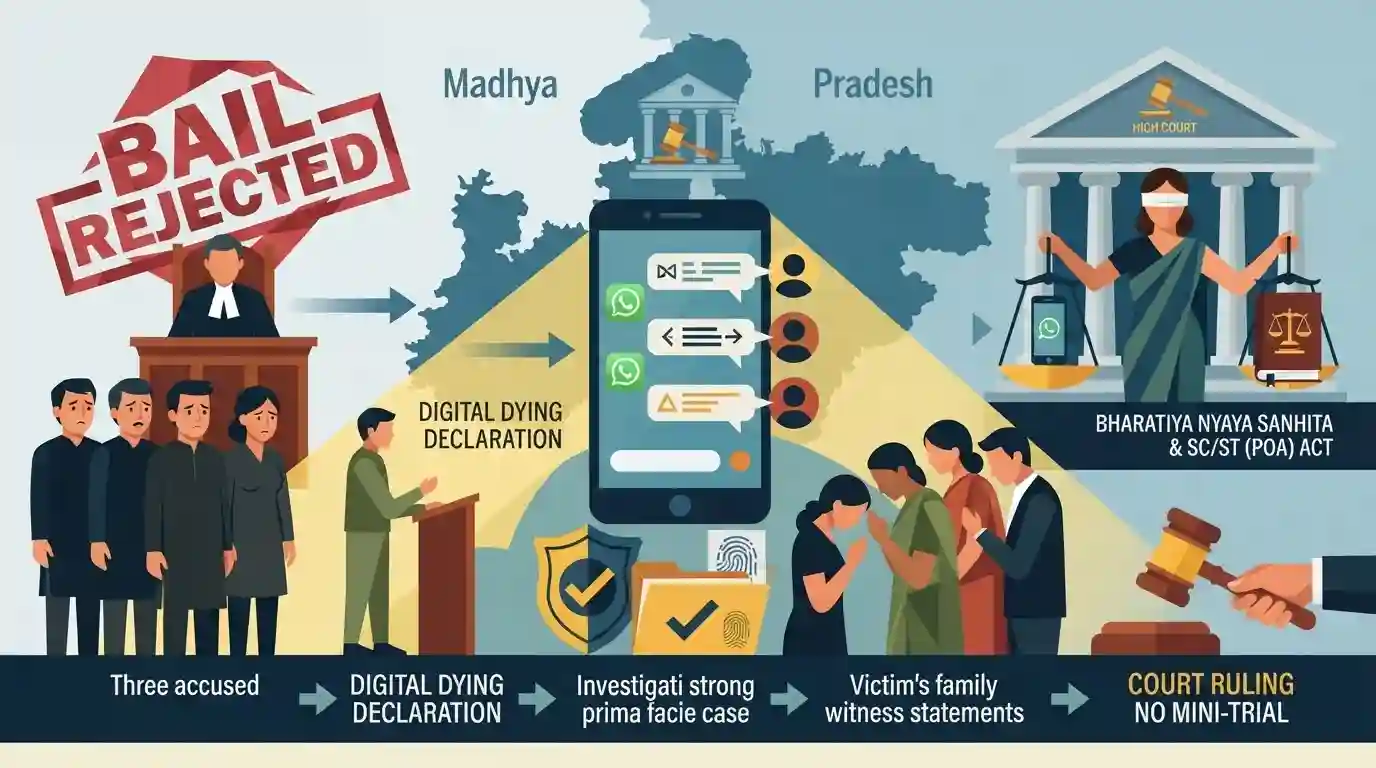
The Madhya Pradesh High Court has rejected the bail plea of three individuals accused of abetting a young Bhil man's suicide, ruling that his final WhatsApp messages explicitly naming them constitute a "crucial prima facie dying declaration." The accused are being prosecuted under Section 108 of the Bharatiya Nyaya Sanhita and relevant sections of the SC/ST (Prevention of Atrocities) Act. Refusing to conduct a "mini-trial" at the bail stage, the Court concluded that the electronic evidence, alongside corroborating witness statements, established a strong prima facie case.
Key Points
- The Madhya Pradesh High Court held that WhatsApp messages sent by a deceased person shortly before death can serve as a 'prima facie dying declaration.'
- The court denied bail to three men accused of abetting the suicide of a young Bhil man, affirming the decision of the Special Court in Dhar.
- The accused face charges under Section 108 of the Bharatiya Nyaya Sanhita (abetment of suicide) and the SC/ST (Prevention of Atrocities) Act, 1989.
- This judgment highlights the evolving jurisprudence around the legal validity and admissibility of digital records and electronic communications in severe criminal offenses.
Important Terms
Bharatiya Nyaya Sanhita

India's new criminal code replacing the IPC. Section 108 of the BNS criminalizes the abetment of suicide, the charge leveled in this case for driving the victim to end his life.
UPSC context
GS Paper 2 (Polity). Tests awareness of recent criminal justice reforms and substantive shifts from the IPC to BNS.
Scheduled Castes and the Scheduled Tribes (Prevention of Atrocities) Act, 1989
A special legislation designed to prevent and punish atrocities against SC/ST community members. Invoked in this case because the deceased victim belonged to the marginalized Bhil tribe.
UPSC context
GS Paper 2 (Social Justice). Tests statutory frameworks safeguarding vulnerable groups and the mechanisms of special courts.
Indian Evidence Act
The 1872 statute (now transitioning to the Bharatiya Sakshya Adhiniyam) governing evidence admissibility. Section 32(1) allows "dying declarations" (like final WhatsApp texts) as valid exceptions to the hearsay rule.
UPSC context
GS Paper 2 (Polity/Judiciary). Tests evidentiary laws, the concept of dying declarations, and admissibility of digital records.
Information Technology Act, 2000
India's core cyber law, which introduced amendments recognizing electronic records. It enables digital communications, such as WhatsApp messages, to be legally admissible as evidence in Indian courts.
UPSC context
GS Paper 3 (Cyber Security) & GS 2 (Governance). Tests the intersection of digital technology, cyber law, and judicial procedures.
Prelims Trap
A dying declaration must be recorded by a Judicial Magistrate to be legally admissible as evidence.
A dying declaration can be made to anyone, in oral, written, or electronic (WhatsApp) form. A Magistrate's recording has higher evidentiary value, but it is not mandatory for admissibility.
Static Concepts Connected
What is the legal status and evidentiary value of a Dying Declaration?
- Hearsay exception: Admissible under Section 26(a) of the BSA, 2023 (formerly Sec 32(1) IEA) based on the legal maxim that a dying person is presumed not to lie.
- Sole basis: It can form the sole basis of a criminal conviction without independent corroboration if the court finds it to be genuine, voluntary, and reliable.
- Form neutral: It is not restricted to formal written statements; it can be oral, conveyed through gestures, or via electronic communications like WhatsApp.
How does the Bharatiya Sakshya Adhiniyam (BSA) treat electronic evidence?
- Primary Evidence: Section 61 of the BSA explicitly elevates electronic and digital records to hold the exact same legal status as traditional paper documents.
- Certification rules: Under Section 63 (replacing old Sec 65B of IEA), admitting digital records requires a certificate signed by both the device in-charge and a cyber expert.
Cross-Topic Patterns
Digital Evidence + Privacy rights
The expanding reliance on WhatsApp and digital records in criminal probes links closely to Article 21 (Puttaswamy right to privacy) and Article 20(3) (protection against self-incrimination).
Special Acts vs General Laws
The simultaneous application of the SC/ST Act's strict bail provisions alongside the newly codified BNS provisions is a prime area for mains questions on judicial equity and statutory overlap.

Expect a multi-statement Prelims question on the BSA's treatment of electronic evidence and dying declarations compared to the old IEA.
Linked PYQs · 4
Linked PYQs · 4
- 2021MPPSC_PRELIMSGS1
Important concept(s) introduced in IT Act, 2000
- 2019MPPSC_PRELIMSGS1
First cyberlaw which provides the legal infrastructure for e-commerce in India is
- 2018MPPSC_PRELIMSGS1
Under which one of the following Sections of the Scheduled Castes and Scheduled Tribes [Prevention of Atrocities] Act, 1989 is anticipatory bail prohibited?
- 2013MPPSC_PRELIMSGS1
Under the scheduled castes and scheduled tribes (prevention of atrocities) Act, 1989, which of the following is absolutely barred?
