Rare Earth Hypothesis and Astrobiological Conditions for Life
Source:The Hindu ↗
Why It Matters
Understanding conditions for life and the study of exoplanets are central to the Science and Technology component of UPSC GS3. Concepts like the Goldilocks Zone, the Fermi Paradox, and the objectives of major space missions (like JWST) are heavily tested in both Prelims and Mains.
Summary
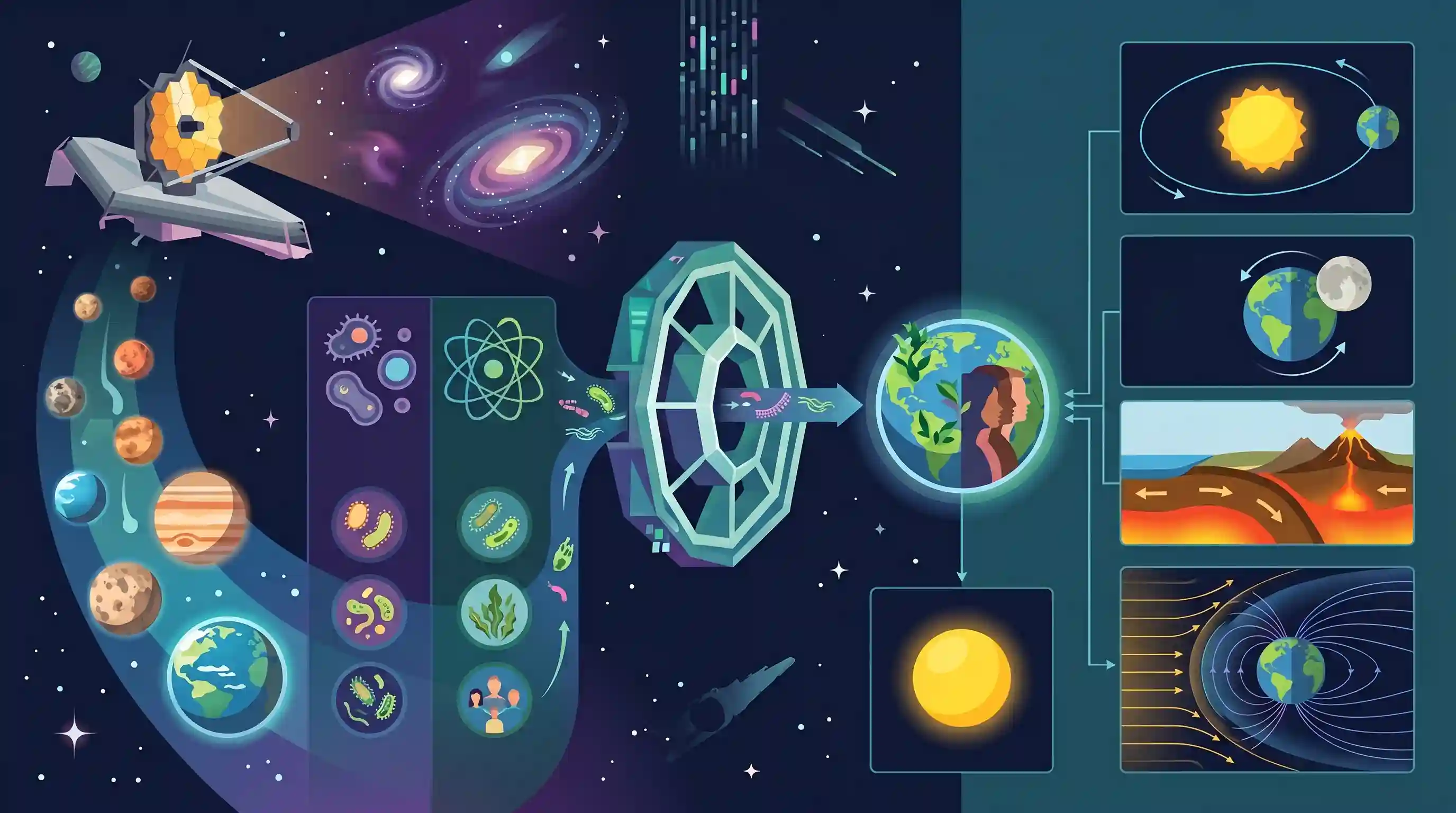
The article examines the ongoing relevance of the 'Rare Earth' hypothesis, which argues that the emergence of complex life requires an incredibly improbable alignment of astrophysical and geological factors. Proposed in 2000, the hypothesis contends that while simple microbes may be widespread, intelligent life is scarce, offering a direct answer to the Fermi Paradox. Despite the recent boom in exoplanet discoveries by advanced space telescopes, the lack of definitive biosignatures for complex life continues to support the premise that Earth's specific combination of a stable orbit, large moon, plate tectonics, and magnetic field makes it unique in the cosmos.
Key Points
- The 'Rare Earth' hypothesis challenges the principle of mediocrity by proposing that while simple microbial life might be common in the universe, complex, multicellular, and intelligent life is exceedingly rare.
- The hypothesis outlines a stringent set of prerequisites for complex life, including a star of the right size, a planet in the 'Goldilocks Zone' (habitable zone) allowing liquid water, a stable orbit, a large moon to stabilize axial tilt, plate tectonics, and a magnetic field to shield against cosmic radiation.
- It serves as a primary solution to the Fermi Paradox (the contradiction between the high probability of extraterrestrial civilizations and the lack of evidence for them) by implying that such civilizations simply do not exist due to statistical improbability.
- Despite the discovery of over 5,000 exoplanets through missions like Kepler, the hypothesis remains robust because finding a planet that simultaneously satisfies all the 'Rare Earth' geological and astrophysical conditions has not yet been achieved.
- Modern astrobiology and instruments like the James Webb Space Telescope (JWST) have shifted focus from merely finding Earth-sized planets to characterizing exoplanet atmospheres for definitive biosignatures.
Important Terms
Rare Earth Hypothesis

A hypothesis suggesting that while simple microbial life might be common, the specific astrophysical and geological conditions for complex life are exceptionally rare.
UPSC context
GS Paper III (Science & Technology); relevant for understanding astrobiology, evolution of life, and theories on Earth's uniqueness.
Fermi Paradox
The contradiction between the high statistical probability of extraterrestrial civilizations and the lack of evidence for or contact with such civilizations.
UPSC context
GS Paper III (Science & Tech); tests conceptual knowledge of the search for extraterrestrial intelligence (SETI).
James Webb Space Telescope (JWST)
A powerful infrared space observatory launched by NASA, ESA, and CSA to study the early universe and search for life on exoplanets.
UPSC context
GS Paper III (Space Technology); frequent topic in Prelims/Mains regarding its mission goals and technical superiority over Hubble.
Biosignatures
Measurable substances, patterns, or phenomena (like oxygen or methane) that provide scientific evidence of past or present life on a planet.
UPSC context
GS Paper III (Science & Tech); critical for questions on astrobiology and techniques for detecting extraterrestrial life.
Exoplanets
Planets located outside our solar system orbiting other stars; they are primary targets in the search for habitable environments.
UPSC context
GS Paper III (Space Technology); fundamental to modern space missions and understanding planetary systems.
Kepler Space Telescope
A retired NASA mission that discovered thousands of exoplanets using the transit method, proving that Earth-sized planets are common.
UPSC context
GS Paper III (Space Technology); provides historical context for the evolution of exoplanetary discovery.
Prelims Trap
Planets discovered in the Goldilocks Zone possess liquid water and are inherently habitable.
The zone only indicates the right stellar distance for potential liquid water. Actual liquid water and habitability require sufficient atmospheric pressure and a magnetic field.
Static Concepts Connected
What geophysical factors besides the Goldilocks Zone make Earth habitable?
- Magnetic Field: Deflects solar winds and cosmic radiation, preventing the atmosphere from being stripped away over time.
- Plate Tectonics: Recycles carbon into the mantle, acting as a geological thermostat to regulate long-term climate stability.
- Large Moon: Stabilizes Earth's axial tilt, preventing extreme, chaotic climatic shifts that would disrupt complex biological evolution.
What is the Fermi Paradox in astrobiology?
- The Contradiction: The stark contradiction between the high mathematical probability of alien civilizations and the complete lack of observational evidence.
- Potential Solutions: Includes the Rare Earth Hypothesis (complex life is exceptionally rare) or the 'Great Filter' (civilizations self-destruct).
Cross-Topic Patterns
JWST and exoplanet biosignatures
UPSC questions have evolved from basic exoplanet detection methods (Kepler) to atmospheric characterization (JWST identifying biosignatures like water, methane, and CO2).
Geomorphology linking to Astrobiology
Connects static geography (plate tectonics, geomagnetism) to space technology by making Earth's internal geophysical processes a benchmark for analyzing exoplanet viability.

Expect a multi-statement Prelims question combining JWST's atmospheric biosignature capabilities with geophysical prerequisites for habitability.
Linked PYQs · 4
Linked PYQs · 4
- 2015PrelimsGS1
The term 'Goldilocks Zone' is often seen in the news in the context of
- 2022MainsGS3
Launched on 25th December, 2021, James Webb Space Telescope has been much in the news since then. What are its unique features which make it superior to its predecessor Space Telescopes ? What are the key goals of this mission ? What potential benefits does it hold for the human race?
- 2017PrelimsGS1
The terms 'Event Horizon', 'Singularity', 'String Theory' and 'Standard Model' are sometimes seen in the news in the context of
- 2023PrelimsGS1
Consider the following statements: 1. Some microorganisms can grow in environments with temperature above the boiling point of water. 2. Some microorganisms can grow in environments with temperature below the freezing point of water. 3. Some microorganisms can grow in highly acidic environment with a pH below 3. How many of the above statements are correct?
