International Recognition of Palestine and Geopolitical Implications
Source:The Hindu ↗
Why It Matters
The evolving international consensus on the recognition of Palestine and the two-state solution is central to understanding Middle Eastern geopolitics. UPSC frequently examines the Israel-Palestine conflict, international peace initiatives, and the functioning of global institutions like the UN in both Prelims (mapping, specific terms like "two-state solution") and Mains (impact of global policies, Indian foreign policy).
Summary
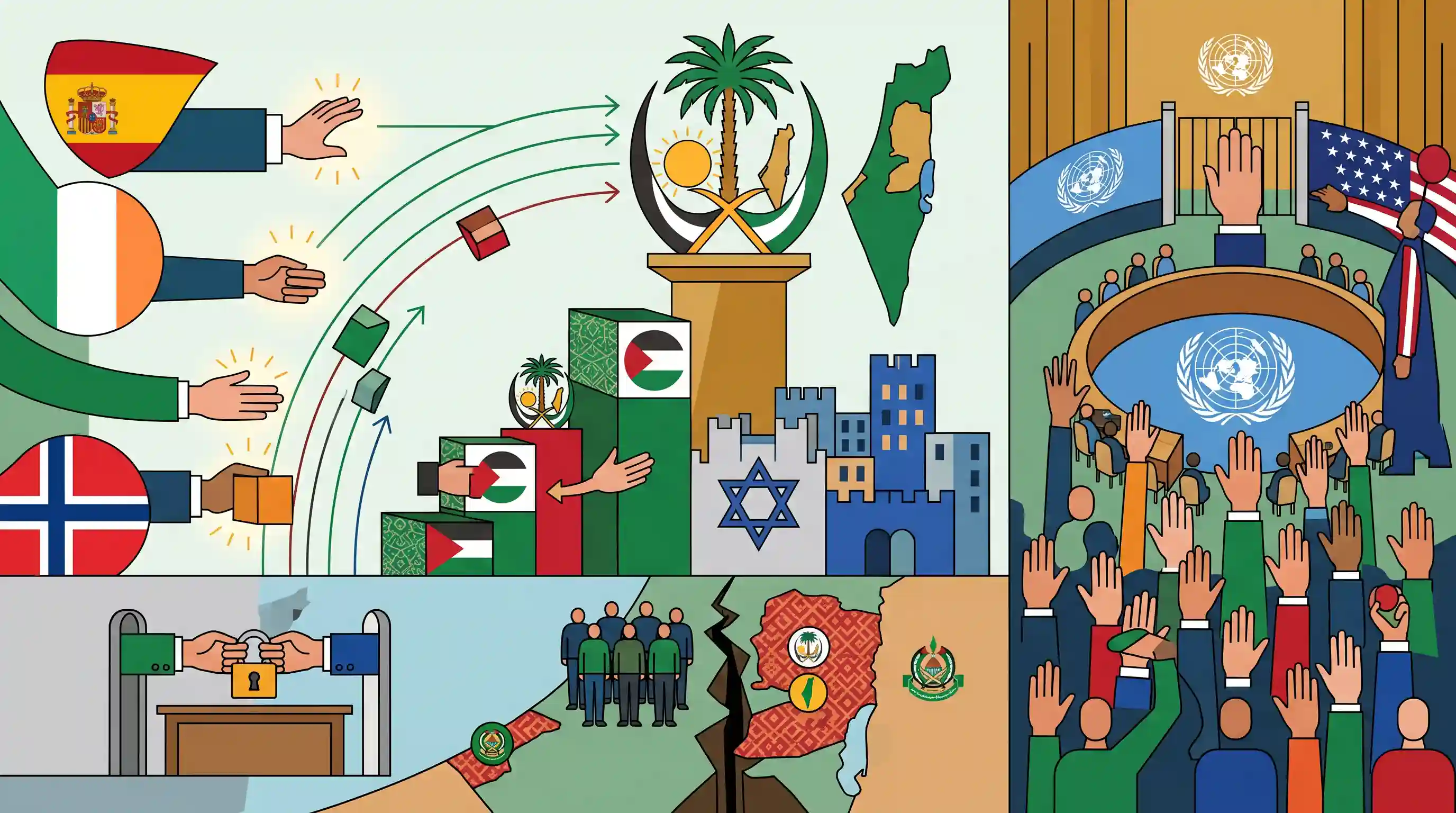
A growing number of Western countries, most recently Spain, Ireland, and Norway, are moving to formally recognize an independent Palestinian state, a significant diplomatic shift meant to pressure Israel amid the ongoing war in Gaza. Historically, Western nations maintained that recognition should only follow a negotiated "two-state solution." The Palestinian Authority (PA), which exercises limited self-rule in the West Bank following the 1990s Oslo Accords, views this as a major diplomatic victory that legitimizes its quest for statehood in the West Bank, East Jerusalem, and Gaza. However, recognition offers little immediate practical change on the ground, given Israel's strong opposition and the continued division between the PA and Hamas-controlled Gaza. The UN General Assembly has increasingly backed Palestine's bid for full membership, though the US has vetoed this at the Security Council.
Key Points
- Several Western countries, including Spain, Ireland, and Norway, have formally recognised an independent Palestinian state, signalling a shift from their historical stance that recognition should only follow a negotiated settlement.
- The State of Palestine was first proclaimed by Yasser Arafat in 1988, garnering recognition primarily from developing nations; currently, over 140 UN member states recognize it.
- The Palestinian Authority (PA), established post-Oslo Accords, holds limited self-rule in the West Bank and is distinct from Hamas, which governs the Gaza Strip and is recognized as a terror group by Western nations.
- The UN General Assembly recently voted to back the Palestinian bid to become a full UN member, but achieving full membership requires UN Security Council approval, which has been vetoed by the US.
- While international recognition grants the PA a diplomatic victory and isolates Israel further on the global stage, it has limited immediate practical impact on the ground amidst the ongoing Gaza conflict.
Important Terms
Two-state solution

A proposed diplomatic framework to resolve the conflict by establishing an independent Palestinian state alongside Israel, typically based on pre-1967 borders and the principle of 'land for peace.'
UPSC context
GS Paper II (International Relations); central to India's long-standing 'de-hyphenated' policy and support for a sovereign Palestinian state.
Oslo Accords
A series of 1990s peace agreements between Israel and the PLO that established a roadmap for Palestinian self-rule and created the Palestinian Authority (PA) as an interim government.
UPSC context
GS Paper II (International Relations); key historical context for understanding the legal and administrative foundations of the current West Bank/Gaza status.
Palestinian Authority (PA)
The interim governing body established in 1994 to exercise limited self-rule in the West Bank and Gaza Strip, currently led by the Fatah faction under President Mahmoud Abbas.
UPSC context
GS Paper II (Bilateral/Global Groupings); tests knowledge of the administrative structure of Palestine and internal political friction with Hamas.
Hamas
A Palestinian Sunni-Islamic militant and political organization that governs the Gaza Strip; it rejects the Oslo Accords and has been in a long-standing power struggle with Fatah.
UPSC context
GS Paper II (Security/International Relations); critical for analyzing regional instability, the Gaza blockade, and the impact of non-state actors.
United Nations Security Council (UNSC)
The 15-member UN body where a positive recommendation (requiring at least nine votes and no permanent-member veto) is a mandatory precursor for any state to gain full UN membership.
UPSC context
GS Paper II (International Organizations); essential for understanding UN voting procedures and the impact of P5 vetoes on global statehood.
Palestine Liberation Organisation (PLO)
An umbrella political organization recognized internationally as the 'sole legitimate representative of the Palestinian people,' which formally recognized Israel's right to exist in 1988 to pursue diplomacy.
UPSC context
GS Paper II (International Relations); vital for understanding the diplomatic history of the Palestinian national movement and its shift towards negotiation.
Prelims Trap
The UN General Assembly recently granted Palestine full UN membership by a majority vote.
Palestine is only a non-member observer state. Full UN membership requires a UNSC recommendation—meaning no P5 vetoes—before the UNGA can vote.
Static Concepts Connected
How is a new member state admitted to the United Nations?
- UNSC Recommendation: The UN Security Council must recommend admission. This requires 9 affirmative votes and no vetoes from the P5.
- UNGA Approval: Following the UNSC recommendation, the UN General Assembly must approve the admission with a two-thirds majority vote.
- Palestine's Status: Palestine holds "non-member observer state" status (granted in 2012) because US vetoes in the UNSC block full membership.
What were the Oslo Accords (1993/1995)?
- Mutual Recognition: The PLO officially recognized Israel's right to exist, and Israel recognized the PLO as the legitimate representative of the Palestinian people.
- Creation of PA: Established the Palestinian Authority (PA) to exercise limited self-governance in parts of the West Bank and Gaza Strip.
- Deferred Final Status: Left highly contentious issues like Jerusalem, borders, settlements, and Palestinian refugees for future "final status" negotiations, which ultimately stalled.
Cross-Topic Patterns
India's De-hyphenation Policy in West Asia
India balances deepening defence ties with Israel alongside its historical support for a Palestinian state (recognized in 1988). This "de-hyphenation" showcases India pursuing mutually independent bilateral tracks.
Fracturing Western consensus on Israel
Spain, Ireland, and Norway breaking ranks to recognize Palestine signals a fracture in Western consensus, showing how European nations are increasingly diverging from US/UK stances on human rights and international law.

Expect a 2026 Prelims question testing the UN membership process (UNSC veto requirement) paired with India's 1988 recognition of Palestine.
Linked PYQs · 3
Linked PYQs · 3
- 2018PrelimsGS1
The term "two-state solution" is sometimes mentioned in the news in the context of the affairs of
- 2023PrelimsGS1
Consider the following statements: Statement-I: Israel has established diplomatic relations with some Arab States. Statement-II: The 'Arab Peace Initiative' mediated by Saudi Arabia was signed by Israel and Arab League. Which one of the following is correct in respect of the above statements?
- 2018MainsGS2
“India’s relations with Israel have, of late, acquired a depth and diversity, which cannot be rolled back.” Discuss.
