French Nuclear Deterrence and European Strategic Autonomy
Source:The Hindu ↗
Why It Matters
The debate around a European nuclear umbrella reflects a fundamental shift in post-Cold War security architecture. For UPSC aspirants, understanding the weakening of traditional US-led alliances, the drive for strategic autonomy by major powers like France, and the resulting geopolitical multipolarity is crucial for answering questions on international relations and global security.
Summary
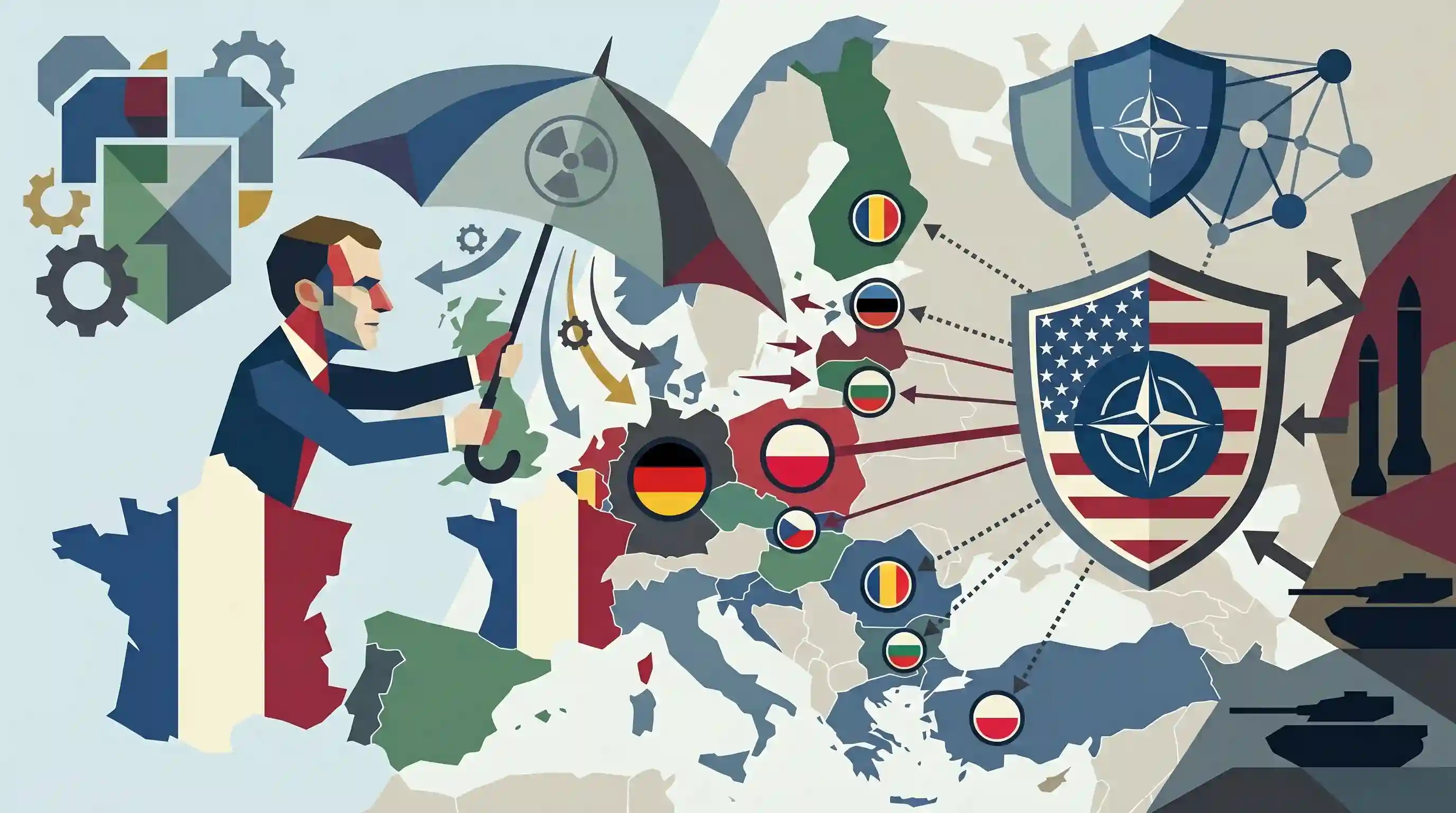
The article examines French President Emmanuel Macron's proposal to extend France's nuclear deterrence to serve as a 'nuclear umbrella' for Europe. Driven by the vision of European 'strategic autonomy', the move aims to reduce the continent's heavy reliance on the US-led NATO security guarantee, particularly amid fears of a weakening transatlantic alliance. While France is currently the sole nuclear power within the European Union, the proposal faces resistance from other European nations that remain deeply reliant on the established American nuclear deterrent to counter regional threats.
Key Points
- French President Emmanuel Macron has proposed extending France's nuclear deterrence to provide a 'nuclear umbrella' for the European Union.
- The proposal seeks to advance European 'strategic autonomy,' preparing for potential shifts in the US commitment to NATO's defense architecture, particularly amid uncertainties over future American leadership.
- Following Brexit, France is the only officially recognized nuclear-weapons state within the EU, giving it a unique position to offer deterrence.
- Many European nations, especially in Central and Eastern Europe, remain hesitant to swap the robust US nuclear guarantee for a European alternative, viewing the American deterrent as irreplaceable against threats.
- The proposal raises complex logistical and strategic questions regarding joint decision-making, cost-sharing, and maintaining compliance with international non-proliferation treaties.
Important Terms
NATO (North Atlantic Treaty Organization)

An intergovernmental military alliance established in 1949, based on the principle of collective defense (Article 5). It binds North American and European members to mutual defense against external aggression.
UPSC context
GS Paper 2 (International Relations); tests understanding of global security architecture and the evolving role of military alliances.
Strategic Autonomy
The capacity of a state or union to make sovereign decisions in foreign policy and defense without being constrained by external powers or alliance dependencies.
UPSC context
GS Paper 2 (Foreign Policy); central to debates on India's and Europe's independent geopolitical positioning in a multipolar world.
Nuclear Deterrence
A military doctrine where the threat of nuclear retaliation discourages an adversary from attacking, often based on the principle of 'Mutually Assured Destruction' (MAD).
UPSC context
GS Paper 3 (Security); tests knowledge of strategic stability, nuclear doctrines, and regional security dynamics.
Treaty on the Non-Proliferation of Nuclear Weapons (NPT)
A landmark 1968 international treaty aimed at preventing the spread of nuclear weapons, promoting cooperation in peaceful nuclear energy, and furthering the goal of disarmament.
UPSC context
GS Paper 2 (International Treaties); critical for understanding the global nuclear regime and India’s specific objections to its discriminatory framework.
Nuclear Umbrella
A security guarantee where a nuclear-armed state extends its deterrence capability to protect non-nuclear allies, effectively shielding them under its nuclear arsenal.
UPSC context
GS Paper 2 (International Relations); tests understanding of extended deterrence and the implications of shifting superpower guarantees for regional stability.
European Union (EU)
A supranational political and economic union of 27 member states, characterized by a single market and common institutions, increasingly seeking a unified security identity.
UPSC context
GS Paper 2 (International Organizations); focuses on regional integration, India-EU strategic partnerships, and global economic dynamics.
Transatlantic Alliance
The longstanding security and political partnership between North America and Europe, primarily institutionalized through NATO to maintain post-WWII international order.
UPSC context
GS Paper 2 (Global Groupings); tests analysis of Western geopolitical unity and the impacts of internal friction on global governance.
Prelims Trap
"Both France and the United Kingdom are officially recognized nuclear-weapon states within the European Union."
Following Brexit, the United Kingdom is no longer a member of the EU. Consequently, France is the sole recognized nuclear-weapon state within the European Union.
Static Concepts Connected
What constitutes a "Nuclear-Weapons State" under the NPT?
- Definition: States that manufactured and exploded a nuclear weapon or other nuclear explosive device prior to January 1, 1967.
- Recognized States: The P5 members of the UN Security Council: the US, Russia, UK, France, and China.
- Obligations: Article I prohibits transferring nuclear weapons or control over them to any non-nuclear-weapon state.
What is the concept of "Extended Deterrence" in geopolitics?
- Meaning: A commitment by a nuclear-armed state to use its nuclear arsenal to defend non-nuclear allies against external aggression.
- Non-proliferation linkage: It is often used to prevent allies from developing their own nuclear weapons by providing a credible, shared security guarantee.
Cross-Topic Patterns
European Strategic Autonomy vs. NATO
France’s push for independent European defense policy often clashes with Eastern European states' reliance on the US-led NATO alliance against Russian aggression.
AUKUS and shifting nuclear alliances
Just as AUKUS shifted Indo-Pacific nuclear submarine dynamics, a French nuclear umbrella proposal reflects the broader global fragmentation of legacy US security guarantees.

Expect a Prelims question testing the P5 nuclear states, NPT cut-off dates (Jan 1, 1967), and France's sole nuclear status in the EU.
Linked PYQs · 2
Linked PYQs · 2
- 2023MainsGS2
‘The expansion and strengthening of NATO and a stronger US-Europe strategic partnership works well for India.’ What is your opinion about this statement ? Give reasons and examples to support your answer.
- 2015PrelimsGS1
Consider the following countries: 1. China 2. France 3. India 4. Israel 5. Pakistan Which among the above are Nuclear Weapons States as recognized by the Treaty on the Non-Proliferation of Nuclear Weapons, commonly known as Nuclear Non-Proliferation Treaty (NPT)?
