Opposition Raises Economic Fallout of West Asia War in Parliament
Source:The Hindu ↗
Why It Matters
The article highlights the direct correlation between geopolitical tensions (such as the West Asia conflict) and domestic macroeconomic indicators like currency valuation and foreign capital flows. It also touches upon the intersection of internal security and regional trade diplomacy.
Summary
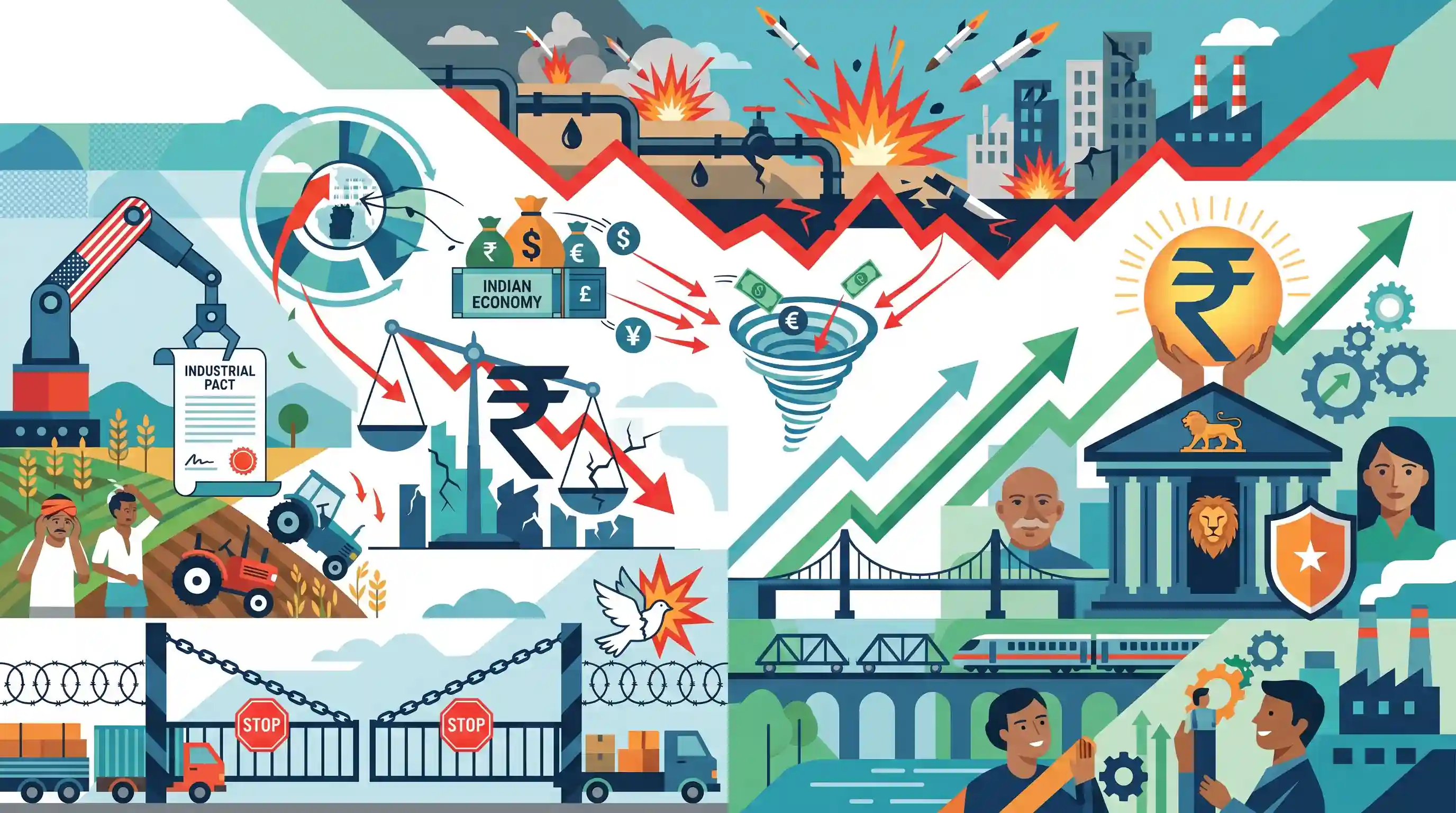
In a Lok Sabha debate, Opposition members questioned the government on the economic fallout of the West Asia war, highlighting the steep depreciation of the rupee and significant outflows of FDI and FPI. They also expressed concern over a potential US trade pact affecting domestic agriculture and demanded the resumption of cross-border trade at the Attari-Wagah border, closed since the 2025 Pahalgam terror attack. Ruling party MPs defended India's macroeconomic resilience amid global crises.
Key Points
- Opposition leaders in the Lok Sabha expressed concern over the Indian economy's vulnerability to the West Asia conflict, citing the rupee's fall to a historic low of ₹93 against the dollar.
- Concerns were raised regarding a massive exodus of Foreign Direct Investment (FDI) and Foreign Portfolio Investment (FPI) from the country.
- A proposed trade agreement with the US was criticized for potentially opening the Indian market to American agricultural products, which could harm domestic farmers.
- Ruling party members defended the government's economic management, stating India remains a fast-growing economy despite global headwinds like the pandemic and ongoing wars.
- Demands were made to reopen the Attari-Wagah border for trade between Amritsar and Lahore, which has been closed since the May 2025 Pahalgam terror attack.
- Members also advocated for tax relief and employment-linked incentives for Dalit business founders to support inclusive growth.
Important Terms
Foreign Direct Investment (FDI)

Long-term investment by foreign entities in domestic companies, providing capital, technology, and management control. It is considered a stable source of capital for industrial growth.
UPSC context
GS III (Economy); tests knowledge of capital inflows, industrial growth, and Balance of Payments.
Foreign Portfolio Investment (FPI)
Investment by foreign individuals or institutions in financial assets like stocks and bonds without management control. It is highly liquid but volatile ("hot money").
UPSC context
GS III (Economy); relevant for stock market liquidity and exchange rate volatility.
Currency Depreciation
The market-driven fall in the Rupee's value against foreign currencies. It makes exports more competitive but increases the cost of imports like crude oil.
UPSC context
GS III (Economy); vital for understanding external sector management and imported inflation.
Lok Sabha
The directly elected lower house of India’s Parliament. Under Article 75(3), the Council of Ministers is collectively responsible to it, ensuring executive accountability.
UPSC context
GS II (Polity); essential for legislative oversight, financial control, and democratic accountability.
Attari-Wagah Border Trade
The primary land-based commercial corridor between India and Pakistan in Punjab. It serves as a vital transit point for regional commerce and bilateral diplomacy.
UPSC context
GS II (International Relations); tests understanding of neighborhood relations and regional trade dynamics.
Macroeconomic Stability
The maintenance of low inflation, sustainable fiscal deficits, and a stable exchange rate to foster consistent economic growth and investor confidence.
UPSC context
GS III (Economy); a core theme for fiscal policy and national development strategies.
Prelims Trap
Geopolitical crises primarily lead to massive immediate outflows of Foreign Direct Investment (FDI).
Geopolitical panics trigger fast outflows of FPI (hot money), not FDI. FDI is long-term, illiquid, and does not immediately flee during short-term market shocks.
Static Concepts Connected
How does the RBI manage severe Rupee depreciation?
- Forex intervention: Selling dollar reserves in the spot/forward markets to absorb excess rupee liquidity and stabilize the exchange rate.
- Monetary tightening: Hiking the repo rate or tightening liquidity to increase yields, attract foreign capital, and prevent capital flight.
- Import curbs: Imposing restrictions or higher tariffs on non-essential imports to bridge the Current Account Deficit (CAD).
What are the key provisions of the Stand-Up India Scheme?
- Target Group: Facilitates bank loans between ₹10 lakh and ₹1 crore to at least one SC/ST and one woman borrower per bank branch.
- Greenfield focus: Loans are strictly for setting up greenfield enterprises in manufacturing, services, agri-allied activities, or the trading sector.
- Credit Guarantee: Margin money requirement is set at a reduced 15%, backed by the Credit Guarantee Fund for Stand-Up India (CGFSI).
Cross-Topic Patterns
Energy Security & Imported Inflation
West Asia conflicts spike global crude prices, widening India's Current Account Deficit and triggering imported inflation. This depreciates the INR and forces the RBI to tighten liquidity.
FTAs vs. Agricultural Safeguards
Proposed FTAs with developed nations (like the US) frequently hit roadblocks over agriculture, as highly subsidized Western agricultural products threaten India's vulnerable smallholder farming ecosystem.
Border Security & SAARC Trade Stagnation
The prolonged closure of Attari-Wagah highlights the persistent hurdle in India-Pakistan relations, where cross-border terrorism consistently derails regional economic integration and land-port connectivity.

Prelims 2026 will likely test the macro-linkage between West Asia shocks, FPI capital flight, CAD widening, and RBI forex interventions.
Linked PYQs · 5
Linked PYQs · 5
- 2018MainsGS3
How would the recent phenomena of protectionism and currency manipulations in world trade affect macroeconomic stability of India?
- 2025MainsGS3
What are the challenges before the Indian economy when the world is moving away from free trade and multilateralism to protectionism and bilateralism? How can these challenges be met?
- 2016MainsGS2
Increasing cross-border terrorist attacks in India and growing interference in the internal affairs of several member-states by Pakistan are not conducive for the future of SAARC (South Asian Association for Regional Cooperation)." Explain with suitable examples.
- 2015MainsGS2
Terrorist activities and mutual distrust have clouded India-Pakistan relations. To what extent the use of soft power like sports and cultural exchanges could help generate goodwill between the two countries? Discuss with suitable examples.
- 2021PrelimsGS1
Consider the following : 1. Foreign currency convertible bonds 2. Foreign institutional investment with certain conditions 3. Global depository receipts 4. Non-resident external deposits Which of the above can be included in Foreign Direct Investments?
