Independence Day Economic and Strategic Policy Announcements Reviewed
Source:The Hindu ↗
Why It Matters
The Prime Minister's Independence Day address sets the government's policy and reform agenda for the coming year. Announcements covering GST restructuring, semiconductor manufacturing, and renewable energy targets directly apply to the GS3 syllabus (Economy, Environment, and Science & Technology). Concurrently, indicating a review of the Indus Water Treaty is highly relevant for GS2 (India and its Neighborhood).
Summary
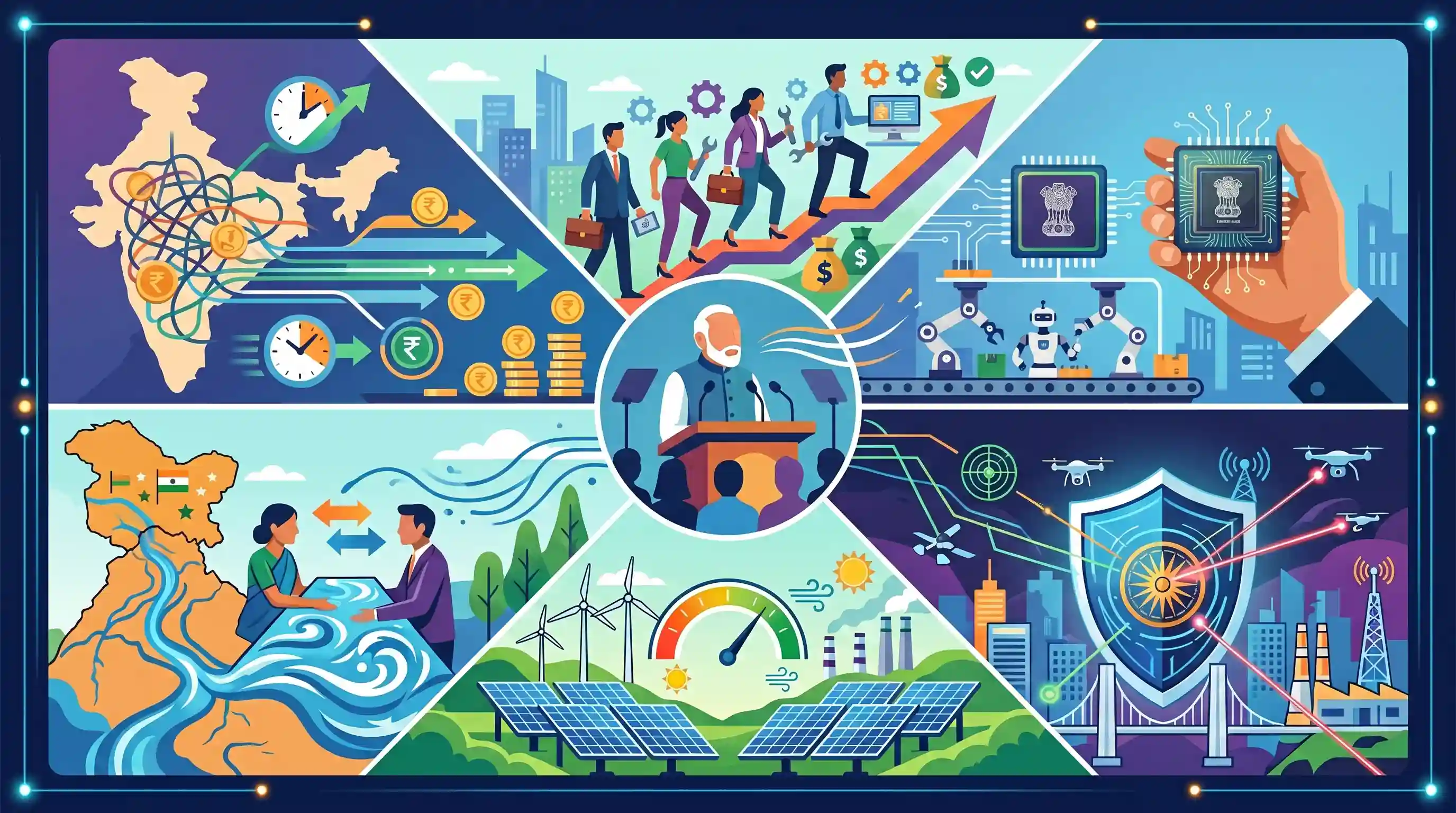
During his 12th consecutive Independence Day address in 2025, Prime Minister Narendra Modi outlined major economic, technological, and strategic initiatives. Key announcements included a comprehensive simplification of the GST framework by October 2025, the launch of the ₹1-lakh-crore 'Pradhan Mantri Viksit Bharat Rojgar Yojana' for youth employment, and the impending rollout of indigenous semiconductor chips. Strategically, he announced 'Mission Sudarshan Chakra' for infrastructure protection using domestic technology, a review of the Indus Water Treaty to secure agricultural water rights, and noted the success of 'Operation Sindoor' in J&K. Additionally, he highlighted that India has already achieved its target of sourcing 50% of its electricity from non-fossil fuels ahead of 2030.
Key Points
- The government plans to simplify the Goods and Services Tax (GST) structure and reduce rates on essential goods by October 2025.
- The ₹1-lakh-crore 'Pradhan Mantri Viksit Bharat Rojgar Yojana' was announced to grant a ₹15,000 stipend to first-time private-sector job seekers.
- India will see domestically manufactured semiconductor chips entering the market before the end of 2025.
- Mission Sudarshan Chakra, a decade-long program using indigenous technology to protect strategic and civilian sites, will be launched.
- The Prime Minister signaled a review of the Indus Water Treaty to safeguard India's agricultural water rights.
- India successfully met its climate goal of generating 50% electricity from non-fossil fuel sources well ahead of the 2030 deadline.
Important Terms
GST 2.0 (Goods and Services Tax Reforms)

A 2025 reform package simplifying India’s indirect tax regime by streamlining slabs into 0%, 5%, 18%, and 40%, while introducing the Invoice Management System (IMS) to tighten input tax credit compliance and reduce administrative complexity.
UPSC context
Relevant for GS Paper III (Indian Economy). Tests understanding of tax reforms, fiscal policy, and their impact on ease of doing business.
Pradhan Mantri Viksit Bharat Rozgar Yojana (PM-VBRY)
A ₹99,446-crore employment-linked incentive scheme launched in 2025 to create 3.5 crore jobs. It provides EPF-linked financial support to first-time employees and subsidies to employers, particularly in the manufacturing sector.
UPSC context
Significant for GS Paper III (Employment/Growth). Evaluates knowledge of government interventions in the labor market and social security for the formal workforce.
Mission Sudarshan Chakra
An indigenous, multi-layered national security initiative announced in 2025 to create a comprehensive defense shield by 2035. It integrates AI, radars, and interceptors to protect critical civilian and military infrastructure from aerial and cyber threats.
UPSC context
Key for GS Paper III (Internal Security). Tests understanding of strategic autonomy and advanced defense infrastructure for critical asset protection.
Indus Water Treaty (IWT) Review
A 1960 water-sharing agreement between India and Pakistan. In 2025, India placed the treaty in "abeyance" following terror attacks, signaling a shift toward utilizing its full water rights for agricultural and strategic needs.
UPSC context
Vital for GS Paper II (International Relations). Analyzes transboundary water diplomacy and the use of water as a strategic tool in geopolitics.
Operation Sindoor
A 2025 counter-terrorism operation involving precision strikes on terror launchpads in Pakistan and PoJK. It utilized indigenous technology and marked a doctrinal shift towards proactive deterrence following the Pahalgam terror attack.
UPSC context
Important for GS Paper III (Internal Security). Tests knowledge of India's counter-terrorism strategy and military modernization.
Prelims Trap
"The Indus Water Treaty prohibits India from agricultural or hydroelectric usage of the Western rivers (Indus, Jhelum, Chenab)."
The Treaty actually permits India limited agricultural use, domestic use, and 'run-of-the-river' hydroelectric projects on the Western rivers. The PM's speech signals a push to maximize these exact, existing rights.
Static Concepts Connected
What are India's rights over Western rivers under the Indus Water Treaty?
- Basic Allocation: Pakistan receives largely unrestricted use of the Indus, Jhelum, and Chenab rivers. India has full control over the Eastern rivers (Ravi, Beas, Sutlej).
- Permitted Usage: India is permitted domestic, non-consumptive, and specified agricultural use of the Western rivers, which are often underutilized.
- Hydroelectric Projects: India can build 'run-of-the-river' (RoR) hydroelectric projects on Western rivers, provided they adhere to specific design criteria regarding water storage.
What are the key targets of India's updated NDCs (Panchamrit)?
- Non-fossil Capacity: Achieve 50% cumulative electric power installed capacity from non-fossil fuel energy resources by 2030 (often misread as generation).
- Emission Intensity: Reduce the emission intensity of its GDP by 45% by 2030, compared to 2005 levels.
- Net Zero: Achieve the overarching target of net-zero carbon emissions by the year 2070.
Cross-Topic Patterns
Critical Infra + Indigenous Tech
The launch of 'Mission Sudarshan Chakra' links internal security directly to the Semiconductor Mission, emphasizing indigenous chips to safeguard strategic networks against emerging cyber-physical threats.
Employment schemes + Labor formalization
The ₹1-lakh-crore 'PM Viksit Bharat Rojgar Yojana' shifts employment strategy from corporate subsidies to direct stipends, merging labor market formalization with youth upskilling in the private sector.

A multi-statement Prelims question testing India's exact agricultural and run-of-the-river hydro rights on Western Rivers is highly likely.
Linked PYQs · 4
Linked PYQs · 4
- 2012MainsGS2
The situation today is far different to that prevalent fifty years back when the Indus Water Treaty was signed." Highlight the complexity of the current challenges on both sides of the border in this regard. Do you think that a review of the Treaty is in India's best interests?
- 2019MainsGS3
Enumerate the indirect taxes which have been subsumed in the Goods and Services Tax (GST) in India. Also, comment on the revenue implications of the GST introduced in India since July 2017.
- 2022MainsGS3
Do you think India will meet 50 percent of its energy needs from renewable energy by 2030 ? Justify your answer. How will the shift of subsidies from fossil fuels to renewables help achieve the above objective ? Explain.
- 2025MainsGS3
India aims to become a semiconductor manufacturing hub. What are the challenges faced by the semiconductor industry in India? Mention the salient features of the India Semiconductor Mission.
