Supreme Court Ruling on Scheduled Caste Reservation for Converts
Source:The Hindu ↗
Why It Matters
This judgment is critical for understanding the intersection of religious freedom, secularism, and affirmative action in India. It highlights the constitutional complexities surrounding the definitions of Scheduled Castes versus Scheduled Tribes and underscores ongoing debates about extending social justice benefits to Dalit minorities.
Summary
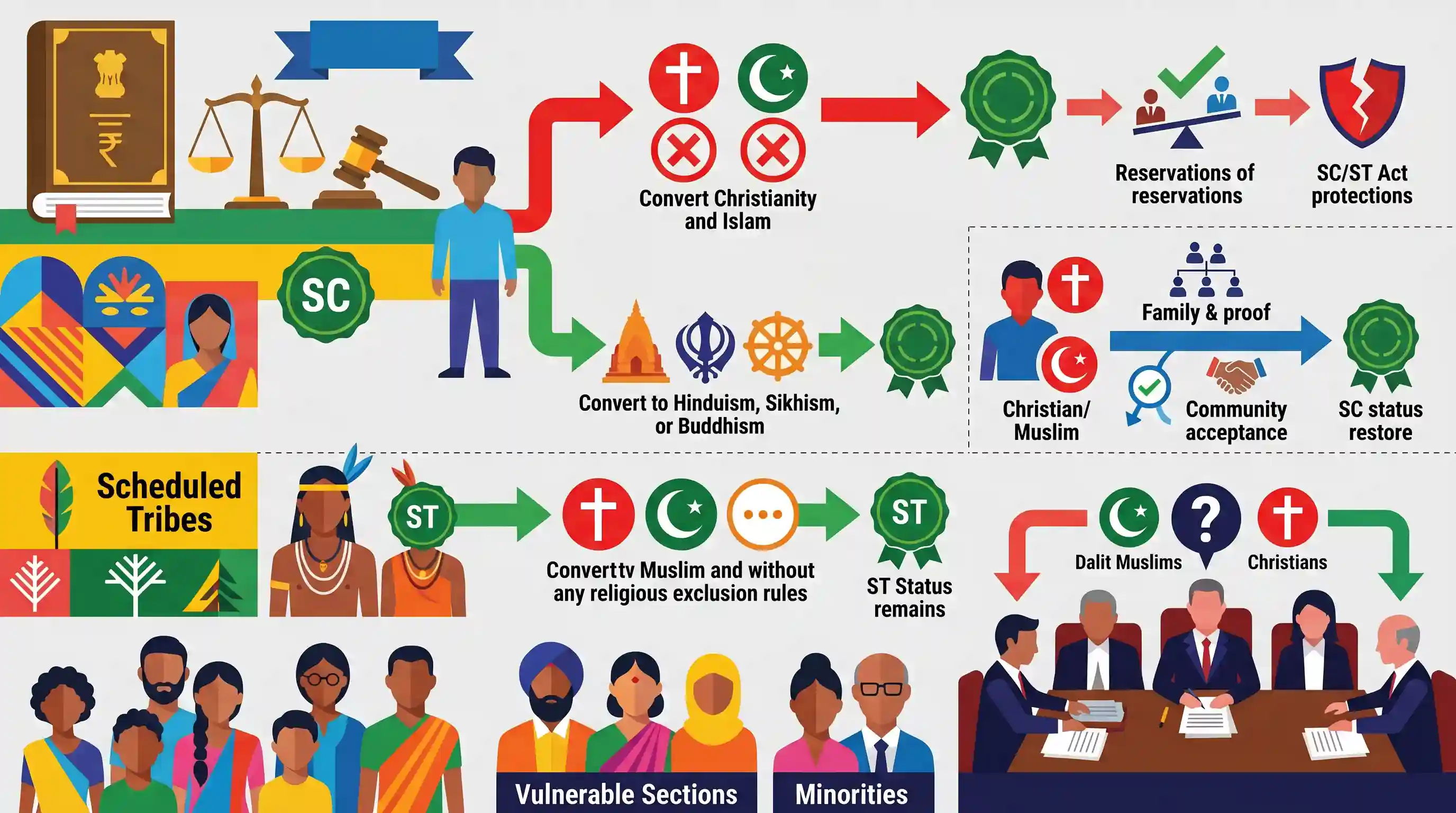
The Supreme Court has ruled that members of Scheduled Castes (SC) who convert to Christianity or Islam lose their SC status, as these religions fall outside the purview of the Constitution (Scheduled Castes) Order, 1950. The 1950 Order explicitly restricts SC categorization to those practicing Hinduism, Sikhism, or Buddhism, based on the premise that Christianity and Islam do not recognize the caste system. Consequently, such converts forfeit statutory benefits, including reservations and protections under the SC/ST (Prevention of Atrocities) Act. Conversely, reconversion to a recognized religion allows for the restoration of SC status, contingent upon proof of original caste roots and community acceptance. Notably, the Constitution (Scheduled Tribes) Order, 1950 lacks this religious exclusion, allowing tribal members to retain ST status post-conversion. The Central government has formed a Commission of Inquiry, led by former Chief Justice K.G. Balakrishnan, to evaluate the potential inclusion of Dalit Muslims and Christians within the SC category.
Key Points
- The Constitution (Scheduled Castes) Order, 1950 restricts SC status exclusively to individuals professing Hinduism, Sikhism, or Buddhism.
- Conversion to Christianity or Islam results in the immediate loss of SC status, terminating access to reservations and protections under the SC/ST (Prevention of Atrocities) Act.
- The Supreme Court's ruling rests on the rationale that Christianity and Islam do not officially recognize or incorporate the caste system.
- SC status can be restored upon reconversion to a recognized religion, provided the individual can prove their original caste lineage and gain community acceptance.
- Unlike the SC Order, the Constitution (Scheduled Tribes) Order, 1950 does not impose a religious bar; individuals can retain ST status post-conversion if they maintain tribal characteristics.
- The K.G. Balakrishnan Commission is currently examining the viability of extending SC status to Dalit Christians and Dalit Muslims.
Important Terms
Constitution (Scheduled Castes) Order, 1950

A Presidential order issued under Article 341 that identifies Scheduled Castes. Paragraph 3 restricts SC status to those professing Hinduism, Sikhism, or Buddhism, excluding converts to Christianity or Islam.
UPSC context
GS Paper 2: Social Justice; tests understanding of legal barriers and affirmative action eligibility for religious minorities.
Article 341
The constitutional provision empowering the President to specify castes as Scheduled Castes. It defines SC status as a legal construct tied to specific religious and geographic criteria.
UPSC context
Prelims and GS Paper 2: Constitutional provisions for vulnerable sections; tests clarity on the President vs. Parliament's role.
K.G. Balakrishnan Commission
A 2022 commission tasked with evaluating whether Scheduled Caste status should be extended to Dalits who converted to religions like Christianity or Islam, focusing on their socio-economic backwardness.
UPSC context
GS Paper 2: Social Justice; relevant for contemporary issues involving minority rights and the expansion of reservation.
SC/ST (Prevention of Atrocities) Act, 1989
Legislative protection against caste-based violence and discrimination. The Supreme Court recently reaffirmed that SC converts to Christianity or Islam lose protection under this Act due to loss of SC status.
UPSC context
GS Paper 2: Welfare schemes and laws for vulnerable sections; tests the legal implications of religious conversion on statutory rights.
Article 342
The constitutional provision for identifying Scheduled Tribes. Crucially, the related 1950 Order for STs contains no religious bar, unlike the order for Scheduled Castes.
UPSC context
GS Paper 2: Comparison of SC and ST legal frameworks; tests knowledge of the religion-neutral nature of tribal status.
National Commission for Scheduled Castes (NCSC)
A constitutional body under Article 338 mandated to investigate and monitor safeguards provided for Scheduled Castes and inquire into specific complaints regarding the deprivation of their rights.
UPSC context
GS Paper 2: Constitutional Bodies; tests the institutional framework protecting disadvantaged groups and its advisory role in reservation debates.
Prelims Trap
"An individual loses their Scheduled Tribe (ST) status upon conversion to Christianity or Islam."
The Constitution (Scheduled Tribes) Order, 1950 has no religious bar. ST status depends on tribal characteristics and isolation, not religion, unlike the Scheduled Caste classification.
Static Concepts Connected
How are SCs and STs notified under Articles 341 and 342?
- Presidential Notification: The President issues the initial list of SCs/STs for a State or UT. If it is a State, this is done after consulting the respective Governor.
- Parliamentary Law: Any subsequent inclusion, exclusion, or modification to this initial Presidential list can only be made by an Act of Parliament, not by the Executive.
Why does the 1950 Order limit SC status to specific religions?
- Historical Untouchability: SC categorization is constitutionally linked to the specific social disability and discrimination arising from the historical practice of untouchability within the traditional Hindu caste system.
- Legislative Additions: Sikhism (1956) and Buddhism (1990) were later added via amendments because they originated in India and structurally inherited similar caste-based socio-economic legacies.
Cross-Topic Patterns
Article 25 vs Affirmative Action
Denying SC status upon conversion creates tension with Article 25, raising questions about whether state welfare mechanisms are indirectly coercing citizens to remain in specific religions.
SC/ST Atrocities Act protection gaps
The SC/ST (Prevention of Atrocities) Act's protections vanish for SC converts to Christianity/Islam, revealing a gap where social prejudice may continue despite the legal loss of caste status.

Expect a comparative Prelims statement contrasting Art 341 (SC Order religion limit) with Art 342 (ST Order religion neutrality) in 2026.
Linked PYQs · 4
Linked PYQs · 4
- 2018MainsGS2
Whether National Commission for Scheduled Castes (NCSC) can enforce the implementation of constitutional reservation for the Scheduled Castes in the religious minority institutions? Examine.
- 2024PrelimsGS1
Consider the following statements : 1. It is the Governor of the State who recognizes and declares any community of that State as a Scheduled Tribe. 2. A community declared as a Scheduled Tribe in a State need not be so in another State. Which of the statements given above is/are correct?
- 2023MainsGS2
“Development and welfare schemes for the vulnerable, by its nature, are discriminatory in approach.” Do you agree? Give reasons for your answer.
- 2019MainsGS2
Performance of welfare schemes that are implemented for vulnerable sections is not so effective due to absence of their awareness and active involvement at all stages of policy process. Discuss.
