Security failure addressed after incident at US event
Source:The Hindu ↗
Why It Matters
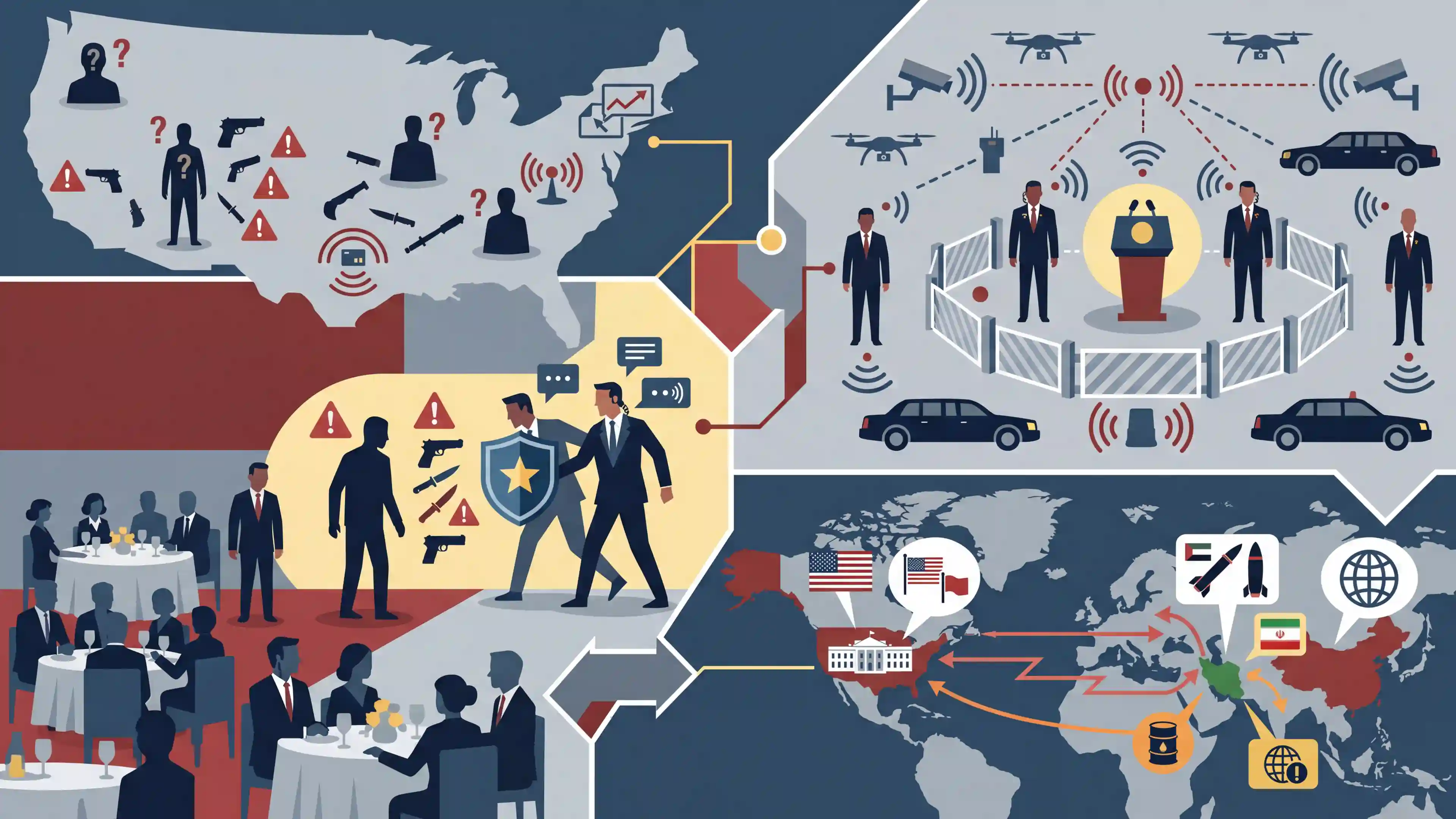
Assassination attempts on major world leaders demonstrate the fragility of political stability and the critical need for advanced VIP security mechanisms. Furthermore, the explicit linkage of the incident to U.S.-Iran relations highlights how domestic security events in global superpowers can trigger diplomatic ripple effects, potentially impacting global peace and energy security.
Summary
A lone-wolf assassination attempt on U.S. President Donald Trump was thwarted during the White House Correspondents' Association dinner in Washington, D.C. The suspect, armed with multiple firearms and knives, was neutralized by the Secret Service. For UPSC aspirants, the incident is relevant on multiple fronts: it highlights the ongoing internal security challenges of lone-wolf attacks and gun violence, emphasizes the necessity of stringent VIP security frameworks, and touches upon international relations given the subsequent rhetoric linking U.S. domestic stability with ongoing geopolitical tensions involving Iran.
Key Points
- The interception of a heavily armed 'lone-wolf' attacker underscores the persistent threat posed by individualized violence and the operational challenges of pre-empting such incidents.
- The successful evacuation of the U.S. President highlights the critical role of robust VIP security protocols, which can be comparatively analyzed with India's Special Protection Group (SPG) architectures.
- The incident inherently reignites debates around gun control, political violence, and internal security vulnerabilities in democracies with pervasive civilian firearm ownership.
- The geopolitical dimension is emphasized by the President's assertion that the attack would not deter his stance on a potential conflict with Iran, illustrating how domestic security threats can intersect with global diplomacy and regional stability in the Middle East.
Important Terms
Secret Service

The U.S. federal agency tasked with protecting the President and investigating financial crimes. Established in 1865, it transitioned to full-time presidential protection after the 1901 assassination of William McKinley.
UPSC context
GS II/III. Useful for comparative analysis of VIP security protocols (USSS vs India's SPG) and international security cooperation.
Lone Wolf Attack
A violent act carried out by an individual acting independently, without direct command, logistical support, or formal membership in a terrorist organization. These individuals are often self-radicalized via online platforms.
UPSC context
GS III: Internal Security. Tests understanding of evolving terror threats, radicalization challenges, and intelligence-gathering difficulties for solitary actors.
Special Protection Group (SPG)
India’s elite security force mandated to protect the Prime Minister. Established in 1985 after the assassination of Indira Gandhi, it draws personnel on deputation from various Central Armed Police Forces.
UPSC context
GS III: Security Agencies and their Mandate. Tests knowledge of specialized protection frameworks and legislative amendments (e.g., SPG Act 2019).
White House Correspondents' Association (WHCA)
A non-profit organization of journalists covering the U.S. President. It hosts an annual dinner that serves as a high-profile platform for media-government interaction and is a notable target for security planning.
UPSC context
Prelims: International current affairs. Contextualizes international events involving heads of state and media dynamics in major democracies.
Internal Security
The domain of maintenance of peace and order within a nation's borders, involving the management of threats like extremism, insurgencies, and organized crime by various security agencies.
UPSC context
GS III core syllabus. Encompasses the structural and operational challenges of protecting democratic processes and high-profile targets from internal threats.
VIP Security
A multi-layered security framework involving threat assessments, physical barriers (magnetometers), and specialized counter-assault teams to protect high-ranking officials and public figures from harm.
UPSC context
GS III. Focuses on Standard Operating Procedures (SOPs) and the prevention of security lapses during large-scale public events.
Prelims Trap
"The SPG provides security to the serving Prime Minister, former Prime Ministers, and the President of India."
Post-2019 amendment, SPG cover is restricted exclusively to the serving PM and family residing at the official residence. Former PMs do not receive SPG protection.
Static Concepts Connected
What are the key provisions of the SPG (Amendment) Act, 2019?
- Serving PM Only: Restricts cover strictly to the incumbent Prime Minister and their immediate family residing at the official residence.
- Former PMs: Removed SPG cover for former PMs and their families, who are now typically provided with CRPF Z+ security instead.
Why are 'Lone Wolf' attacks structurally difficult for intelligence agencies to preempt?
- Operational Isolation: Perpetrators act independently without coordinating with established terror networks, generating no communication chatter for signals intelligence to intercept.
- Financial Invisibility: They require negligible funding, bypassing Financial Intelligence Units (FIU) and traditional anti-terror financing tracking mechanisms.
- Everyday Weapons: They rely on easily accessible, dual-use items like commercial vehicles or kitchen knives rather than smuggled military-grade explosives.
Cross-Topic Patterns
Lone Wolf + Social Media Intermediaries
The self-radicalization of lone wolves connects directly to IT Rules 2021 and the debate over intermediary liability for algorithmic promotion of extremist content.
US-Iran Tensions + India's Energy Security
Rhetoric linking US domestic attacks to Iran can trigger Middle East volatility, directly impacting India's crude oil import bills and macroeconomic inflation calculations.

SPG's 2019 amendment limits or lone-wolf terror financing mechanisms (bypassing traditional PMLA) are highly probable targets for 2026.
Linked PYQs · 3
Linked PYQs · 3
- 2024MainsGS2
‘Terrorism has become a significant threat to global peace and security.’ Evaluate the effectiveness of the United Nations Security Council's Counter Terrorism Committee (CTC) and its associated bodies in addressing and mitigating this threat at the international level.
- 2016MainsGS3
“Terrorism is emerging as a competitive industry over the last few decades.” Analyze the above statement.
- 2025MainsGS2
"Energy security constitutes the dominant kingpin of India's foreign policy, and is linked with India's overarching influence in Middle Eastern countries.” How would you integrate energy security with India's foreign policy trajectories in the coming years?
