Iran Protests Escalate Amid State Crackdown and Internet Blackouts
Source:Indian Express ↗
Why It Matters
Escalating US-Iran tensions and instability in the Middle East directly threaten India's energy security, regional investments (like the Chabahar Port), and the safety of the Indian diaspora in the Gulf. Additionally, the Iranian government's use of internet shutdowns to quell protests is highly relevant to governance debates regarding digital rights, state overreach, and freedom of expression.
Summary
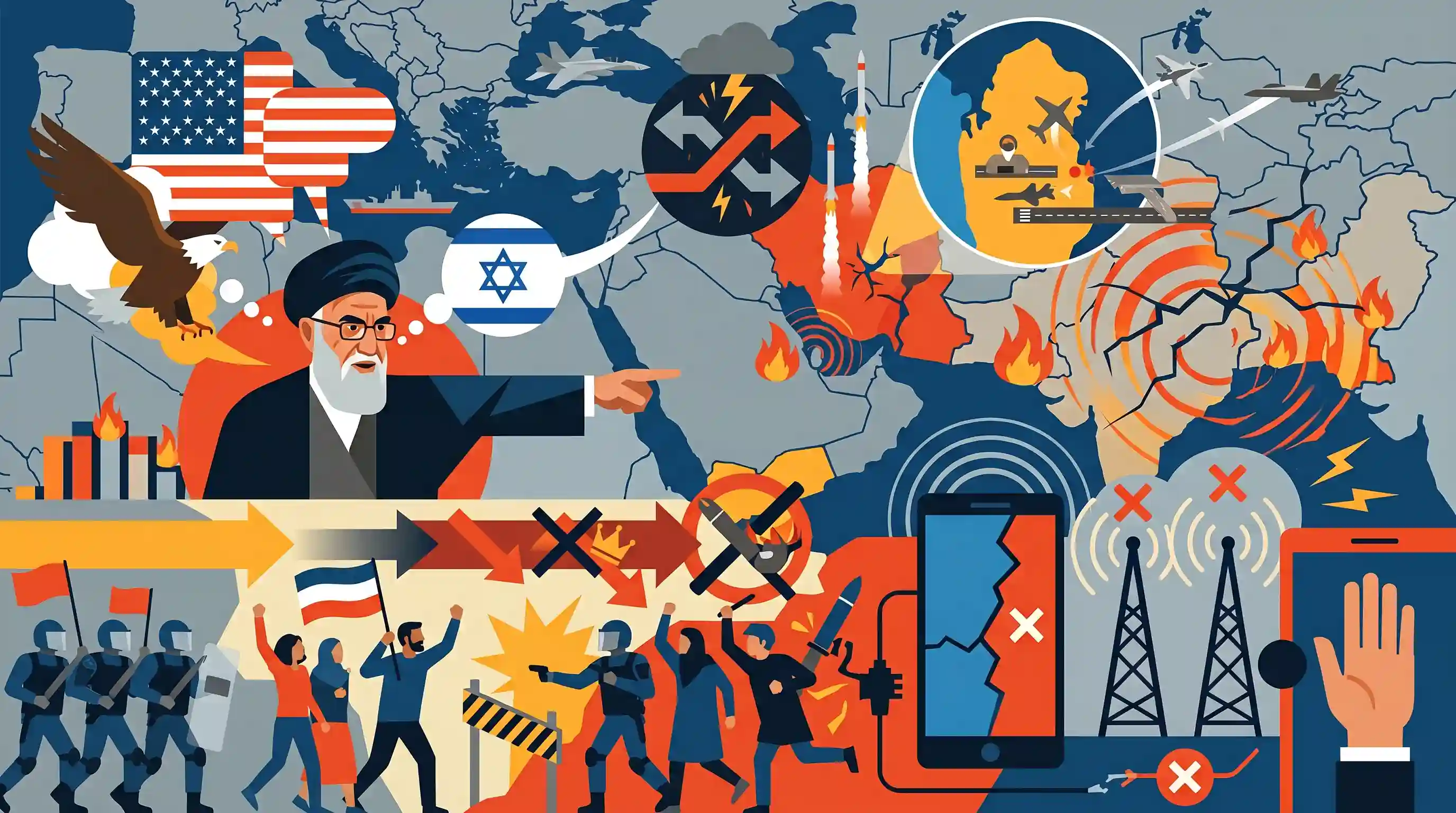
The article highlights the intensifying anti-government protests in Iran and the subsequent severe state crackdown. Supreme Leader Ayatollah Ali Khamenei has acknowledged the killings but blamed the unrest on the United States and Israel. Driven by economic grievances, the protests have transformed into calls for regime change, met with lethal force and sweeping internet shutdowns by Iranian authorities. The situation has severely escalated US-Iran tensions, with the US threatening military action and adjusting its military footprint in the region, particularly at the Al-Udeid air base in Qatar, raising alarms about broader Middle Eastern stability.
Key Points
- Supreme Leader Ayatollah Ali Khamenei publicly addressed the mass protests in Iran for the first time, attributing the unrest and violence to foreign adversaries, primarily the US and Israel.
- The protests, initially sparked by severe economic distress, have evolved into a broader movement demanding the end of the current regime.
- Human rights organizations estimate the death toll exceeds 3,000, while the Iranian government has imposed near-total internet blackouts (reducing connectivity to 2%) to suppress information and organizing.
- Geopolitical tensions are escalating as the US warns of potential military intervention if the crackdown continues, prompting the US and UK to reduce personnel at the Al-Udeid air base in Qatar.
Important Terms
Human Rights Activists News Agency (HRANA)

An independent news agency founded in 2009 by Iranian advocates to monitor and document human rights violations, casualties, and arrests during periods of civil unrest in Iran.
UPSC context
GS-II: International Relations/Human Rights. Tests knowledge of non-state actors' roles in monitoring global rights violations and democratic values.
Supreme Leader of Iran
The highest political and religious authority in Iran, holding ultimate control over the judiciary, military, and foreign policy under the theocratic principle of Velayat-e Faqih.
UPSC context
GS-II: International Relations. Critical for analyzing the impact of West Asian leadership on regional stability and India's strategic partnerships.
Al-Udeid Air Base
A sprawling military facility in Qatar serving as the forward headquarters for U.S. Central Command (CENTCOM) and housing the largest U.S. military presence in the Middle East.
UPSC context
GS-II: International Relations. Relevant for studying foreign military footprints and their implications for India's energy security and maritime trade.
West Asia Geopolitics
The strategic interaction of regional powers (Iran, Saudi Arabia, Israel) and external actors in the Middle East, influencing global energy security and India's "Link West" policy.
UPSC context
GS-II: Effect of policies of developed/developing countries on India's interests. Tests understanding of regional conflicts and Indian diaspora welfare.
Internet Shutdowns
The deliberate disruption of digital communications by a state to control the flow of information, suppress political dissent, and potentially conceal human rights violations during protests.
UPSC context
GS-II: Governance and Fundamental Rights. Tests the debate between national security imperatives and the right to freedom of expression and information.
Chabahar Port
A strategic deep-sea port in Iran, developed with Indian cooperation, serving as a gateway for India to access Afghanistan and Central Asia by bypassing Pakistan.
UPSC context
GS-II: Connectivity Projects. Essential for understanding India's strategic autonomy and regional infrastructure diplomacy in a sanctions-heavy environment.
Prelims Trap
"The strategic Al-Udeid US air base is located in Saudi Arabia."
UPSC frequently tests Middle East mapping by misaligning strategic assets. Al-Udeid is located in Qatar, not Saudi Arabia, and houses US CENTCOM.
Static Concepts Connected
How are internet shutdowns regulated and constitutionally protected in India?
- Constitutional shield: Access is protected under Article 19(1)(a) (speech) and 19(1)(g) (trade) as established in the Anuradha Bhasin v. Union of India (2020) ruling.
- No indefinite bans: The Supreme Court mandated that indefinite internet suspensions are disproportionate, impermissible, and subject to judicial review.
- Statutory authority: Executed under the Telecommunications Act, 2023, requiring suspension orders to be issued strictly by the Union or State Home Secretary.
What is India's strategic imperative for developing Iran's Chabahar Port?
- Bypassing Pakistan: It provides a direct maritime-to-land route for India to access Afghanistan and Central Asia, effectively circumventing overland transit blockades by Pakistan.
- INSTC integration: It serves as a critical southern nodal gateway for the International North-South Transport Corridor (INSTC), linking Indian markets to Russia and Europe.
- Sanctions diplomacy: While India secured a rare US sanctions waiver for the port's development, broader US-Iran geopolitical hostility continues to cause indirect banking and logistical hurdles.
Cross-Topic Patterns
Gulf instability & India's CAD
Escalation involving US forces in Qatar and Iranian crackdowns threatens Gulf stability. Spikes in global crude prices directly inflate India's import bill, widening the Current Account Deficit (CAD).
Digital Rights vs State Security
Iran’s 98% internet blackout mirrors global debates on telecom suspensions. India evaluates similar executive powers against the proportionality doctrine outlined in the Anuradha Bhasin judgment.

Expect a Prelims mapping pair on Middle East military bases (e.g., Al-Udeid) or a statement question on INSTC and US sanctions waivers.
Linked PYQs · 4
Linked PYQs · 4
- 2018MainsGS2
In what ways would the ongoing US-Iran Nuclear Pact Controversy affect the national interest of India? How should India respond to this situation?
- 2012MainsGS2
How have the US sanctions against Iran affected India's bilateral relations with Iran?
- 2025MainsGS2
"Energy security constitutes the dominant kingpin of India's foreign policy, and is linked with India's overarching influence in Middle Eastern countries.” How would you integrate energy security with India's foreign policy trajectories in the coming years?
- 2022PrelimsGS1
The term "Levant" often heard in the news roughly corresponds to which of the following regions?
