US Protectionist Trade Policies and India Structural Economic Reforms
Source:Indian Express ↗
Why It Matters
Understanding the spillover effects of US economic policies is critical for UPSC aspirants, as it connects global geopolitics with India's domestic macroeconomic imperatives, industrial policy, and trade strategy.
Summary
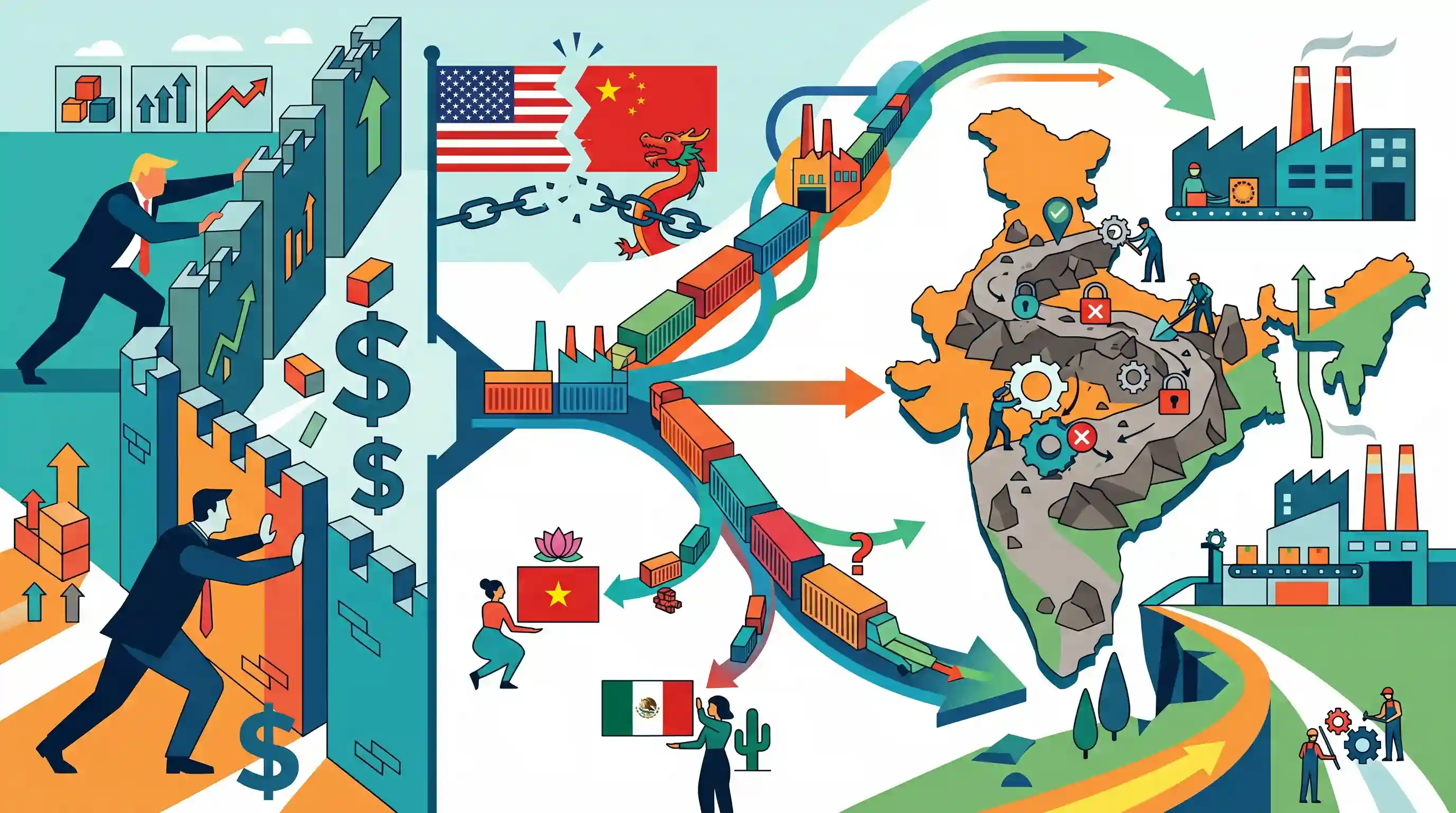
An analysis of Donald Trump's "America First" economic agenda—characterized by protectionism, higher tariffs, and decoupling from China—and its broader macroeconomic implications for India. While Trump's policies aim to restrict imports and penalize companies moving abroad, they inadvertently accelerate the "China Plus One" strategy, presenting an opportunity for India to attract shifting global supply chains. However, to effectively capitalize on this geopolitical and economic reset, India must implement deep structural reforms, lower its own tariff barriers, and significantly improve the ease of doing business to compete with alternatives like Vietnam and Mexico.
Key Points
- Donald Trump's proposed "America First" policies feature strong protectionist measures, including 10-20% universal tariffs on all imports and up to 60% tariffs on Chinese goods to revitalize US domestic manufacturing.
- The acceleration of US-China decoupling drives the "China Plus One" supply chain restructuring, offering emerging economies a chance to attract relocating investments.
- While India shares strong geopolitical ties with the US, it remains exposed to Trump's transactional trade approach, which could target Indian exports, services, and H-1B visas.
- To capitalize on shifting global supply chains, India urgently needs deep structural reforms, including a reduction in its own import tariffs and better integration into global value chains (GVCs).
- Improving the ease of doing business, boosting manufacturing competitiveness, and liberalizing Foreign Direct Investment (FDI) are critical for India to outpace competitors like Vietnam and Mexico.
Important Terms
America First

A policy prioritizing domestic industry through protectionism, tariffs, and restricted immigration. It seeks to reduce trade deficits and reshore manufacturing, often through bilateral reciprocity rather than multilateral agreements.
UPSC context
GS Paper II: International Relations. Tests understanding of US foreign policy shifts and their impact on India’s exports and strategic autonomy.
China Plus One strategy
A global business strategy where companies diversify manufacturing by establishing facilities in countries other than China to mitigate supply chain risks, geopolitical tensions, and rising labor costs.
UPSC context
GS Paper III: Economy/Manufacturing. Tests India's potential as a global manufacturing hub and competition with rivals like Vietnam.
World Trade Organization (WTO)
The only international organization dealing with the global rules of trade. Its main function is to ensure that trade flows as smoothly, predictably, and freely as possible.
UPSC context
GS Paper II: International Institutions. Tests knowledge of multilateral trade rules and the challenges of the dispute settlement mechanism.
US Federal Reserve
The central banking system of the United States. Its monetary policy decisions, particularly interest rate changes, significantly influence global capital flows, exchange rates, and emerging market stability.
UPSC context
GS Paper III: Indian Economy. Tests impact of global monetary policy on India’s capital inflows (FPI), inflation, and Rupee value.
Protectionism
Economic policy of restricting imports from other countries through methods such as tariffs, quotas, and subsidies to protect domestic industries from foreign competition.
UPSC context
GS Paper III: Economy/Trade. Tests understanding of trade barriers and their impact on globalized economies and export-led growth.
Generalised System of Preferences (GSP)
A trade program where developed countries provide preferential (low or zero) duty-free entry for products from designated developing countries to promote their economic growth.
UPSC context
GS Paper II: Bilateral Relations. Specifically relevant to trade disputes and market access issues between India and the US.
Prelims Trap
"The 'China Plus One' strategy is an official trade framework adopted by the World Trade Organization."
"China Plus One" is a corporate business strategy driven by multinational companies to diversify supply chains, not an official government policy or WTO treaty.
Static Concepts Connected
How do high import tariffs impact a country's Global Value Chain (GVC) integration?
- Input cost escalation: High tariffs on imported raw materials increase the cost of final assembled products, reducing the country's overall export competitiveness.
- Inverted duty structure: When intermediate raw materials face higher import tariffs than finished goods, it actively discourages domestic manufacturing and assembly.
- Retaliatory trade barriers: Imposing high domestic tariffs often invites reciprocal trade barriers from partner countries, shrinking potential export markets.
What does the WTO's Most-Favoured-Nation (MFN) principle mandate?
- Equal treatment: A country cannot normally discriminate between its trading partners; a trade favor granted to one member must apply to all WTO members.
- Key exceptions: Free Trade Agreements (FTAs) and special access preferences for developing nations (like the Generalized System of Preferences) are permitted exceptions to MFN.
- Tariff bindings: Members commit to a ceiling rate (bound rate). Applying universal tariffs above this violates WTO rules unless justified by national security.
Cross-Topic Patterns
Protectionism vs. Demographic Dividend
Rising global protectionism directly threatens India's ability to use an export-led manufacturing boom to absorb its massive youth workforce, making domestic structural reforms urgent.
H-1B Visas and WTO GATS Mode 4
Restrictive US visa policies (like H-1B curbs) disrupt Mode 4 of the WTO's General Agreement on Trade in Services (GATS), which covers the temporary movement of skilled professionals.

Expect a 2026 Mains question linking US protectionism to India's demographic dividend: is the traditional export-led growth model dead?
Linked PYQs · 4
Linked PYQs · 4
- 2012MainsGS2
Discuss the likely negative impact of the protectionist measures proposed by the US on India's software industry.
- 2017MainsGS3
Industrial growth rate has lagged-behind in the overall growth of Gross-Domestic-Product (GDP) in the post-reform period." Give reasons. How far the recent changes in Industrial-Policy are capable of increasing the industrial growth rate?
- 2020PrelimsGS1
With reference to Trade-Related Investment Measures (TRIMS), which of the following statements is/are correct? 1. Quantitative restrictions on imports by foreign investors are prohibited. 2. They apply to investment measures related to trade in both goods and services. 3. They are not concerned with the regulation of foreign investment. Select the correct answer using the code given below:
- 2022PrelimsGS1
Consider the following statements: 1. Tight monetary policy of US Federal Reserve could lead to capital flight. 2. Capital flight may increase the interest cost of firms with existing External Commercial Borrowings (ECBs). 3. Devaluation of domestic currency decreases the currency risk associated with ECBs. Which of the statements given above are correct?
