Multi-dimensional framework for substantive women empowerment
Source:The Hindu ↗
Why It Matters
Women's empowerment is a core cross-cutting theme in the UPSC syllabus, featuring prominently in GS1 (Indian Society), GS2 (Social Justice/Vulnerable Sections), GS3 (Inclusive Growth), and Essays. Understanding the nuances between equality, equity, and holistic empowerment is crucial for comprehensive answer writing.
Summary
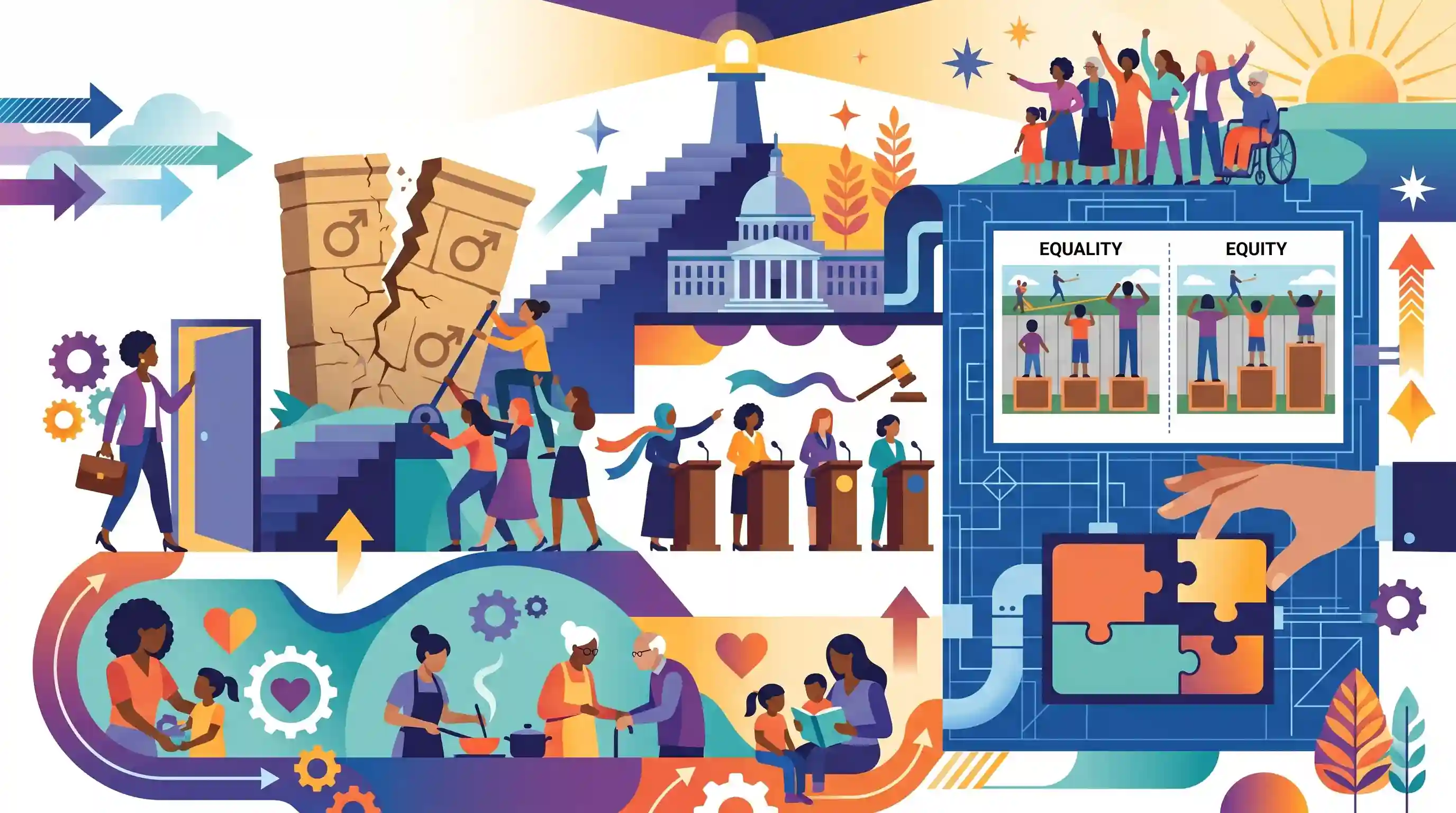
The article explores the multi-dimensional nature of women's empowerment, arguing that genuine progress requires looking beyond basic economic independence. It emphasizes the need to tackle structural patriarchal norms, recognize and integrate the 'care economy', and ensure substantive political representation. Achieving true empowerment entails a shift from mere equality to gender equity, demanding that gender considerations be deeply embedded into all levels of policy design and social reform.
Key Points
- True empowerment extends beyond mere economic participation; it necessitates decision-making power, agency, bodily autonomy, and freedom from patriarchal constraints.
- Addressing the 'care economy' and the disproportionate burden of unpaid domestic labor on women is essential for transitioning toward genuine economic independence.
- Gender concerns must be structurally integrated into program design and implementation to shift from formal gender equality to substantive gender equity.
- Political representation and active participation at all levels of governance are critical pillars for enabling holistic empowerment.
Important Terms
Nari Shakti Vandan Adhiniyam

Enacted as the 106th Constitutional Amendment Act (2023), it reserves one-third of seats in the Lok Sabha and State Legislative Assemblies for women to enhance political participation.
UPSC context
GS Paper 2 (Polity); tests knowledge of legislative reforms and constitutional amendments for gender-inclusive governance.
Self Help Groups (SHGs)
Small community-based groups where members (predominantly women) pool savings for mutual credit, fostering financial inclusion, grassroots leadership, and collective socio-economic empowerment.
UPSC context
GS Paper 2 (Social Justice) and GS Paper 3 (Economy); evaluates mechanisms for rural development and poverty alleviation.
Care Economy
The sector encompassing both paid and unpaid caregiving—such as childcare and eldercare—vital for social welfare but often uncounted in traditional GDP calculations.
UPSC context
GS Paper 3 (Economy) and GS Paper 1 (Society); addresses the "unpaid labor" burden and female labor force participation.
Gender Equity
A principle of fairness acknowledging different needs and historical disadvantages of genders, using targeted measures like affirmative action to achieve equal outcomes rather than just equal treatment.
UPSC context
GS Paper 1 (Social Empowerment); tests conceptual clarity on social justice vs. formal equality in policy design.
Substantive Representation
A form of representation where elected officials do not just reflect a group's numbers but actively exert agency to influence policies that advance the group's specific interests.
UPSC context
GS Paper 2 (Polity); evaluates the effectiveness of political quotas and the quality of democratic participation for women.
Prelims Trap
The Nari Shakti Vandan Adhiniyam secures one-third reservation for women across the Lok Sabha, Rajya Sabha, and State Legislative Assemblies.
The 106th Amendment (Nari Shakti Vandan Adhiniyam) mandates 33% reservation in the Lok Sabha and State Legislative Assemblies, but explicitly excludes the Rajya Sabha and Legislative Councils.
Static Concepts Connected
What is the 'Care Economy' and how does India officially measure it?
- Definition: Encompasses unpaid domestic duties and caregiving, which are essential for sustaining the formal labor market but remain unrecognized in GDP calculations.
- Measurement: The Ministry of Statistics and Programme Implementation (MoSPI) conducts the Time Use Survey (TUS) to quantify time spent on unpaid domestic and caregiving services.
- Time Poverty: The disproportionate burden of unpaid labor creates severe time poverty for women, directly restricting their ability to enter formal, monetized employment.
How does the Constitution secure women's political representation in local governance?
- Article 243D: Mandates that at least one-third of total seats in Panchayats (including SC/ST reserved seats) be reserved for women.
- Chairperson roles: Extends the one-third reservation requirement to the offices of Chairpersons at all three levels of the Panchayati Raj system.
- State enhancements: Multiple states, including Bihar, Madhya Pradesh, and Kerala, have passed legislation to increase this grassroots reservation for women to 50%.
Cross-Topic Patterns
Care Economy and the gig workforce
The burden of unpaid care limits formal employment, pushing women toward the gig economy. While flexible, this work often lacks social security and deepens the divide in true economic empowerment.
Patriarchal proxies in local governance
Despite constitutional guarantees under the 73rd Amendment, de facto political empowerment is often bypassed by the 'Sarpanch Pati' phenomenon, where male relatives wield the actual administrative power.

Expect a 2026 Mains question linking 'time poverty' from the care economy to the failure of converting formal equality into gender equity.
Linked PYQs · 4
Linked PYQs · 4
- 2024MainsGS1
Distinguish between gender equality, gender equity and women's empowerment. Why is it important to take gender concerns into account in programme design and implementation?
- 2019MainsGS1
“Empowering women is the key to control population growth.” Discuss.
- 2023MainsGS2
Discuss the contribution of civil society groups for women's effective and meaningful participation and representation in state legislatures in India.
- 2023MainsGS3
Distinguish between 'care economy' and 'monetized economy'. How can care economy be brought into monetized economy through women empowerment?
