US Passport Gender Marker Regulations and Rights of Minorities
Source:Indian Express ↗
Why It Matters
State policies on gender markers directly intersect with Fundamental Rights (Articles 14, 15, and 21) in India. Understanding international administrative trends on gender self-identification provides crucial comparative context for GS Paper 2 topics concerning vulnerable sections, privacy (Puttaswamy judgement), and gender justice (NALSA judgement).
Summary
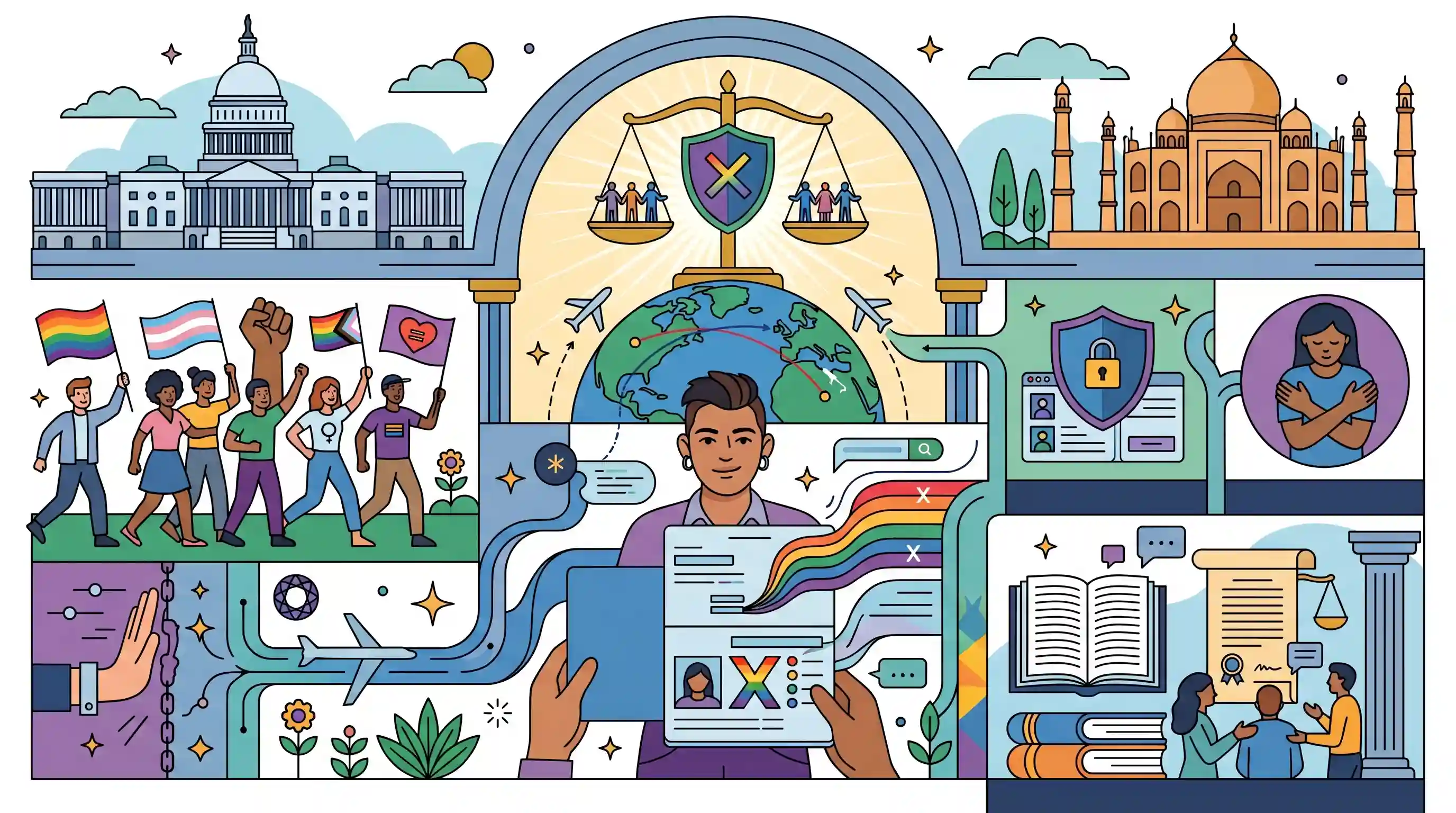
The article discusses recent regulatory updates regarding gender markers on US passports. It outlines how these administrative rules impact the ability of transgender and non-binary individuals to have their gender identity accurately reflected on official travel documents. The issue touches upon broader themes of bodily autonomy, the right to privacy, and the freedom of movement, raising important questions about the state's role in verifying versus accepting self-identified gender. For UPSC aspirants, this serves as a comparative international case study relevant to India's own constitutional debates on gender justice, LGBTQIA+ rights, and the implementation of the Transgender Persons Act following the landmark NALSA judgment.
Key Points
- New regulations governing US passports impact how individuals can select or update their gender markers, affecting transgender, intersex, and non-binary communities.
- The debate highlights the ongoing tension between bureaucratic state requirements (like biological sex recorded at birth) and the fundamental human right to self-identify one's gender.
- Accurate identity documents are essential for the right to freedom of movement; misgendering on passports can lead to profiling, harassment, or denial of travel.
- Globally, this aligns with legal battles for gender justice, paralleling India's NALSA vs. Union of India (2014) verdict which recognized the third gender and emphasized self-identification under Article 21 (Right to Life and Dignity).
Important Terms
Transgender Persons (Protection of Rights) Act, 2019

A 2019 law providing legal recognition to transgender individuals and prohibiting discrimination in education and employment. It mandates a District Magistrate-issued certificate for official identity, which critics argue undermines self-identification.
UPSC context
GS Paper II (Social Justice); tests knowledge of legislative frameworks for vulnerable sections and their constitutional alignment.
NALSA vs. Union of India (2014)
Landmark 2014 Supreme Court judgment recognizing the 'third gender' and affirming the right to self-identify gender as a fundamental right under Articles 14, 15, 19, and 21 of the Indian Constitution.
UPSC context
GS Paper II (Polity); central to questions on judicial activism and the expansion of fundamental rights.
Article 21 (Constitution of India)
Guarantees the right to life and personal liberty. The Supreme Court has interpreted this to include the right to live with dignity and the autonomy to choose one's gender identity.
UPSC context
GS Paper II (Constitution); foundational for understanding Fundamental Rights and judicial interpretation.
Gender Marker 'X'
A non-binary gender designation recognized by the International Civil Aviation Organization (ICAO). It allows individuals to travel with a gender marker that does not strictly conform to 'Male' or 'Female'.
UPSC context
GS Paper II (IR/Human Rights); relevant for international standards and comparative study of administrative laws.
Right to Privacy
Affirmed as a fundamental right in K.S. Puttaswamy (2017), it protects an individual’s bodily autonomy and the 'privacy of choice' regarding identity, including gender and sexual orientation.
UPSC context
GS Paper II (Polity); tests understanding of evolving rights in the digital and social justice eras.
US State Department
The U.S. federal agency responsible for foreign policy and passport issuance. In 2025, it implemented rules reverting markers to 'biological sex at birth,' sparking global legal and rights debates.
UPSC context
GS Paper II (International Relations); secondary agency context for comparative global policy analysis.
Prelims Trap
Under the Transgender Persons Act 2019, an individual can change their legal gender to 'male' or 'female' purely through self-declaration.
While a 'transgender' identity certificate is issued based on self-declaration, legally changing one's gender specifically to 'male' or 'female' requires proof of medical intervention (Section 7 of the Act).
Static Concepts Connected
How does the Transgender Persons Act 2019 regulate gender identity certification?
- Self-Declaration: A Certificate of Identity recognizing a person as 'transgender' is issued by the District Magistrate solely based on self-declaration, without medical proof.
- Revised Certificate: To explicitly change legal gender to 'male' or 'female', individuals must apply for a revised certificate requiring a medical certificate confirming gender-affirming medical intervention.
- Welfare & Criticism: The Act mandates non-discrimination in employment and education but has faced criticism for criminalizing begging, a traditional source of livelihood for marginalized trans communities.
What are the Yogyakarta Principles cited in Indian LGBTQIA+ jurisprudence?
- Core Definition: A foundational international framework applying global human rights law to issues of sexual orientation and gender identity (SOGI).
- Key Mandate: It strongly advocates for state recognition of self-identified gender without demanding mandatory medical or surgical interventions as a prerequisite.
- Indian Application: The Supreme Court heavily relied on these principles in the landmark NALSA (2014) and Navtej Singh Johar (2018) verdicts to expand Article 21 rights.
Cross-Topic Patterns
Bodily Autonomy & Right to Privacy
The progression from NALSA (2014) to Puttaswamy (2017) intertwined gender self-determination with the Right to Privacy. International rollbacks make comparative constitutional perspectives on bodily autonomy highly relevant for Mains.
Administrative Bureaucracy vs. Fundamental Rights
Insistence on 'biological sex' for travel documents mirrors the Aadhaar biometric debates—highlighting the friction between rigid state administrative architectures and dynamic fundamental human rights.

A 2026 Prelims multi-statement question will likely test the medical-proof caveat for male/female certification under the Transgender Act.
Linked PYQs · 3
Linked PYQs · 3
- 2023MainsGS2
Explain the constitutional perspectives of Gender Justice with the help of relevant Constitutional Provisions and case laws.
- 2024MainsGS2
Right to privacy is intrinsic to life and personal liberty and is inherently protected under Article 21 of the constitution. Explain. In this reference discuss the law relating to D.N.A. testing of child in the womb to establish its paternity.
- 2017MainsGS2
Examine the scope of Fundamental Rights in the light of the latest judgement of the Supreme Court on Right to Privacy.
