NATO Summit Addresses US Shift in European Defense
Source:The Hindu ↗
Why It Matters
This development marks a significant transformation of the post-WWII security architecture. The shift toward a transactional 'NATO 3.0' and the U.S. review of its European security commitments reshape global geopolitics. For India, NATO's growing interface with Indo-Pacific partners and the pressure on transatlantic ties are of high relevance, directly impacting regional security calculations, international law, and global multilateral alignments.
Summary
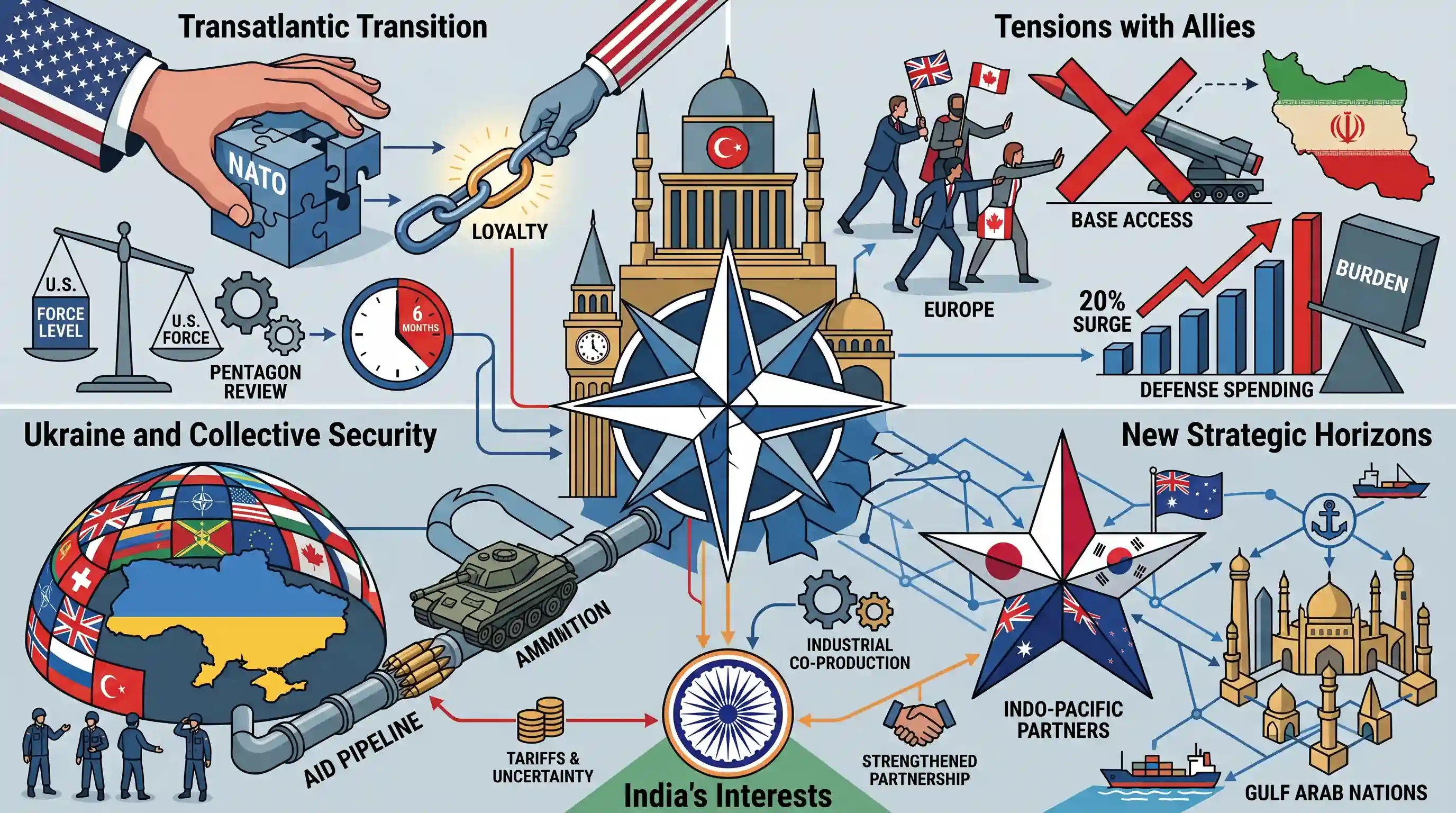
The 2026 NATO Summit in Ankara, Turkey, highlights a deep-seated transition in the transatlantic security alliance as the United States, under President Donald Trump, reassesses its traditional role in European defense. Proposing a reboot to 'NATO 3.0,' the Trump administration has demanded absolute 'loyalty' and initiated a six-month Pentagon review of U.S. force levels in Europe. Tensions have flared over European nations' refusal to allow the U.S. to use local bases for attacks on Iran, alongside persistent debates over burden-sharing despite a 20% surge in European and Canadian defense spending. Concurrently, the summit addresses long-term support for Ukraine and showcases NATO's deepening security ties with Indo-Pacific partners (Japan, South Korea, Australia, New Zealand) and Gulf Arab nations.
Key Points
- The July 2026 NATO Summit in Ankara, Turkey, hosted by President Recep Tayyip Erdogan, comes at a historic turning point marked by fragile trans-Atlantic bonds and a transactional U.S. foreign policy approach.
- The Trump administration has proposed a reboot to 'NATO 3.0,' demanding 'loyalty' from allies and criticizing major European members (Britain, France, Germany, Italy, and Spain) for refusing base access for U.S. strikes on Iran.
- While European allies and Canada increased their defense spending by 20% in 2025, U.S. President Trump continues to criticize their defense contributions, pointing to the disproportionate U.S. military budget ($901 billion or ~3.3% of GDP).
- The Pentagon has initiated a six-month review of the U.S. military presence in Europe, linking future deployments to European self-defense efforts, base access, and overflight clearances.
- European allies and Canada currently fund the majority of Ukraine's defensive needs, including approximately 90% of its air defense systems, as the conflict enters its fifth year.
- Expanding NATO's geopolitical scope, defense ministers are holding side meetings with Indo-Pacific partners (Japan, South Korea, Australia, New Zealand) and Gulf Arab countries, highlighting overlapping global security concerns.
Important Terms
NATO

An intergovernmental military alliance of 32 North American and European countries, established in 1949 by the Washington Treaty, committed to collective defense and security against external aggression.
UPSC context
Relevant for GS Paper II (International Relations - Global Groupings), testing understanding of global security architectures and India's strategic partnerships.
North Atlantic Treaty (Article 5)
The core collective defense clause of the 1949 North Atlantic Treaty, stating that an armed attack against one NATO member is considered an attack against all, triggering mutual assistance obligations.
UPSC context
Relevant for GS Paper II (International Relations), analyzing multilateral security treaties, deterrence frameworks, and international law on collective self-defense.
NATO-Ukraine Council
A joint collaborative body established in 2023 where NATO allies and Ukraine participate as equals to advance political dialogue, coordinate crisis consultations, and support Ukraine's integration aspirations.
UPSC context
Relevant for GS Paper II (Bilateral & Multilateral Groupings), testing knowledge of security mechanisms in the ongoing Russia-Ukraine conflict and geopolitical shifts.
Pentagon
The headquarters of the United States Department of Defense, symbolizing American military leadership, strategic planning, global force posture, and defense policy coordination.
UPSC context
GS Paper II (Effect of Policies of Developed Countries), evaluating U.S. global military adjustments and their regional security implications.
Prelims Trap
The Indo-Pacific Four (IP4) partners are covered under NATO's Article 5 collective defense security umbrella.
Article 5 is geographically restricted to the North Atlantic area (north of the Tropic of Cancer). Global partners like the IP4 or ICI countries do not receive collective defense guarantees, despite institutionalized summit partnerships.
Static Concepts Connected
What is NATO's Article 5 and its geographic limits?
- Collective Defense: An attack on one member is considered an attack on all, requiring collective self-defense action.
- Geographic Limit: Restricted to territories of member states in Europe, North America, and islands north of the Tropic of Cancer.
- Historical Invocation: Invoked only once in NATO history, following the September 11, 2001 terrorist attacks on the United States.
What is the Istanbul Cooperation Initiative (ICI)?
- Origin and Mandate: Launched at the 2004 Istanbul Summit to foster practical security cooperation with Middle Eastern nations.
- Membership: Active members include Bahrain, Kuwait, Qatar, and the United Arab Emirates (Saudi Arabia and Oman are not members).
- Core Objectives: Focuses on practical military-to-military cooperation, counter-terrorism, border security, and disaster management.
Cross-Topic Patterns
Atlantic-Pacific Security Convergence
NATO's institutionalized ties with the IP4 bridge Atlantic and Pacific security architectures, reflecting how European stability is now structurally linked to Indo-Pacific maritime deterrence.
Strategic Autonomy vs. Alliance Dependency
U.S. pressure on European allies for base access and burden-sharing highlights the risks of alliance dependency, reinforcing India's strategic choice of multi-alignment and strategic autonomy.

Shifting US defense guarantees and the formalization of NATO-IP4 ties will likely be tested as a multi-statement Prelims question on global alliances.
Linked PYQs · 2
Linked PYQs · 2
- 2023MainsGS2
‘The expansion and strengthening of NATO and a stronger US-Europe strategic partnership works well for India.’ What is your opinion about this statement ? Give reasons and examples to support your answer.
- 2025PrelimsGS1
Consider the following countries : I. Austria II. Bulgaria III. Croatia IV. Serbia V. Sweden VI. North Macedonia How many of the above are members of the North Atlantic Treaty Organization?
