Rafale M Deal and Its Implications for Indian Navy Indigenisation
Source:Indian Express ↗
Why It Matters
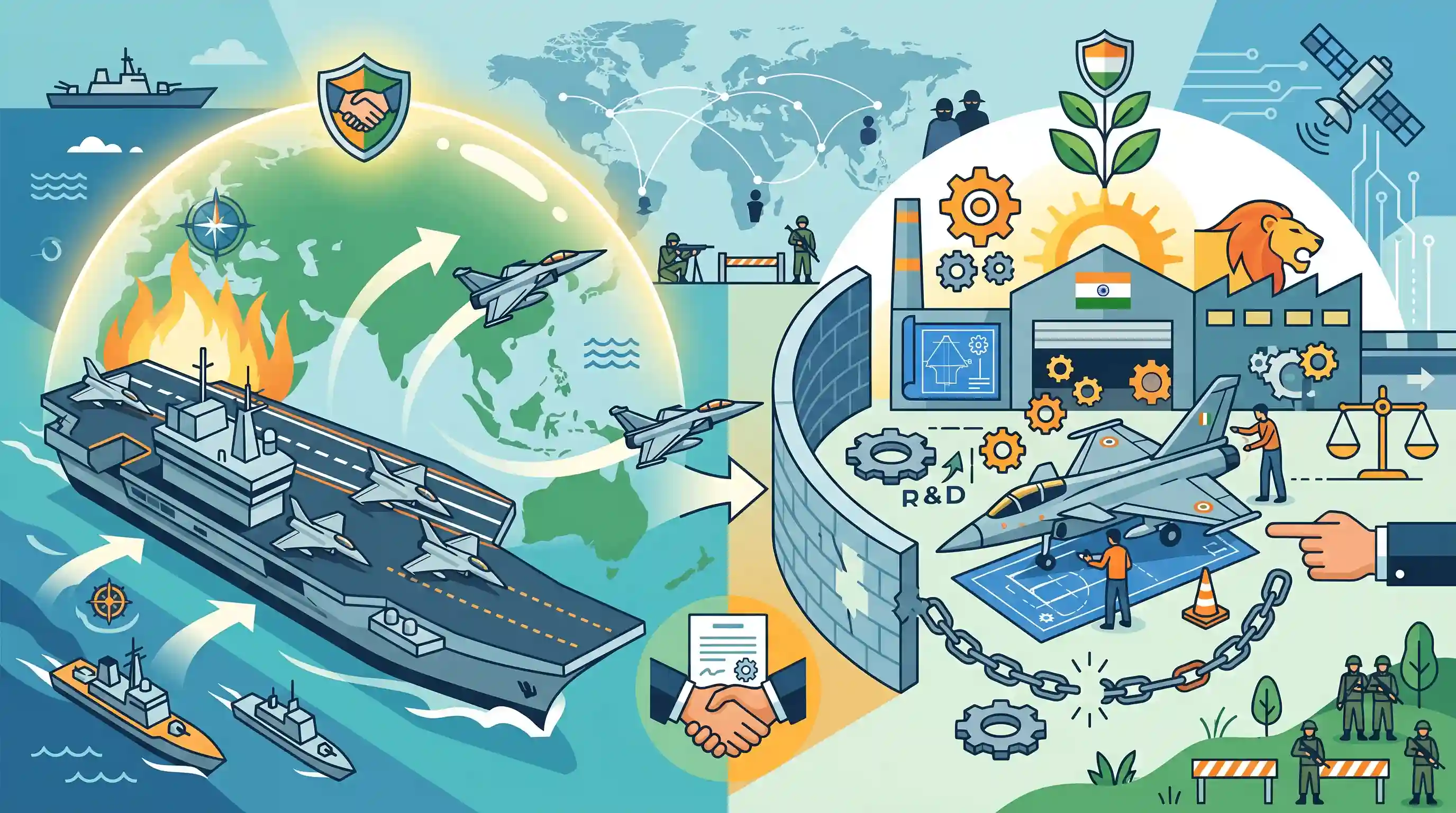
Defense procurement decisions are central to India's national security strategy. This deal highlights the tension between immediate operational readiness for maritime security and the long-term goal of self-reliance (Atmanirbhar Bharat) in defense manufacturing, a recurring theme in UPSC GS3 and GS2 papers.
Summary
The article examines the implications of the Rafale-M fighter jet deal for the Indian Navy. While the acquisition is crucial for equipping India's aircraft carriers like INS Vikrant and bolstering maritime deterrence in the Indo-Pacific, it also exposes ongoing vulnerabilities in India's defense indigenisation efforts. The continued reliance on foreign imports underscores a gap in domestic technological capabilities, emphasizing the need to expedite indigenous programs such as the Twin Engine Deck Based Fighter (TEDBF) to truly realize the vision of an 'Atmanirbhar' defense sector.
Key Points
- The Rafale-M deal fills a critical operational gap for the Indian Navy's aircraft carriers, notably INS Vikrant, which currently lacks adequate indigenous deck-based fighters.
- Acquiring these jets enhances India's maritime security, deterrence, and power projection capabilities across the strategically vital Indo-Pacific region.
- The procurement marks a significant step in deepening the Indo-French strategic partnership and bilateral defense cooperation.
- However, the reliance on off-the-shelf foreign defense imports highlights the persistent challenges and delays in defense indigenisation, running contrary to the core objectives of 'Atmanirbhar Bharat'.
- The situation underscores the urgent need to accelerate indigenous projects, specifically the development of the Twin Engine Deck Based Fighter (TEDBF), to achieve long-term self-reliance.
Important Terms
Atmanirbhar Bharat

A flagship government vision aiming to make India self-reliant by reducing import dependency and bolstering domestic manufacturing, particularly in strategic sectors like defense.
UPSC context
GS Paper III (Indigenization of Technology); analyzes India's transition from an arms importer to a self-reliant manufacturer.
Twin Engine Deck Based Fighter (TEDBF)
An indigenous, twin-engine carrier-based multirole fighter being developed by the ADA and HAL to eventually replace the Indian Navy's aging MiG-29K fleet.
UPSC context
GS Paper III (Defense Technology); vital for studying domestic aerospace capabilities and carrier-borne aviation.
Rafale-M
The naval variant of the Rafale jet designed for carrier operations, featuring reinforced landing gear, arrestor hooks, and maritime-tuned sensors.
UPSC context
GS Paper II (India-France Bilateral Relations) and GS Paper III (Security Challenges in the Indian Ocean).
INS Vikrant
India’s first indigenously designed and built aircraft carrier, representing a significant milestone in India's quest for complex maritime manufacturing capabilities.
UPSC context
GS Paper III (Make in India in Defense); tests knowledge of indigenous maritime platforms and blue-water naval strength.
Dassault Aviation
A French aerospace giant and manufacturer of the Rafale, serving as a key partner in India's defense modernization and indigenization programs.
UPSC context
GS Paper II (Strategic Partnerships); relevant for the role of foreign original equipment manufacturers (OEMs) in India.
STOBAR (Short Take-Off But Arrested Recovery)
A maritime launch and recovery system where aircraft use a ski-jump for takeoff and arrestor wires for landing, used on Indian carriers.
UPSC context
GS Paper III (Science & Technology); focuses on technical operational parameters of carrier-based aviation.
Prelims Trap
"INS Vikrant relies on a CATOBAR (catapult) system to launch heavy fighter aircraft like the Rafale-M."
INS Vikrant uses a STOBAR (ski-jump) system, not a catapult. Rafale-M had to undergo specific trials to prove it could launch from a ski-jump without catapult assistance.
Static Concepts Connected
What is the difference between STOBAR and CATOBAR systems on aircraft carriers?
- STOBAR: Short Take-Off But Arrested Recovery uses a ski-jump ramp. Aircraft rely on their own thrust to launch. Both INS Vikramaditya and INS Vikrant use this.
- CATOBAR: Catapult Assisted Take-Off uses steam or electromagnetic catapults (EMALS) to launch heavier, fully armed jets. It is used by the US Navy, not currently by India.
How does the Defence Acquisition Procedure (DAP) prioritize military procurement?
- Buy (Indian-IDDM): Indigenously Designed, Developed and Manufactured (IDDM) is the highest priority category, designed to enforce 'Atmanirbhar Bharat' in defense manufacturing.
- Buy (Global): Outright purchase from foreign vendors to fill critical operational gaps. The off-the-shelf Rafale-M purchase falls under foreign procurement routes, bypassing indigenous priority.
Cross-Topic Patterns
Import Dependency vs Strategic Autonomy
The Rafale-M buy highlights the tension between immediate operational readiness for the Indo-Pacific and long-term goals of 'Atmanirbhar' capability building (TEDBF).
The Indo-French Maritime Axis
Deepening defence ties (Rafale, Scorpène submarines) position France as India's primary independent strategic partner in countering China's naval expansion in the Indian Ocean.

Expect a 2026 Prelims question comparing STOBAR (INS Vikrant) vs CATOBAR, paired with statements on indigenous projects like TEDBF.
Linked PYQs · 4
Linked PYQs · 4
- 2022MainsGS3
What are the maritime security challenges in India ? Discuss the organisational, technical and procedural initiatives taken to improve the maritime security.
- 2025MainsGS3
Why is maritime security vital to protect India's sea trade? Discuss maritime and coastal security challenges and the way forward.
- 2014MainsGS3
Foreign Direct Investment (FDI) in the defence sector is now set to be liberalized. What influence this is expected to have on Indian defence and economy in the short and long run?
- 2020MainsGS2
What is the significance of Indo-US defence deals over Indo-Russian defence deals? Discuss with reference to stability in the Indo-Pacific region.
