E100 Vehicle Rules and Ethanol Fuel Transition in India
Source:The Hindu ↗
কেন এটি গুরুত্বপূর্ণ
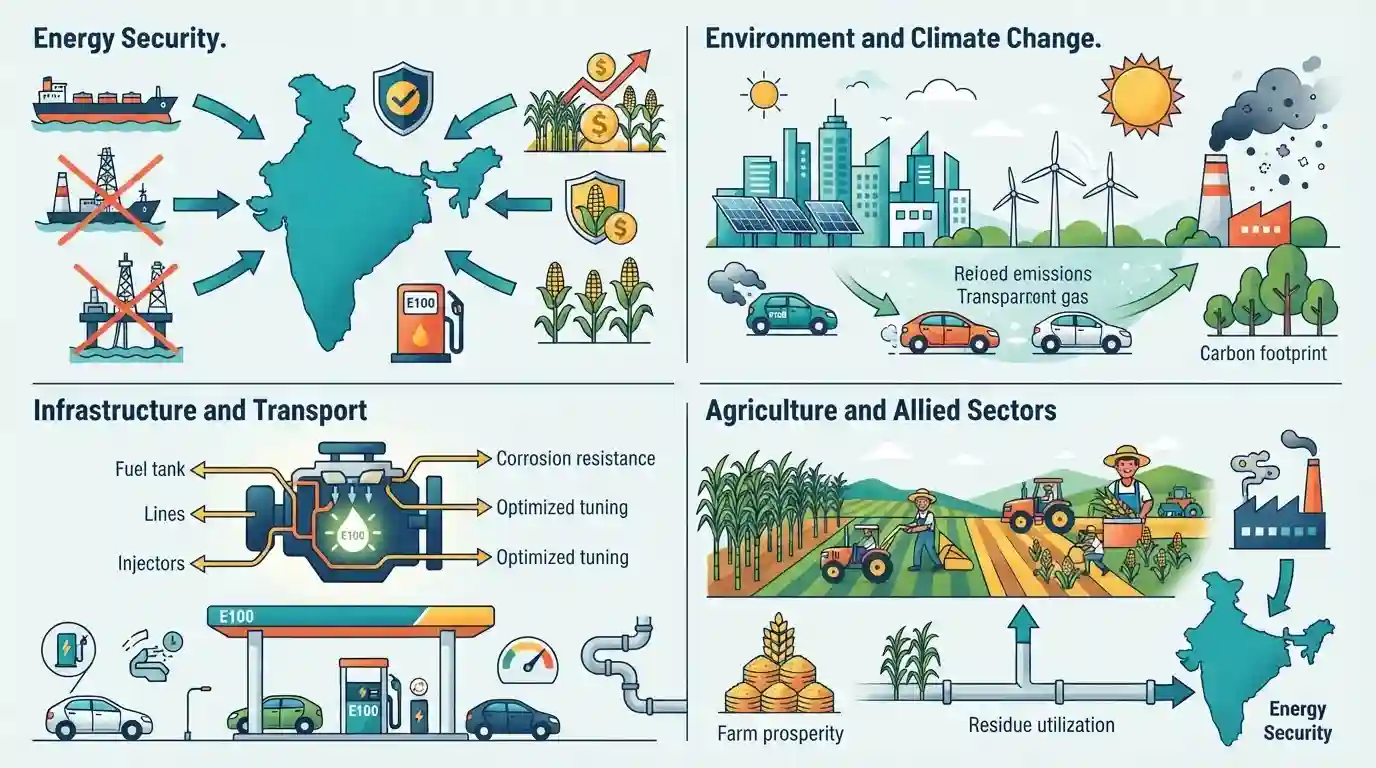
The transition to high-blend ethanol (E100) is crucial for India's strategic push towards reducing crude oil import dependency, fulfilling climate pledges, and boosting the agricultural economy through alternate fuel markets.
সারসংক্ষেপ
An analysis of the new E100 (100% ethanol) vehicle rules in India, detailing their implications for energy security, decarbonization, technical modifications required in flex-fuel vehicles, and the challenges in scaling up infrastructure.
মূল বিষয়
- India introduced new vehicle rules for E100 (100% ethanol fuel), marking a major shift towards flexible-fuel and high-blend ethanol vehicles.
- E100 vehicles help reduce carbon emissions, lower crude oil import bills, and support domestic sugarcane and grain farmers.
- Key challenges include engine durability, cold-start issues, corrosion management, and establishing a widespread retail dispensing infrastructure for E100.
- Aligns with India's broader net-zero commitments and energy independence goals by 2047.
গুরুত্বপূর্ণ শব্দ
National Policy on Biofuels

A comprehensive framework introduced by the Government of India to promote the production and use of biofuels, aiming to enhance energy security, reduce crude oil imports, and support agricultural incomes through blending targets.
UPSC context
Important for GS Paper III (Economy, Environment, and Energy Security). Evaluates India's alternate energy transition and climate commitments.
Ministry of Road Transport and Highways
The apex central government ministry in India responsible for formulating policies, rules, and regulations concerning road transport, national highways, and automotive safety standards.
UPSC context
Relevant for GS Paper II (Governance) and GS Paper III (Infrastructure and Transport). Tests regulatory frameworks for vehicle standards and transport.
Automotive Industry Standards Committee
A committee under the Central Motor Vehicles Rules Technical Standing Committee that prepares and recommends safety and technical standards for the Indian automotive industry.
UPSC context
Useful for GS Paper III (Infrastructure, Science and Technology). Tests technical compliance bodies for new fuel vehicle rules and emissions.
প্রিলিমস ফাঁদ
E100 and E85 fuels can be utilized across all existing modern petrol-powered vehicles if blended gradually.
Aspirants often assume E100/E85 can be used in existing petrol or E20 vehicles without modification; however, rules restrict high blends solely to certified Flex-Fuel Vehicles with corrosion-resistant fuel systems.
সংযুক্ত স্থির ধারণা
What are the key objectives and provisions under India's National Policy on Biofuels?
- Classification: Categorizes biofuels into Basic biofuels (First Generation bioethanol/biodiesel) and Advanced biofuels (Second/Third Generation, algae, bio-CNG) to incentivize financial assistance.
- Feedstock Expansion: Expands feedstock range for ethanol production to include surplus food grains like damaged food grains, broken rice, and maize, augmenting farmer incomes.
- Blending Targets: Targeted blending roadmaps accelerating petrol-ethanol blending to 20% (E20) ahead of schedule while laying the legal foundation for E85 and E100.
আন্তঃবিষয় প্যাটার্ন
Biofuels bridging agriculture and energy security
Ethanol blending programs create critical overlaps between agrarian surplus management (MSP, FCI grain stocks) and external sector import bill reduction.
Decarbonizing transport through flex-fuel standards
High-blend ethanol transitions require massive powertrain redesigns, tying automotive engineering standards directly to India's 2070 net-zero targets.

E100/flex-fuel rules + National Policy on Biofuels targets likely to appear as a matching or statement-based prelims question.
সংযুক্ত PYQ · 3
সংযুক্ত PYQ · 3
- 2025PrelimsGS1
Consider the following statements : Statement I: Of the two major ethanol producers in the world, i.e., Brazil and the United States of America, the former produces more ethanol than the latter. Statement II: Unlike in the United States of America where corn is the principal feedstock for ethanol production, sugarcane is the principal feedstock for ethanol production in Brazil. Which one of the following is correct in respect of the above statements?
- 2020PrelimsGS1
According to India's National Policy on Biofuels, which of the following can be used as raw materials for the production of biofuels ? 1. Cassava 2. Damaged wheat grains 3. Groundnut seeds 4. Horse gram 5. Rotten potatoes 6. Sugar beet Select the correct answer using the code given below:
- 2025MainsGS3
How can India achieve energy independence through clean technology by 2047? How can biotechnology can play a crucial role in this endeavour?
