New E100 vehicle rules promote 100 percent ethanol fuel use
Source:The Hindu ↗
Why It Matters
As India accelerates its ethanol blending roadmap (moving towards E20 and exploring E100 vehicles), understanding the regulatory framework, economic implications, and infrastructure bottlenecks is vital for aspirants tracking India's green energy transition and sustainable development goals.
Summary
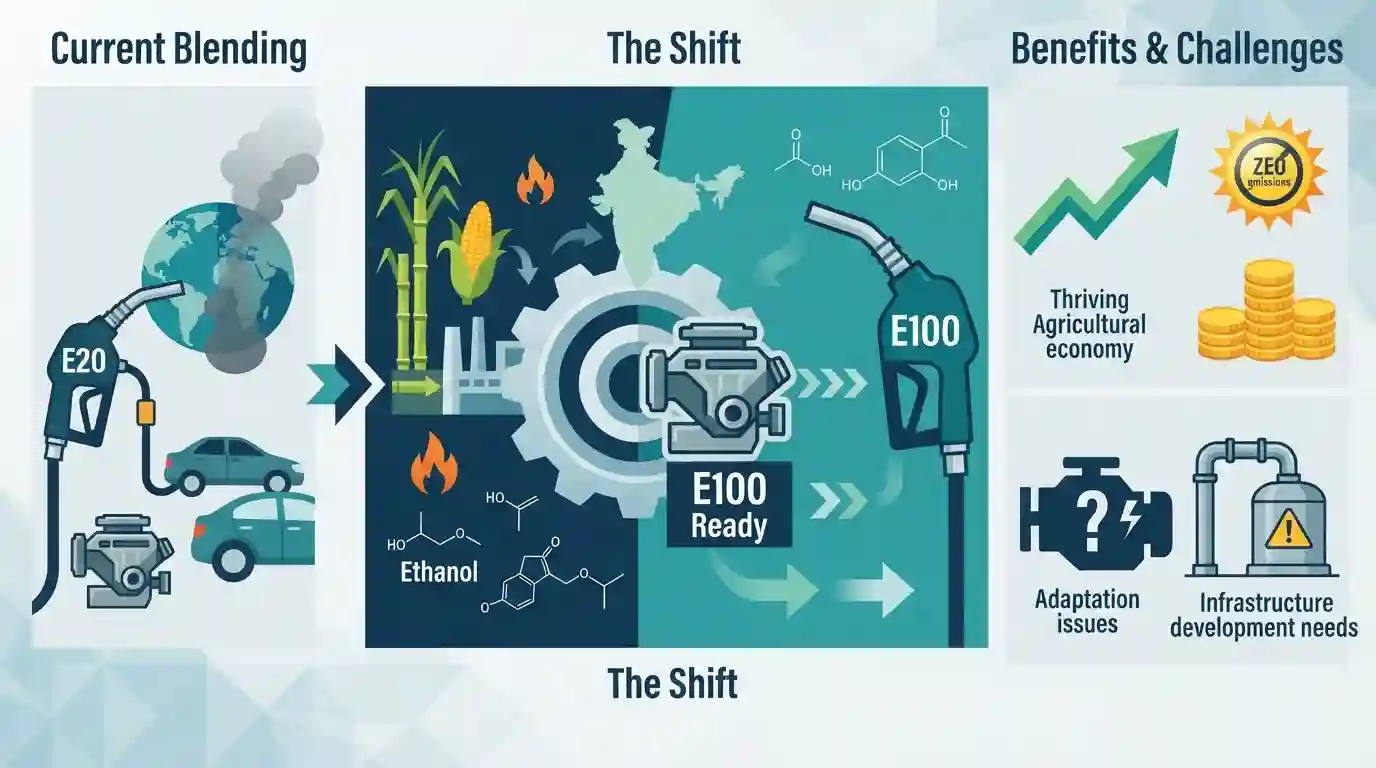
The article explains the newly introduced E100 vehicle rules, which facilitate the use of 100% ethanol fuel in motor vehicles in India. It highlights the strategic shift from blending lower percentages (like E20) to full ethanol adoption, its benefits for energy security, lower carbon footprints, and agricultural economy, alongside infrastructure and engine compatibility challenges.
Key Points
- New vehicle regulations for E100 (100% ethanol fuel) vehicles aim to promote higher biofuel adoption, aligning with India's broader climate and energy transition goals.
- E100 usage reduces import dependency for crude oil, lowers greenhouse gas emissions, and provides alternate income streams for farmers through agricultural feedstocks.
- Key challenges for widespread E100 adoption include retrofitting existing engines, modifying fuel infrastructure (retail distribution networks), and securing consistent feedstock supplies without affecting food security.
Important Terms
E100 Vehicle Rules

Regulations notified under the Central Motor Vehicles Rules to permit the use of 100% ethanol (E100) fuel in specially certified flex-fuel vehicles, aiming to cut emissions and oil imports.
UPSC context
UPSC Prelims/Mains (GS Paper III): Important government policies, infrastructure regulations, and measures for energy security and sustainable transportation.
National Policy on Biofuels
A policy framework aimed at reducing India's crude oil import dependency, lowering carbon footprints, and supporting agricultural economies by promoting the blending and production of biofuels.
UPSC context
UPSC Prelims/Mains (GS Paper III): Key policy interventions for energy security, climate change mitigation, and agricultural development.
Prelims Trap
Vehicles designed for E20 petrol blends can easily run on E100 fuel with minor software recalibrations.
Aspirants often assume that vehicles compatible with E20 (20% ethanol blend) can safely run on E100 or E85. In reality, pure ethanol requires completely specialized engine materials, corrosion-resistant seals, and distinct fuel injection calibrations.
Static Concepts Connected
What are the key generations of biofuels and their primary feedstocks?
- 1G Biofuels:: First Generation derived from food crops like sugarcane, corn, and starch, raising food security and land-use debate.
- 2G Biofuels:: Second Generation sourced from non-food agricultural residues, bagasse, and municipal solid wastes, minimizing direct food-fuel competition.
- 3G & 4G:: Third and Fourth Generations utilize microalgae and genetically modified crops designed to capture carbon dioxide.
Cross-Topic Patterns
Biofuels & Food Security Dilemma
Ethanol blending targets directly intersect with minimum support prices (MSP), paddy diversion, and surplus sugar cane management, balancing farm incomes with water-table depletion concerns in northwestern states.
Automotive Engineering & Material Science Limits
The shift from E20 to E100 highlights the engineering and material science hurdles of corrosive alcohol fuels, demanding specialized elastomers and fuel-injection electronics.

E100 vehicle rules + National Policy on Biofuels amend-tracking will likely feature in a multi-statement environment/economy combo Q.
Linked PYQs · 3
Linked PYQs · 3
- 2025MainsGS3
How can India achieve energy independence through clean technology by 2047? How can biotechnology can play a crucial role in this endeavour?
- 2025PrelimsGS1
Consider the following statements : Statement I: Of the two major ethanol producers in the world, i.e., Brazil and the United States of America, the former produces more ethanol than the latter. Statement II: Unlike in the United States of America where corn is the principal feedstock for ethanol production, sugarcane is the principal feedstock for ethanol production in Brazil. Which one of the following is correct in respect of the above statements?
- 2020PrelimsGS1
According to India's National Policy on Biofuels, which of the following can be used as raw materials for the production of biofuels ? 1. Cassava 2. Damaged wheat grains 3. Groundnut seeds 4. Horse gram 5. Rotten potatoes 6. Sugar beet Select the correct answer using the code given below:
