Scientific Community Perspectives on Research Funding Allocations
Source:The Hindu ↗
Why It Matters
R&D funding and science policy are core to India's aspirations of becoming a developed nation and a global innovation hub. This topic is crucial for GS3 (Science & Technology, Economic Growth) and GS2 (Education, Human Resources), as it links government funding, private sector participation, and administrative reforms to the ease of doing science.
Summary
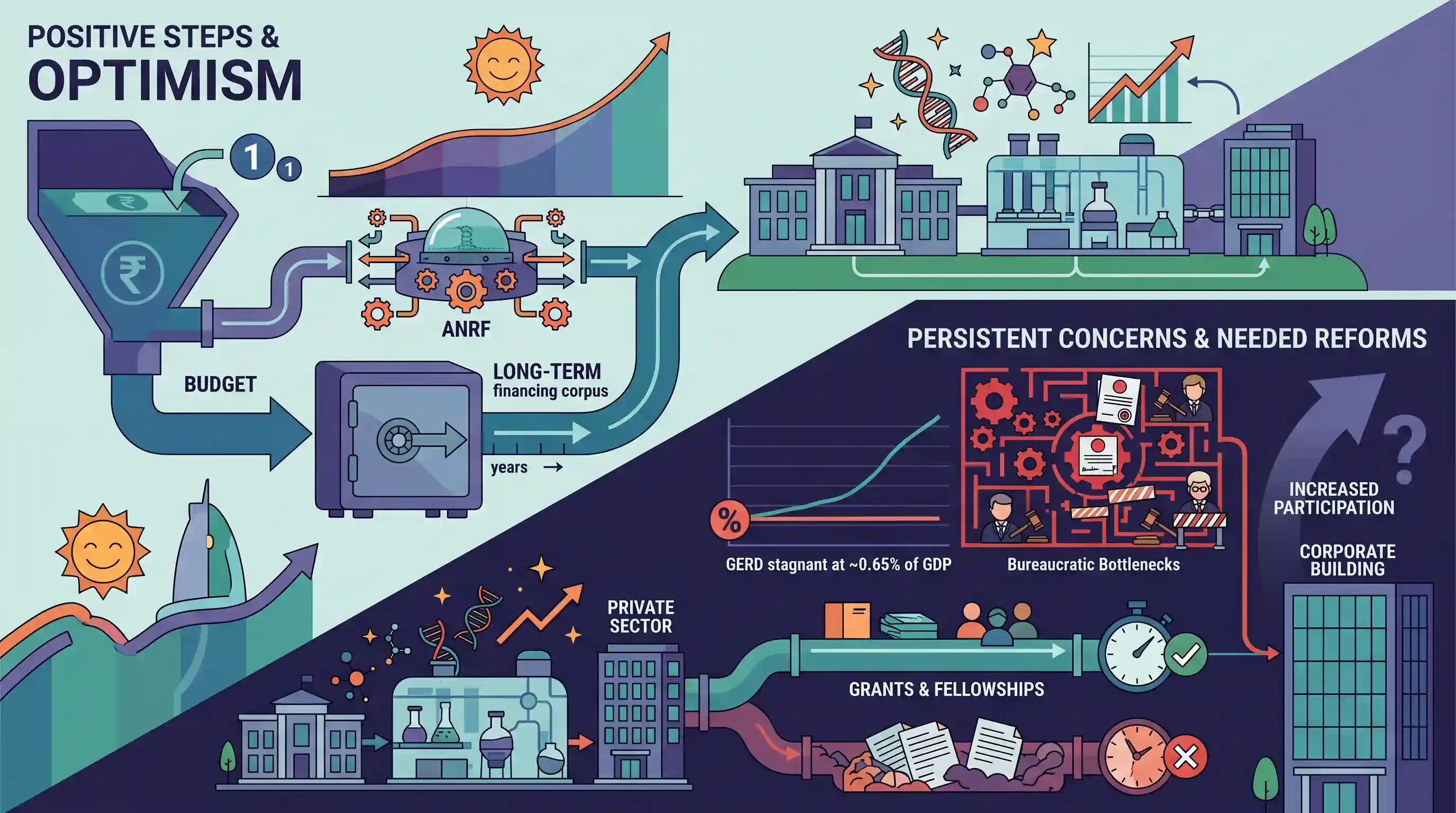
Leading Indian scientists highlight a mix of optimism and persistent concerns regarding the Union Budget's allocation for Research and Development (R&D). While initiatives like the Anusandhan National Research Foundation (ANRF) and a ₹1-lakh crore corpus for long-term R&D financing are seen as positive steps, the fundamental issue of underfunding remains. India's Gross Expenditure on R&D (GERD) is stagnant at ~0.65% of GDP. Scientists emphasize that structural reforms are urgently needed to tackle bureaucratic bottlenecks, ensure timely disbursal of grants and fellowships, and significantly increase private sector participation in the scientific research ecosystem.
Key Points
- India's Gross Expenditure on R&D (GERD) remains stagnant at roughly 0.65% of GDP, far below the global average and the 2% target set by successive governments.
- The establishment of the Anusandhan National Research Foundation (ANRF) is welcomed, but scientists stress the need for swift operationalization and adequate, sustained budgetary support.
- A ₹1-lakh crore corpus to provide long-term, interest-free or low-interest financing is expected to incentivize private sector participation in deep tech and sunrise sectors.
- Bureaucratic hurdles, including delays in disbursing approved grants and fellowships, and complex procurement rules, significantly hinder the 'ease of doing science'.
- Unlike developed nations where the private sector drives R&D funding, India's private sector contributes only about 36% to total R&D, necessitating policy nudges to boost industry-academia collaboration.
Important Terms
Anusandhan National Research Foundation (ANRF)

A statutory apex body established in 2023 to provide high-level strategic direction for scientific research, innovation, and entrepreneurship, subsuming the Science and Engineering Research Board (SERB).
UPSC context
GS Paper 3: Science & Technology; critical for questions on research governance and industry-academia collaboration.
Gross Expenditure on R&D (GERD)
The total amount spent on research and development within a country, currently approximately 0.65% of GDP for India, significantly below the global average of 1.8%.
UPSC context
GS Paper 3: Economic Development and S&T; a key indicator for measuring innovation intensity and funding gaps.
National Education Policy 2020 (NEP 2020)
A 2020 policy framework that envisions transformational reforms in Indian education, specifically recommending the creation of the National Research Foundation to foster a multidisciplinary research culture.
UPSC context
GS Paper 2: Social Justice (Education); fundamental for understanding structural shifts in higher education and research.
Department of Science and Technology (DST)
A nodal department under the Ministry of Science and Technology that formulates policies, promotes new areas of science, and coordinates scientific activities across India.
UPSC context
GS Paper 3: S&T; central to discussions on government initiatives, scholarships, and institutional infrastructure.
Council of Scientific and Industrial Research (CSIR)
India's largest public R&D organization, established in 1942, operating a pan-India network of 37 laboratories focused on industrial research and technology development.
UPSC context
GS Paper 3: S&T; relevant for achievements in indigenous technology (e.g., Atmanirbhar Bharat) and institutional history.
Department of Biotechnology (DBT)
A department within the Ministry of Science and Technology responsible for administrating and promoting R&D in modern biology, healthcare, and agricultural biotechnology.
UPSC context
GS Paper 3: S&T; critical for topics related to vaccines, genomics, and the bio-economy.
Prelims Trap
The private sector contributes the majority of India's total Gross Expenditure on R&D (GERD).
Globally, the private sector drives R&D (>70%). However, in India, the government contributes the majority of funding, while the private sector accounts for only ~36%.
Static Concepts Connected
What are the structural features of the Anusandhan National Research Foundation (ANRF) Act, 2023?
- Subsumes SERB: It formally repeals and subsumes the Science and Engineering Research Board (SERB) Act, 2008 to centralize research ecosystem funding.
- Private funding target: Out of the ₹50,000 crore allocation (2023-28), roughly ₹36,000 crore (over 70%) is targeted to be raised from non-government and industry sources.
- Executive structure: The Prime Minister is the ex-officio President of the Governing Board, while the Principal Scientific Adviser chairs the Executive Council.
What are the persistent structural issues with India's Gross Expenditure on R&D (GERD)?
- Stagnant GDP ratio: It has hovered around 0.65% of GDP for over a decade, consistently missing the government's long-standing target of reaching 2%.
- Strategic dominance: The bulk of government R&D expenditure is concentrated in mission-mode strategic agencies (DRDO, Space, Atomic Energy), leaving civilian universities underfunded.
- Ease of science: Bureaucratic bottlenecks, complex procurement rules, and delayed fellowship disbursals severely hamper the 'ease of doing science'.
Cross-Topic Patterns
Deep Tech & ₹1-Lakh Crore Corpus
The 50-year interest-free loan corpus specifically targets 'sunrise sectors', linking GS3 technology indigenization directly with GS3 investment models and alternative financing.
R&D spending and India's Patent profile
Low GERD and inadequate university funding correlate directly with India's skewed resident-patent filing ratio, a recurring theme in recent Economic Surveys evaluating the broader innovation ecosystem.

A multi-statement question comparing ANRF's private funding targets with India's current GERD distribution is highly probable for 2026.
Linked PYQs · 5
Linked PYQs · 5
- 2016MainsGS3
Discuss India's achievements in the field of Space Science and Technology. How the application of this technology has helped India in its socio-economic development?
- 2016MainsGS3
Why is nanotechnology one of the key technologies of the 21st century? Describe the salient features of Indian Government's Mission on Nanoscience and Technology and the scope of its application in the development process of the country.
- 2020MainsGS2
National Education Policy 2020 is in conformity with the Sustainable Development Goal-4 (2030). It intends to restructure and reorient education system in India. Critically examine the statement.
- 2015MainsGS2
The quality of higher education in India requires major improvements to make it internationally competitive. Do you think that the entry of foreign educational institutions would help improve the quality of higher and technical education in the country? Discuss.
- 2021MainsGS3
“Investment in infrastructure is essential for more rapid and inclusive economic growth.” Discuss in the light of India's experience.
