Bat immunology and zoonotic viral spillover mechanisms
Source:Indian Express ↗
Why It Matters
Understanding bat immunology and the ecological drivers of zoonotic spillover is essential for GS-3 (Science & Tech and Environment). The increasing frequency of Nipah virus outbreaks in India (e.g., Kerala) makes the topic highly relevant for both Prelims and Mains.
Summary
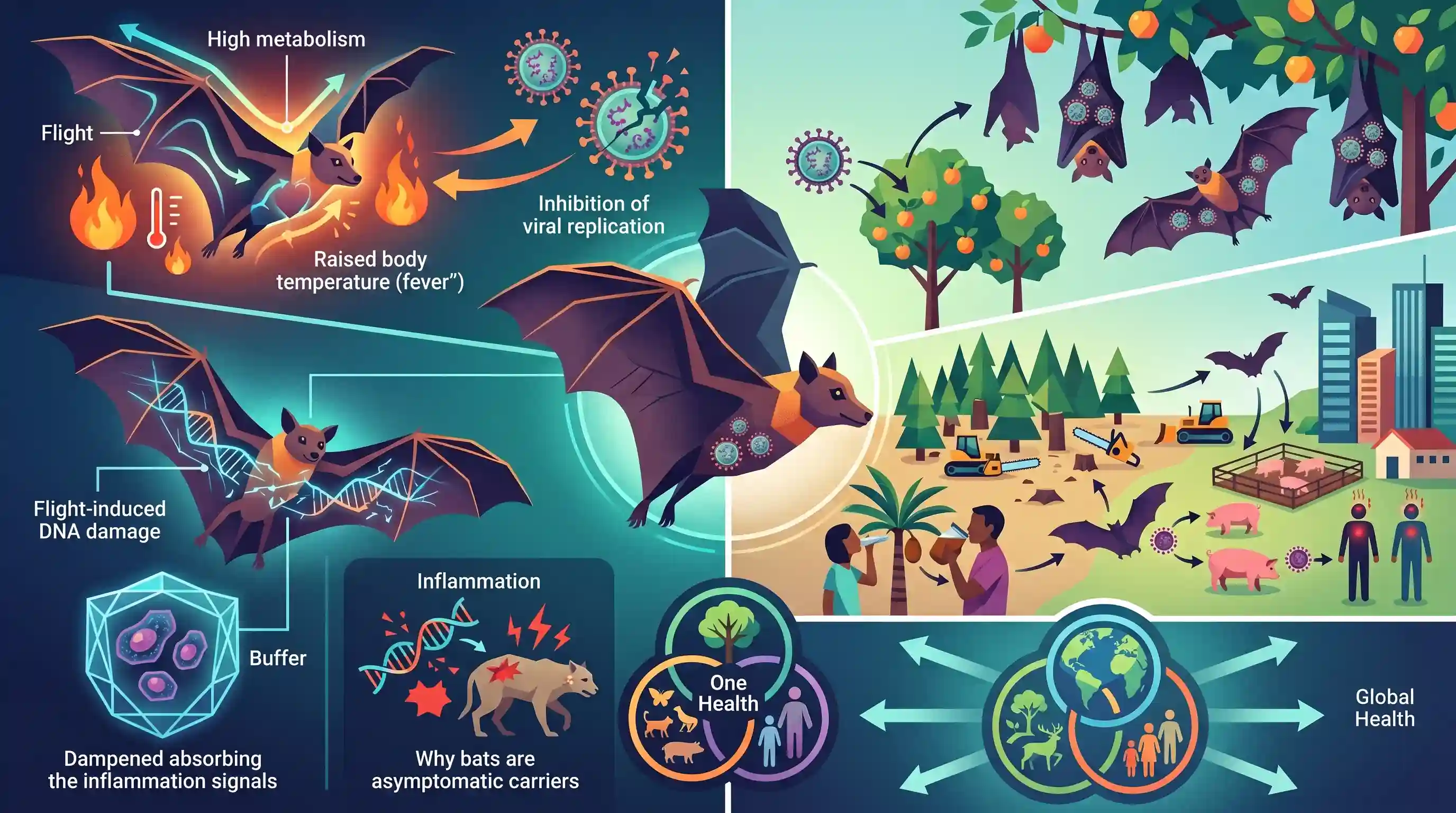
The article explains the biological and ecological reasons why bats are key reservoirs for deadly zoonotic diseases like the Nipah virus. Bats possess a unique immune system shaped by their ability to fly; the high metabolism required for flight raises their body temperature, acting as a natural 'fever' that inhibits viral replication. Additionally, bats have evolved dampened inflammatory responses to survive flight-induced DNA damage, preventing them from falling sick from the viruses they harbor. Nipah, carried primarily by fruit bats, spills over to humans when habitats are encroached upon, underscoring the urgent need to address deforestation and adopt a One Health approach to prevent future pandemics.
Key Points
- Bats serve as major reservoirs for lethal zoonotic viruses like Nipah, Ebola, and Coronaviruses because their unique immune systems allow them to carry pathogens without developing the disease.
- The high metabolic demands of flight raise a bat's body temperature, mimicking a fever that naturally suppresses viral replication.
- To survive flight-induced DNA damage, bats have evolved an enhanced DNA repair mechanism and a dampened inflammatory response, which prevents them from suffering fatal cytokine storms when infected by viruses.
- Nipah virus is naturally hosted by fruit bats (Pteropus species) and frequently spills over to humans through the consumption of partially eaten fruits or contaminated date palm sap.
- Deforestation, climate change, and human encroachment into bat habitats are increasing human-bat interactions, raising the frequency of zoonotic spillover events.
Important Terms
One Health Approach

A collaborative framework recognizing the interconnectedness of human, animal, and environmental health to achieve optimal public health outcomes and prevent potential pandemics.
UPSC context
GS Papers 2 and 3; tests understanding of integrated health governance, pandemic preparedness, and interdisciplinary scientific coordination.
Zoonotic Diseases
Infectious diseases or infections naturally transmissible between vertebrate animals and humans, comprising roughly 75% of all emerging infectious diseases globally.
UPSC context
GS Paper 3; tests knowledge of disease transmission pathways, public health threats, and anthropogenic factors like habitat encroachment.
Nipah Virus (NiV)
A deadly zoonotic virus carried by fruit bats; it causes severe respiratory illness and fatal encephalitis in humans, with no currently approved vaccine.
UPSC context
GS Paper 3; relevant for Science & Technology developments and public health challenges, specifically recurring outbreaks in Kerala and West Bengal.
Reservoir Host
A population or specific environment where a pathogen naturally persists and reproduces without causing severe disease, serving as a source for spillover to humans.
UPSC context
GS Paper 3; tests understanding of ecological factors in disease emergence and the role of specific wildlife in global health security.
ICMR (Indian Council of Medical Research)
India’s apex body for formulating, coordinating, and promoting biomedical research; it spearheads the National One Health Mission for zoonotic disease surveillance and diagnostic development.
UPSC context
GS Paper 2; tests knowledge of national health institutions and their role in research, policy-making, and disease management in India.
WHO (World Health Organization)
The UN specialized agency for international public health that coordinates global responses to health emergencies and lists Nipah as a priority pathogen.
UPSC context
GS Paper 2; tests understanding of international organizations and global health governance in managing transboundary zoonotic threats.
Prelims Trap
Bats carry multiple zoonotic viruses because their weak immune systems cannot clear viral infections.
Bats actually have highly evolved immune systems with dampened inflammatory responses. They tolerate viruses without falling sick, acting as resilient reservoirs, not vulnerable victims.
Static Concepts Connected
What is a zoonotic spillover and why are RNA viruses common culprits?
- Zoonosis: Diseases naturally transmitted from vertebrate animals to humans, such as Nipah, rabies, and Ebola.
- Spillover event: Occurs when a pathogen from a reservoir host jumps to and successfully infects a novel host species (e.g., bats to humans).
- RNA virus adaptability: High mutation rates and lack of proofreading mechanisms in RNA viruses allow rapid genetic adaptation to new host environments.
What are the core components of the One Health approach?
- Interconnected health: Recognizes that human health, animal health, and ecosystem health are inextricably linked and interdependent.
- Multisectoral alliance: Global coordination led by the Quadripartite (WHO, FAO, WOAH, and UNEP) to prevent, predict, and respond to health threats.
- Core focus areas: Primarily addresses emerging zoonotic diseases, antimicrobial resistance (AMR), vector-borne diseases, and food safety.
Cross-Topic Patterns
Habitat loss driving zoonotic spillovers
Deforestation forces fruit bats into agricultural zones, increasing human-wildlife overlap and facilitating direct zoonotic transmission. Connects biodiversity loss directly to public health and emerging epidemics.
Cytokine storms in human immunology
Bats evolved dampened inflammation to prevent cytokine storms. In contrast, cytokine storms—a hyperactive immune response causing fatal tissue damage—are a primary cause of human mortality in viral infections.

Expect a multi-statement question linking bat immunology (flight metabolism, DNA repair) with RNA virus reservoirs and zoonotic spillover.
Linked PYQs · 2
Linked PYQs · 2
- 2024PrelimsGS1
With reference to monoclonal antibodies, often mentioned in news, consider the following statements : I. They are man-made proteins. II. They stimulate immunological function due to their ability to bind to specific antigens. III. They are used in treating viral infections like that of Nipah virus. Which of the statements given above are correct?
- 2022MainsGS3
What is the basic principle behind vaccine development ? How do vaccines work? What approaches were adopted by the Indian vaccine manufacturers to produce COVID-19 vaccines ?
