Ethanol Blending Beyond E20 and Energy Transition Challenges
Source:The Hindu ↗
কেন এটি গুরুত্বপূর্ণ
It evaluates India's energy transition strategy, balancing energy security, agricultural dynamics, and ecological sustainability under the Ethanol Blending Programme.
সারসংক্ষেপ
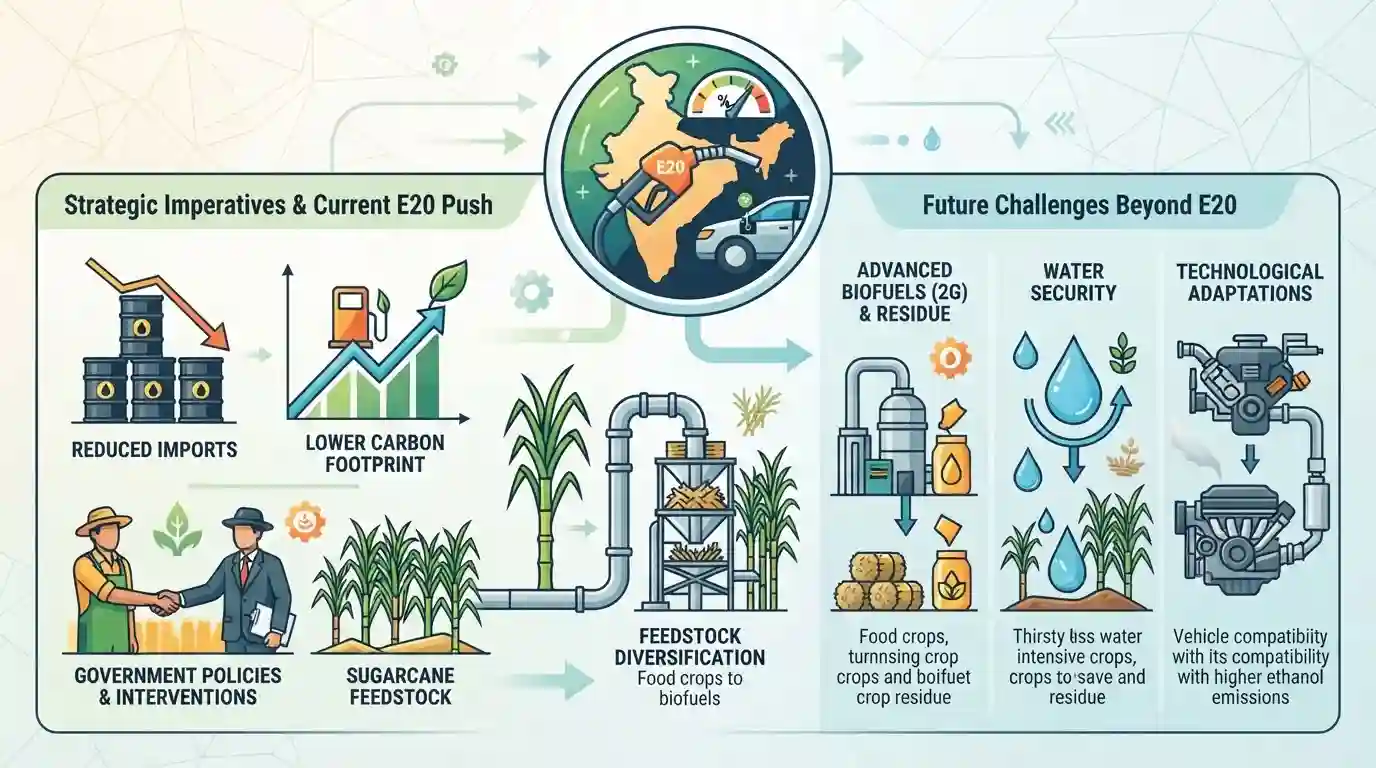
The article examines India's aggressive push toward the E20 ethanol blending target (20% ethanol blended with petrol) and analyzes the strategic imperatives, environmental trade-offs, and future challenges that lie beyond this milestone. While the E20 roadmap helps reduce crude import bills and carbon footprints, moving past E20 requires addressing critical issues such as feedstock diversification (shifting from food crops to agricultural residue/2G biofuels), water security, and technological adaptations in automotive engines.
মূল বিষয়
- India's accelerated E20 ethanol blending push aims to curb crude oil import dependence, reduce carbon emissions, and provide alternate revenue to farmers.
- Beyond 20% blending (E20), challenges emerge regarding feedstock availability, potential competition with food security (sugarcane, grains), water intensity of crops, and vehicular engine adaptability.
- Transitioning to advanced biofuels (2G/3G) from agricultural waste and non-food biomass is crucial for long-term sustainable energy security without stressing land and water resources.
গুরুত্বপূর্ণ শব্দ
E20 Ethanol Blending Programme

An Indian government initiative targeting a 20% blend of anhydrous ethanol with petrol to reduce crude oil import dependence, lower carbon emissions, and support agricultural income through biofuel integration.
UPSC context
Important for GS Paper III (Energy Security, Environment and Conservation). Tests knowledge of India's green energy transition, foreign exchange savings, and climate commitments.
National Policy on Biofuels
A policy framework introduced by the Ministry of Petroleum and Natural Gas to promote biofuels, encourage feedstock diversification from food crops to second-generation residues, and reduce fossil fuel reliance.
UPSC context
Crucial for GS Paper III (Government Policies and Interventions, Agriculture). Evaluates policy mechanisms balancing food security, farmer incomes, and sustainable energy targets.
সংযুক্ত স্থির ধারণা
What are the key classifications of biofuels and their primary feedstocks under the National Policy on Biofuels?
- 1G Biofuels:: First Generation (1G): Derived from food sources such as sugarcane, corn, and grains, raising food security concerns.
- 2G Biofuels:: Second Generation (2G): Produced from non-food biomass, agricultural residues (stubble), and cellulosic material.
- 3G Biofuels:: Third Generation (3G): Utilizes microalgae and aquatic biomass grown in non-arable waters.
- 4G Biofuels:: Fourth Generation (4G): Employs genetically engineered crops or carbon capture technologies for net-negative emissions.
আন্তঃবিষয় প্যাটার্ন
Biofuels vs Food Security Trade-offs
Diverting sugarcane and surplus food grains for fuel production directly impacts buffer stocks, creating tension between the National Policy on Biofuels and the National Food Security Act.
2G Biofuels and Stubble Burning Mitigation
Agri-residue burning in north-west India can be mitigated by incentivizing straw collection for 2G refineries, linking clean energy transition directly with urban air quality management.

Expect statement-based questions on 1G vs 2G biofuels, blending targets, and food vs fuel security trade-offs in Prelims.
সংযুক্ত PYQ · 3
সংযুক্ত PYQ · 3
- 2020PrelimsGS1
According to India's National Policy on Biofuels, which of the following can be used as raw materials for the production of biofuels ? 1. Cassava 2. Damaged wheat grains 3. Groundnut seeds 4. Horse gram 5. Rotten potatoes 6. Sugar beet Select the correct answer using the code given below:
- 2025PrelimsGS1
Consider the following statements : Statement I: Of the two major ethanol producers in the world, i.e., Brazil and the United States of America, the former produces more ethanol than the latter. Statement II: Unlike in the United States of America where corn is the principal feedstock for ethanol production, sugarcane is the principal feedstock for ethanol production in Brazil. Which one of the following is correct in respect of the above statements?
- 2018MainsGS3
“Access to affordable, reliable, sustainable and modern energy is the sine qua non to achieve Sustainable Development Goals (SDGs).” Comment on the progress made in India in this regard.
