Sugar Price Hike and Ethanol Policy Spark Political Debate
Source:Indian Express ↗
આ શા માટે મહત્વનું છે
This article touches on the classic 'food vs fuel' debate, which is highly relevant for GS3. It highlights the complex trade-offs in India's Ethanol Blending Programme (E20) when faced with agricultural shortfalls due to climate and crop diseases. The government's use of supply-side measures (stock limits) to tackle food inflation is also a recurring UPSC theme.
સારાંશ
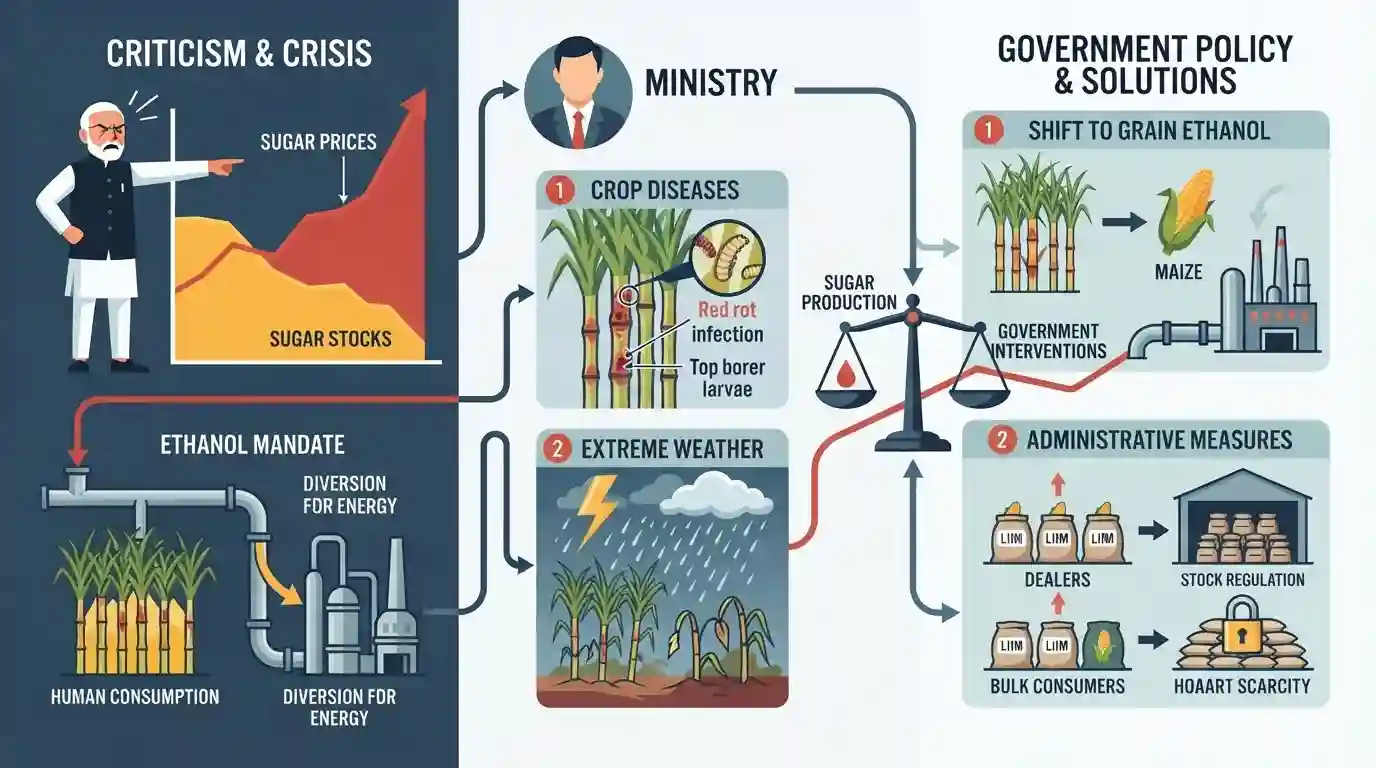
Congress president Mallikarjun Kharge criticised the central government over soaring sugar prices and depleting stocks, attributing the crisis to the aggressive ethanol blending policy and alleged mismanagement. The Ministry of Consumer Affairs, Food and Public Distribution denied these claims, pointing to a drop in sugarcane production caused by crop diseases (Red Rot, Top Borer) and extreme weather. The government defended its ethanol policy by highlighting a shift towards grain-based (maize) ethanol and detailed administrative measures, such as imposing stock limits on dealers and bulk consumers, to curb inflation and prevent hoarding.
મુખ્ય મુદ્દા
- Congress President Mallikarjun Kharge criticised the Centre for a 40% hike in sugar prices and sugar stocks plummeting to a nine-year low, linking it to the ethanol blending policy.
- Kharge highlighted the irony of importing duty-free sugar while heavily diverting domestic sugarcane and grains for ethanol production.
- The Ministry of Consumer Affairs attributed lower domestic sugar output (306 LMT against 343 LMT estimate) to adverse weather (waterlogging) and crop diseases like Red Rot and Top Borer.
- The government defended its ethanol policy, noting sugarcane's share in ethanol production dropped from 12% to 9%, with 75% of ethanol output now sourced from grains like maize.
- To curb hoarding and inflation, the government imposed stock limits of 400 tonnes for dealers until November 30 and a 15-day holding cap for bulk consumers.
મહત્વપૂર્ણ શબ્દો
Ethanol Blended Petrol (EBP) programme

A government initiative to blend ethanol (sourced from sugarcane and grain feedstocks) with petrol to lower crude oil imports, reduce carbon emissions, and boost farmers' incomes.
UPSC context
GS Paper 3 (Energy & Agriculture); tests biofuel targets, energy security, and agricultural diversification.
Essential Commodities Act, 1955
A key legislative act empowering the government to regulate the production, supply, and distribution of critical goods to control inflation, prevent hoarding, and ensure fair availability.
UPSC context
GS Paper 3 (Food Security & Inflation); tests price stabilization, stock limit policies, and state interventions.
Red Rot
A highly destructive fungal disease in sugarcane caused by Colletotrichum falcatum, causing internal reddish discoloration, rotting, and massive reductions in yield and sucrose extraction.
UPSC context
GS Paper 3 (Agriculture); tests crop diseases, agricultural loss management, and raw material supply chain disruptions.
Ministry of Consumer Affairs, Food and Public Distribution
The nodal central ministry responsible for managing the Public Distribution System (PDS), maintaining food grain buffer stocks, stabilizing market prices, and protecting consumer rights.
UPSC context
GS Paper 2 (Governance); tests public distribution mechanisms, food security administrative structures, and inflation control.
પ્રિલિમ્સ ટ્રેપ
Triggering a Tariff Rate Quota (TRQ) permits unlimited duty-free imports of raw sugar.
TRQ only allows a specific, restricted volume to enter at lower/zero duty. Any imports beyond that cap face standard, high customs duties.
સંલગ્ન સ્થિર ખ્યાલો
How is sugarcane pricing determined in India?
- FRP vs MSP: Sugarcane has a statutory Fair and Remunerative Price (FRP), unlike the non-statutory Minimum Support Price (MSP) used for other crops.
- Recommending body: The Commission for Agricultural Costs and Prices (CACP) statutory body recommends the FRP based on production costs and sugar recovery.
- Approving authority: The Cabinet Committee on Economic Affairs (CCEA), chaired by the Prime Minister, officially approves and finalizes the FRP.
- State-level variation: Some state governments declare a State Advised Price (SAP), which is typically higher than the federally mandated FRP.
What is a Tariff Rate Quota (TRQ)?
- Two-tier tariff: It combines tariffs and quotas, applying a lower tariff to imports up to a set physical limit during a specific period.
- Over-quota penalty: Imports that exceed the pre-determined quota limit face a significantly higher, often protective, standard customs duty rate.
- WTO compliance: It is a WTO-compliant mechanism used to import critical shortages without permanently harming domestic agricultural producers.
આંતર-વિષય પેટર્ન
Biofuels vs. Food Security
Diverting sugarcane and maize for ethanol blending directly impacts food inflation, testing the policy coherence of the National Policy on Biofuels against food security goals.
Climate Change and Pest Outbreaks
Erratic monsoons and waterlogging exacerbate fungal diseases like Red Rot and Top Borer, directly threatening cash crop yields and agricultural export stability.

Expect a multi-statement question linking sugarcane FRP pricing mechanism with agricultural pests (Red Rot) and WTO Tariff Rate Quota rules.
સંલગ્ન PYQ · 4
સંલગ્ન PYQ · 4
- 2025PrelimsGS1
Consider the following statements : Statement I: Of the two major ethanol producers in the world, i.e., Brazil and the United States of America, the former produces more ethanol than the latter. Statement II: Unlike in the United States of America where corn is the principal feedstock for ethanol production, sugarcane is the principal feedstock for ethanol production in Brazil. Which one of the following is correct in respect of the above statements?
- 2025PrelimsGS1
Consider the following substances: I. Ethanol II. Nitroglycerine III. Urea Coal gasification technology can be used in the production of how many of them?
- 2015PrelimsGS1
The Fair and Remunerative Price (FRP) of sugarcane is approved by the
- 2017MainsGS3
How do subsidies affect the cropping pattern, crop diversity and economy of farmers? What is the significance of crop insurance, minimum support price and food processing for small and marginal farmers?
