Waste to Energy Technologies and Solid Waste Management
Source:The Hindu ↗
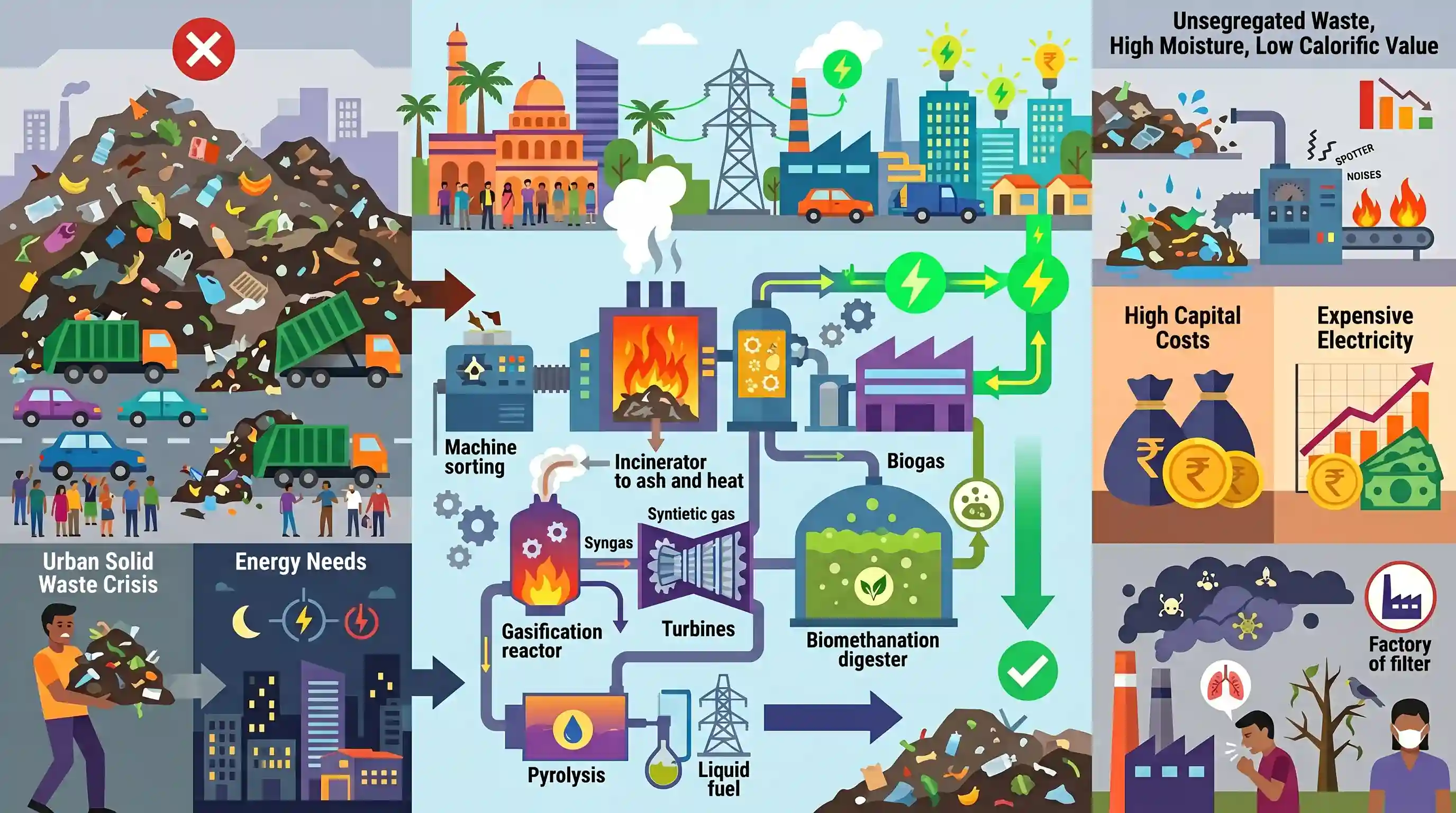
Why It Matters
With rapid urbanization, municipal solid waste management is a persistent crisis in India. WtE technologies present an alternative to overflowing landfills but require critical analysis of their environmental, technical, and economic viability. This topic is directly relevant to GS3 (Environment and S&T) and frequently tested in both Prelims (distinguishing between pyrolysis, gasification, etc.) and Mains (evaluating waste management strategies).
Summary
The article explores Waste-to-Energy (WtE) technologies, which offer a dual solution to India's mounting urban solid waste crisis and energy needs. By utilizing processes such as incineration, pyrolysis, gasification, and biomethanation, non-recyclable waste can be converted into usable energy, thereby drastically reducing landfill burden. However, the adoption of WtE in India faces significant hurdles. Unsegregated waste with high moisture and low calorific value impedes combustion efficiency, while high capital costs make the resulting electricity expensive. Furthermore, if not stringently regulated, thermal WtE plants pose severe environmental and public health risks due to the emission of toxic byproducts like dioxins and furans.
Key Points
- Waste-to-Energy (WtE) encompasses technologies like incineration, gasification, pyrolysis, and biomethanation to convert municipal solid waste into electricity, heat, or fuel.
- WtE plants significantly reduce the volume of solid waste, mitigating the severe land pressures and methane emissions associated with urban landfills.
- A major challenge in India is the lack of source segregation, which leads to mixed municipal solid waste with high moisture content and low calorific value, reducing the efficiency of thermal processes like incineration.
- Environmental concerns include the potential release of toxic pollutants such as dioxins, furans, and heavy metals if stringent emission control technologies are not deployed and monitored.
- Economically, WtE projects face high capital and operational costs, making the per-unit cost of generated electricity more expensive than conventional and other renewable sources.
Important Terms
Solid Waste Management Rules, 2016

Comprehensive regulations mandating waste segregation at source into biodegradable, dry, and hazardous streams. They promote waste-to-energy for non-recyclable waste with calorific value exceeding 1500 kcal/kg to reduce landfill pressure.
UPSC context
GS Paper III: Environmental Pollution & Degradation. Tests knowledge of urban governance and statutory frameworks for sustainable waste handling.
National Bioenergy Programme
An MNRE initiative (2021-22 to 2025-26) providing financial assistance for Waste-to-Energy, Biomass, and Biogas projects. It aims to utilize surplus biomass and urban/industrial waste for power and Bio-CNG.
UPSC context
GS Paper III: Infrastructure and Energy. Relevant for renewable energy targets and the "Waste to Wealth" mission.
Swachh Bharat Mission
India's flagship sanitation campaign. Its 2.0 version (launched 2021) focuses on making cities "Garbage Free" through 100% waste processing, remediation of legacy dumpsites, and promoting circular economy technologies like WtE.
UPSC context
GS Paper II: Welfare Schemes/Governance. Tests understanding of national missions and their impact on public health and sanitation.
Ministry of New and Renewable Energy (MNRE)
The nodal ministry for all matters relating to new and renewable energy. It implements the Waste-to-Energy programme and provides Central Financial Assistance (CFA) to support project developers.
UPSC context
GS Paper II: Ministries/Departments. Important for institutional roles in achieving India's Net-Zero 2070 targets.
Central Pollution Control Board (CPCB)
A statutory body under the MoEFCC responsible for monitoring air and water quality. It sets emission standards for thermal WtE plants and monitors compliance with environmental regulations.
UPSC context
GS Paper II & III: Statutory Bodies. Tests knowledge of regulatory oversight on toxic emissions like dioxins.
Ministry of Environment, Forest and Climate Change (MoEFCC)
The apex administrative body in India for planning and coordinating environmental and forestry programs. It notifies various waste management rules and oversees the country's environmental protection framework.
UPSC context
GS Paper II: Governance. Fundamental for policy-making related to climate change and ecological conservation.
Prelims Trap
Indian municipal solid waste is highly suitable for direct incineration due to its high calorific value.
India's unsegregated waste actually has very low calorific value and high moisture content. This makes direct thermal incineration inefficient and highly expensive without intensive pre-treatment.
Static Concepts Connected
How do incineration, pyrolysis, and gasification differ in oxygen usage?
- Incineration: Full thermal combustion of waste in the presence of excess oxygen, producing ash, heat, and flue gases.
- Pyrolysis: Thermal degradation of organic material at elevated temperatures in the absolute absence of oxygen.
- Gasification: Partial oxidation of waste with a controlled, limited amount of oxygen to produce combustible syngas.
What are dioxins and furans, and how are they regulated globally?
- Emission Source: Toxic byproducts formed during the incomplete combustion of chlorinated materials, like PVC plastics, in municipal incinerators.
- Impact: They are highly toxic, bioaccumulative, and classified as Persistent Organic Pollutants (POPs).
- Global Regulation: They are targeted for reduction and elimination globally under the Stockholm Convention on POPs.
Cross-Topic Patterns
SWM Rules 2016 + Refuse Derived Fuel
The 2016 rules mandate energy-intensive sectors, like cement and power plants, to replace a percentage of their coal usage with high-calorific Refuse Derived Fuel (RDF) sourced from municipal dry waste.
Biomethanation + SATAT Scheme
India's high-moisture wet waste is ideal for biomethanation. This directly ties into the SATAT scheme, which promotes Compressed Bio Gas (CBG) derived from organic waste as a green transport fuel.

Expect a multi-statement Prelims question comparing pyrolysis and gasification, or matching specific WtE technologies with their byproducts.
Linked PYQs · 2
Linked PYQs · 2
- 2019PrelimsGS1
In the context of which one of the following are the terms 'pyrolysis and plasma gasification' mentioned?
- 2018MainsGS3
What are the impediments in disposing the huge quantities of discarded solid wastes which are continuously being generated? How do we remove safely the toxic wastes that have been accumulating in our habitable environment?
