Environmental Degradation and Climate Resilience Challenges in India
Source:The Hindu ↗
Why It Matters
This comprehensive overview is crucial for UPSC aspirants as it provides a macro perspective on India's environmental health, directly feeding into GS3 topics concerning conservation, environmental degradation, and the socio-economic impacts of climate change.
Summary
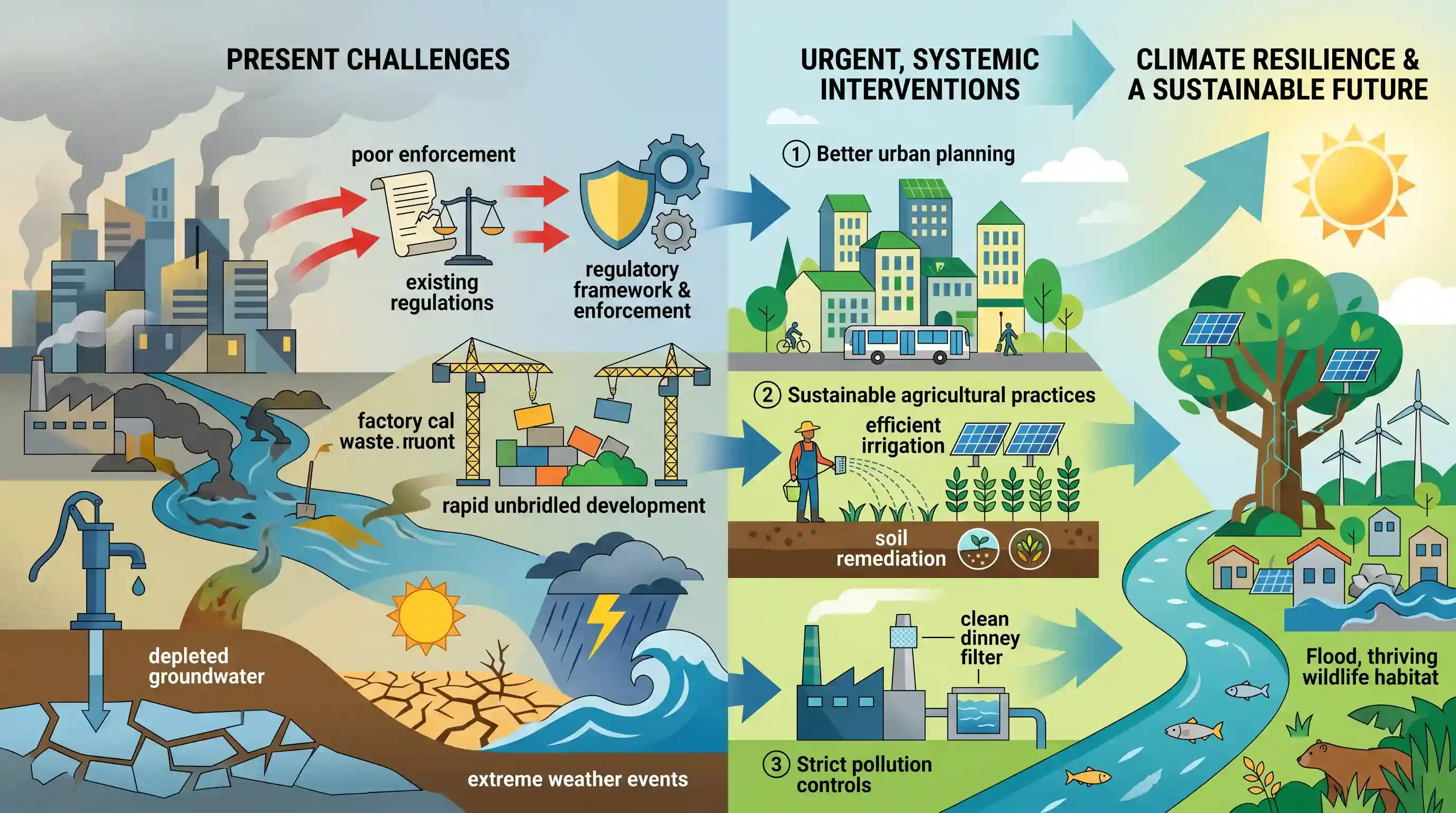
The article provides an in-depth analysis of India's current environmental landscape, detailing the severe challenges posed by air and water pollution, groundwater depletion, and the escalating frequency of extreme weather events due to climate change. It highlights that while regulatory frameworks and initiatives exist, poor enforcement and rapid unbridled development continue to exacerbate ecological degradation. The assessment calls for urgent, systemic interventions—spanning better urban planning, sustainable agricultural practices, and strict pollution controls—to build climate resilience and ensure a sustainable future.
Key Points
- India faces a dual challenge of managing persistent environmental pollution (air and water) while simultaneously addressing the impacts of global climate change.
- Extreme weather events, including unprecedented heatwaves, floods, and erratic monsoons, have escalated in frequency, leading to significant socio-economic losses.
- Groundwater depletion and freshwater scarcity are critical concerns, largely driven by agricultural over-extraction and inadequate wastewater treatment.
- Despite policy frameworks like the National Clean Air Programme, major urban centers continue to record hazardous air quality levels, emphasizing the gap between policy formulation and on-ground enforcement.
- The article underscores the necessity of integrating ecological conservation with developmental planning to achieve long-term sustainability and climate resilience.
Important Terms
National Clean Air Programme (NCAP)

A 2019 national-level strategy to reduce air pollution by 20–30% (revised to 40% by 2026) in 131 "non-attainment" cities, using city-specific action plans and the PRANA monitoring portal.
UPSC context
GS Paper III: Environment. Tests knowledge of pollution mitigation strategies and multi-level governance in urban air quality management.
Jal Jeevan Mission (JJM)
A flagship mission launched in 2019 aiming to provide 55 liters of potable water per capita per day to every rural household through tap connections by 2028.
UPSC context
GS Paper II & III: Governance and Water Resources. Evaluates understanding of decentralized planning and community-led infrastructure for water security.
Paris Agreement
A 2015 legally binding global treaty (COP21) to limit warming well below 2°C. India’s commitments (NDCs) include reducing emission intensity by 45% by 2030.
UPSC context
GS Paper III: Environmental Conservation. Key for international climate diplomacy, NDCs, and India’s 'Panchamrit' targets.
Central Pollution Control Board (CPCB)
A statutory body established under the Water Act (1974) that sets environmental quality standards and provides technical services to the government for pollution control.
UPSC context
GS Paper II & III: Statutory bodies and Pollution Control. Crucial for understanding regulatory frameworks and environmental enforcement.
Ministry of Environment, Forest and Climate Change (MoEFCC)
The nodal agency in India for planning and overseeing environmental, forestry, and wildlife programs, including climate change policies and international environmental negotiations.
UPSC context
GS Paper II & III: Governance and Environment. Central to administrative questions on environmental regulation and policy implementation.
Centre for Science and Environment (CSE)
A New Delhi-based independent think tank that conducts public interest research and advocacy on sustainable development, known for its "Down to Earth" magazine.
UPSC context
GS Paper III: Environment. Relevant for discussing the role of civil society and independent research in environmental policy.
Prelims Trap
The National Clean Air Programme sets legally binding particulate matter reduction targets for non-attainment cities.
NCAP is a non-statutory, non-legally binding collaborative framework. It relies on coordinated city-specific action plans and funding rather than penal provisions for missing targets.
Static Concepts Connected
How is groundwater extraction legally regulated in India?
- EPA 1986 Basis: The Central Ground Water Authority (CGWA) was constituted under the Environment (Protection) Act, 1986, not the Water Act.
- State Subject: Water is a State Subject (Entry 17). The Centre provides guidelines, but on-ground enforcement relies heavily on state groundwater departments and local bodies.
What defines a Non-Attainment City under the NCAP?
- 5-Year NAAQS Failure: Cities that consistently fail to meet the National Ambient Air Quality Standards (NAAQS) for five consecutive years.
- PM Focus: The primary parameters for this classification—and for setting the 40% reduction targets—are Particulate Matter (PM10 and PM2.5).
Cross-Topic Patterns
Agri-subsidies driving the water crisis
MSP regimes favoring water-intensive crops (paddy, sugarcane) in semi-arid regions directly incentivize India's massive agricultural groundwater extraction, linking economy to ecology.
Urban floods: Climate meets local governance
Extreme rainfall events (geography) collide with poor municipal governance (polity), exposing the failure of local bodies to protect urban wetlands and drainage networks.

Expect a 2026 multi-statement question linking NCAP's non-binding targets with the statutory origins of the Central Ground Water Authority.
Linked PYQs · 4
Linked PYQs · 4
- 2024MainsGS3
Industrial pollution of river water is a significant environmental issue in India. Discuss the various mitigation measures to deal with this problem and also the government's initiatives in this regard.
- 2022MainsGS3
Discuss global warming and mention its effects on the global climate. Explain the control measures to bring down the level of greenhouse gases which cause global warming, in the light of the Kyoto Protocol, 1997.
- 2024MainsGS3
The world is facing an acute shortage of clean and safe freshwater. What are the alternative technologies which can solve this crisis? Briefly discuss any three such technologies citing their key merits and demerits.
- 2024MainsGS3
Flooding in urban areas is an emerging climate-induced disaster. Discuss the causes of this disaster. Mention the features of two such major floods in the last two decades in India. Describe the policies and frameworks in India that aim at tackling such floods.
