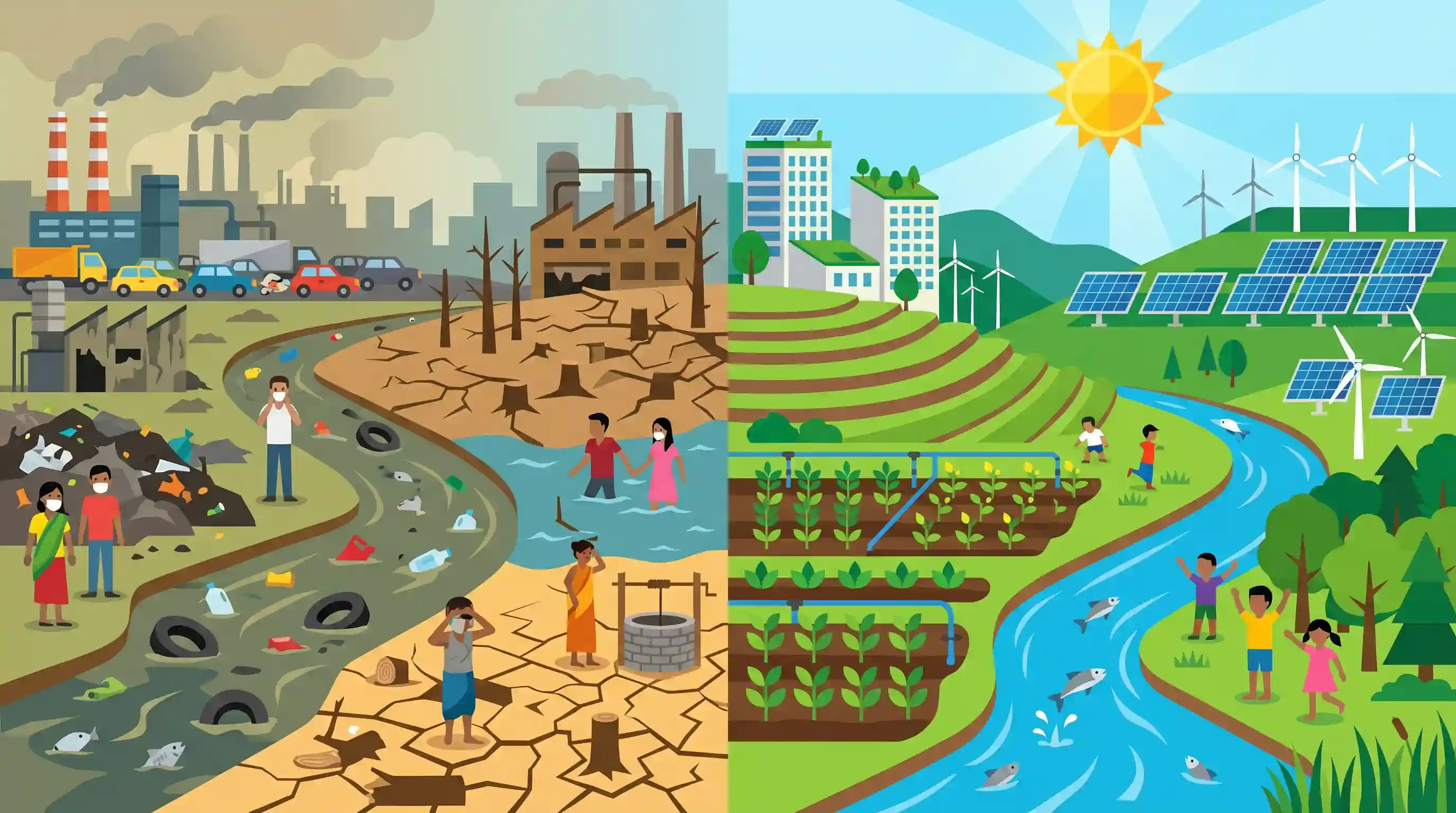
Environmental degradation and resource depletion challenges in India
Source:The Hindu ↗
Why It Matters
Understanding India's environmental state is fundamental for GS-3 (Conservation, environmental pollution and degradation). These issues directly impact national economic growth, food security, and public health, making them a recurring focus in UPSC Mains questions on environmental policies and disaster management.
Summary
The article provides a comprehensive overview of the state of the environment in India, detailing the escalating challenges of air and water pollution, climate change-induced extreme weather, and resource depletion. It emphasizes how factors such as rapid urbanization, industrialization, and inadequate waste management contribute to environmental degradation. Furthermore, the piece highlights the urgent need for robust policy implementation, sustainable agricultural practices, and widespread transition to green energy to safeguard public health and ensure ecological sustainability.
Key Points
- India faces a multifaceted environmental crisis marked by severe air pollution, with multiple Indian cities consistently ranking among the most polluted globally due to vehicular emissions, industrial discharge, and crop residue burning.
- Climate change impacts are accelerating, leading to an increased frequency and intensity of extreme weather events such as heatwaves, erratic monsoons, and urban flooding.
- Groundwater depletion and contamination pose a severe threat to water security, agriculture, and public health across various regions in the country.
- Inadequate solid waste management, especially regarding plastic and e-waste, continues to challenge ecological stability and urban infrastructure.
- Effective mitigation requires stringent enforcement of environmental regulations, better urban planning, and a faster transition toward sustainable and renewable energy sources.
Important Terms
Environment Protection Act, 1986

An 'umbrella' legislation enacted under Article 253 following the Bhopal Gas Tragedy. It empowers the Central Government to coordinate state activities, set environmental standards, and regulate hazardous substances to protect and improve the environment.
UPSC context
GS Paper III (Environment); fundamental framework for environmental governance and frequently tested in Prelims/Mains.
Central Pollution Control Board (CPCB)
A statutory body established under the Water Act (1974) and Air Act (1981). It serves as the apex technical regulator for pollution control, setting standards for air and water quality nationwide.
UPSC context
GS Paper II (Statutory Bodies) and GS III (Pollution Control mechanisms).
National Clean Air Programme (NCAP)
A national-level time-bound strategy launched in 2019 to reduce particulate matter (PM2.5 and PM10) concentrations. Targets were revised to achieve a 40% reduction in 131 non-attainment cities by 2026.
UPSC context
GS Paper III; critical for questions on urban air pollution and environmental policy targets.
Ministry of Environment, Forest and Climate Change (MoEFCC)
The nodal agency for planning and implementing India's environmental and forestry policies. It oversees pollution control, conservation of natural resources, and coordinates international climate commitments like the Paris Agreement.
UPSC context
GS Paper II (Institutional Framework); essential for understanding policy leadership in environmental matters.
Solid Waste Management Rules, 2026
Regulatory framework (superseding 2016 rules) emphasizing the circular economy and mandatory four-stream waste segregation at source (wet, dry, sanitary, and special care waste) to improve urban waste management.
UPSC context
GS Paper III (Waste Management/Environmental Pollution); tests knowledge of decentralized governance and source-level interventions.
Centre for Science and Environment (CSE)
An influential Delhi-based non-profit think tank led by Sunita Narain. It conducts 'knowledge-based activism,' publishing the annual 'State of India’s Environment' report and advocating for sustainable and equitable development.
UPSC context
GS Paper II (Civil Society) and GS III (Environmental Monitoring); relevant for data-driven arguments in Mains.
Prelims Trap
"NCAP aims to bring India's particulate matter levels down to WHO safe limits by 2026."
NCAP targets a relative 40% reduction from 2017 levels, not absolute WHO limits. Even post-reduction, Indian cities will remain well above WHO's 5 µg/m³ limit.
Static Concepts Connected
How are groundwater assessment units classified in India?
- Safe: Groundwater extraction is less than 70% of the annual replenishable recharge without significant long-term decline.
- Critical: Extraction is between 90-100% of recharge, coupled with a significant long-term decline in water levels.
- Over-exploited: Extraction rate exceeds 100% of the natural annual recharge, heavily concentrated in Punjab, Haryana, and Rajasthan.
What are the core mandates of Solid Waste Management Rules, 2016?
- Source Segregation: Mandatory separation of waste into wet, dry, and domestic hazardous streams directly at the generator level.
- Extended Producer Responsibility: Manufacturers of packaging products must financially or operationally support the collection system for packaging waste.
- Local Body Powers: Empowers municipalities to levy user fees for waste collection and issue spot fines for littering and non-segregation.
Cross-Topic Patterns
MSP policies + Groundwater depletion
Open-ended procurement of paddy in Punjab/Haryana, subsidized by free electricity, directly causes 'Over-exploited' groundwater basins. This links GS3 agricultural economics to GS1 geography.
Urban Flooding + NDMA Guidelines
NDMA treats urban flooding as distinct from riverine flooding, driven by concretization and wetland encroachment. This directly connects GS1 urbanization trends to GS3 disaster management.

Expect a 2026 Prelims question mapping WHO's revised PM2.5 limits against NCAP targets, or linking groundwater status to cropping patterns.
Linked PYQs · 4
Linked PYQs · 4
- 2024MainsGS3
Industrial pollution of river water is a significant environmental issue in India. Discuss the various mitigation measures to deal with this problem and also the government's initiatives in this regard.
- 2024MainsGS3
Flooding in urban areas is an emerging climate-induced disaster. Discuss the causes of this disaster. Mention the features of two such major floods in the last two decades in India. Describe the policies and frameworks in India that aim at tackling such floods.
- 2021MainsGS3
Describe the key points of the revised Global Air Quality Guidelines (AQGs) recently released by the World Health Organisation (WHO). How are these different from its last update in 2005? What changes in India's National Clean Air Programme are required to achieve these revised standards?
- 2022PrelimsGS1
Excess of which of the above in the environment is/are cause(s) of acid rain? 1. Carbon monoxide 2. Nitrogen oxide 3. Ozone 4. Sulphur dioxide
