Environmental Degradation and Extreme Weather Vulnerability
Source:The Hindu ↗
Why It Matters
The state of the environment report provides critical data points on extreme weather, air quality, and waste management. For UPSC aspirants, these metrics are essential to substantiate answers in GS Paper 3 regarding environmental degradation, the efficacy of the National Clean Air Programme (NCAP), climate vulnerability, and disaster management.
Summary
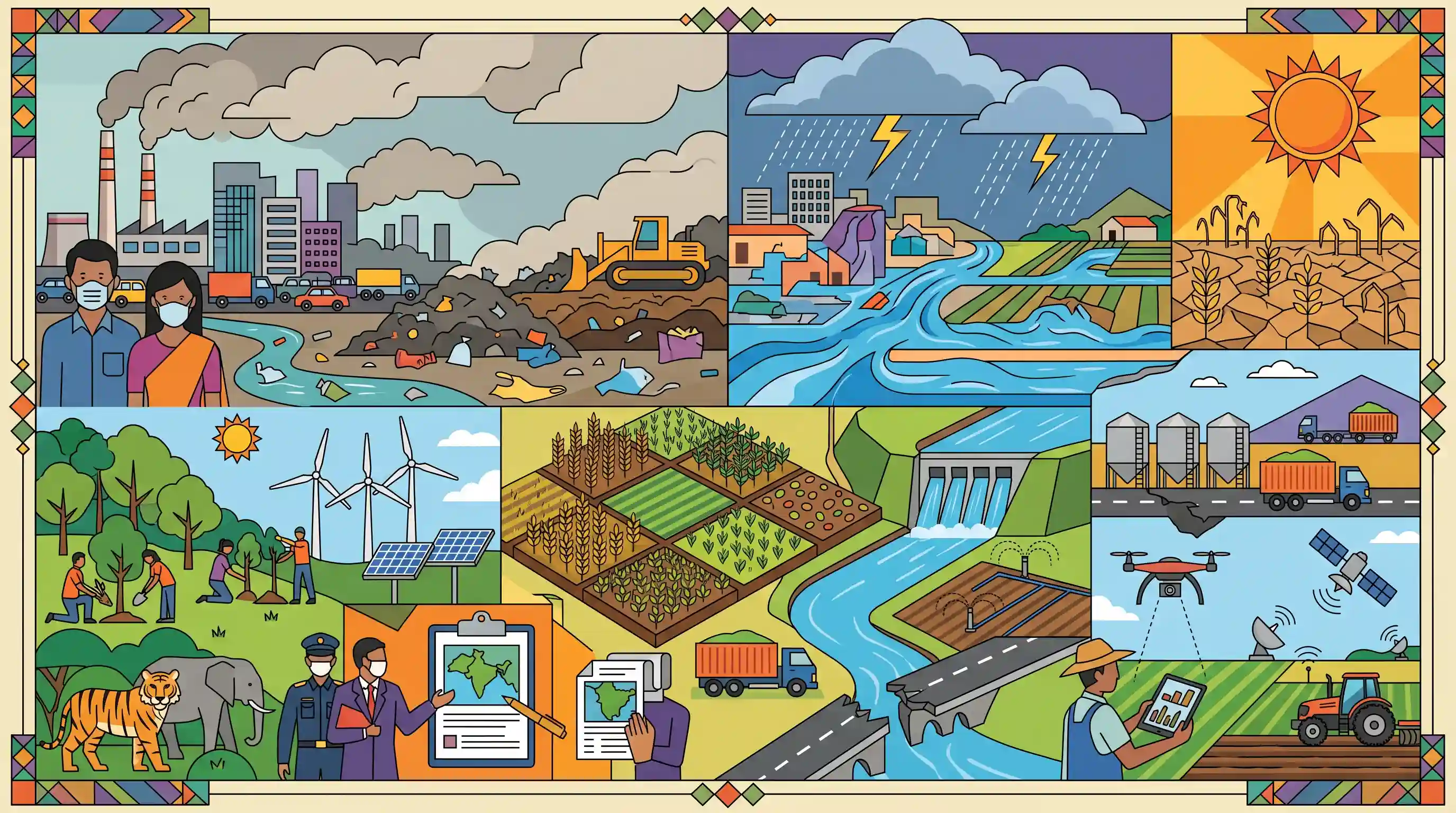
The article unpacks the findings surrounding the state of India's environment, highlighting the nation's severe ecological and climate-related challenges. Based on annual environmental assessments (such as those by the Centre for Science and Environment), it details the alarming frequency of extreme weather events that cause widespread disruption to agriculture and urban areas. The piece also underscores the persistent air pollution crisis, with numerous cities breaching safe air quality limits, and points to the systemic failures in municipal solid waste management. Overall, the analysis underscores India's high climate vulnerability and the urgent need for robust environmental governance, stronger policy enforcement, and sustainable developmental planning.
Key Points
- Extreme Weather Events: India is experiencing a surge in extreme weather days (such as heatwaves, intense cloudbursts, and urban flooding), leading to massive socio-economic and infrastructural damage.
- Air Pollution Crisis: A large majority of Indian cities continue to fail to meet the clean air standards set by the National Clean Air Programme (NCAP) and the WHO, severely affecting public health.
- Waste Management Deficit: India faces mounting challenges with municipal solid waste and plastics. A significant percentage of waste remains untreated or ends up in landfills, contributing to soil and water pollution.
- Climate Vulnerability & Agriculture: Changing rainfall patterns and extreme climate events heavily impact agricultural yields, threatening food security and farmers' livelihoods.
Important Terms
National Clean Air Programme (NCAP)

Launched in 2019, it is India’s first national-level strategy for air quality improvement, targeting a 40% reduction in particulate matter concentrations by 2026 across 131 non-attainment cities.
UPSC context
GS III (Environment and Pollution); tests knowledge of domestic environmental policies and time-bound pollutant reduction targets.
Paris Agreement
A 2015 legally binding international treaty aimed at limiting global temperature rise to well below 2°C, preferably 1.5°C, compared to pre-industrial levels.
UPSC context
GS II/III (International Relations/Climate Change); essential for understanding global governance and India's international climate commitments.
Nationally Determined Contributions (NDCs)
Voluntary climate action plans updated every five years under the Paris Agreement; India's targets include reducing emission intensity by 45% and reaching 50% non-fossil energy by 2030.
UPSC context
GS III (Climate Change/Environment); core topic for evaluating India's progress toward global environmental goals and sustainable development.
Centre for Science and Environment (CSE)
An influential New Delhi-based research and advocacy organization that publishes the annual "State of India's Environment" report monitoring ecological and developmental trends.
UPSC context
GS III (Conservation/Environment); useful for citing credible data on environmental degradation and policy critique in India.
WHO Air Quality Guidelines
Stricter 2021 global standards (e.g., PM2.5 limit at 5 µg/m³) designed to protect health from air pollutants; they highlight the gap with India’s less stringent national standards.
UPSC context
GS III (Environment/Health); important for comparative analysis of air quality standards and public health policy interventions.
Non-attainment Cities
Cities identified under the NCAP that consistently fail to meet the National Ambient Air Quality Standards (NAAQS) for particulate matter over a five-year period.
UPSC context
GS III (Environmental Pollution); critical for discussing urban air quality management and city-specific environmental action plans.
Prelims Trap
"NCAP targets apply universally to all Indian cities and are legally binding under the Environment Protection Act."
NCAP is a collaborative strategy, but it is NOT legally binding. Furthermore, it specifically targets 131 'non-attainment' cities that failed NAAQS criteria (2011-2015), not all cities.
Static Concepts Connected
What are the pollutants covered under India's National Ambient Air Quality Standards (NAAQS)?
- 12 Pollutants: Includes PM10, PM2.5, Nitrogen Dioxide (NO2), Sulphur Dioxide (SO2), Carbon Monoxide (CO), Ozone (O3), Ammonia (NH3), Lead, Nickel, Arsenic, Benzene, and Benzo(a)pyrene.
- Key exclusions: Notably excludes Carbon Dioxide (CO2) and Chlorofluorocarbons (CFCs), which are frequently used as trap options in UPSC Prelims.
- Regulatory authority: Notified by the Central Pollution Control Board (CPCB) under the powers of the Air (Prevention and Control of Pollution) Act, 1981.
How do the Wetlands (Conservation and Management) Rules, 2017 regulate urban sinks?
- Decentralized regulation: Delegates primary regulatory and identification powers to State Wetland Authorities (SWAs), moving away from the Central-heavy approach of the 2010 rules.
- Strict prohibitions: Strictly prohibits solid waste dumping, discharge of untreated industrial effluents, and permanent construction within notified wetlands.
- Definition exclusions: The rules explicitly exclude river channels, paddy fields, human-made water bodies for drinking, and areas under the Coastal Regulation Zone.
Cross-Topic Patterns
Urban flooding & wetland encroachment
The destruction of urban sinks (like Chennai's lost water bodies) links environmental degradation directly to GS3 Disaster Management, specifically the rising frequency of urban flooding.
Changing monsoons & agricultural distress
Rising extreme weather days directly alter cropping patterns and soil health, linking GS3 climate vulnerability reports to agricultural distress, MSP demands, and food security challenges.

Expect a multi-statement Prelims question contrasting India's 2026 NCAP PM reduction targets with the stringent WHO Air Quality Guidelines.
Linked PYQs · 4
Linked PYQs · 4
- 2024MainsGS3
Flooding in urban areas is an emerging climate-induced disaster. Discuss the causes of this disaster. Mention the features of two such major floods in the last two decades in India. Describe the policies and frameworks in India that aim at tackling such floods.
- 2021MainsGS3
Describe the key points of the revised Global Air Quality Guidelines (AQGs) recently released by the World Health Organisation (WHO). How are these different from its last update in 2005? What changes in India's National Clean Air Programme are required to achieve these revised standards?
- 2019MainsGS3
Vulnerability is an essential element for defining disaster impacts and its threat to people. How and in what ways can vulnerability to disasters be characterized? Discuss different types of vulnerability with reference to disasters.
- 2025PrelimsGS1
Consider the following statements : Statement I: Article 6 of the Paris Agreement on climate change is frequently discussed in global discussions on sustainable development and climate change. Statement II: Article 6 of the Paris Agreement on climate change sets out the principles of carbon markets. Statement III : Article 6 of the Paris Agreement on climate change intends to promote inter-country non-market strategies to reach their climate targets. Which one of the following is correct in respect of the above statements?
