Delhi High Court Frames Proportionality Test for Right to be Forgotten
Source:The Hindu ↗
Why It Matters
The intersection of constitutional rights, judicial transparency, and modern digital privacy is a high-yield area for UPSC. The Delhi High Court's formulation of a proportionality test to apply the Right to be Forgotten within the Indian legal system directly touches upon GS2 syllabus topics (Fundamental Rights, Judicial Pronouncements) and GS3 (Data Protection and Cyber Security).
Summary
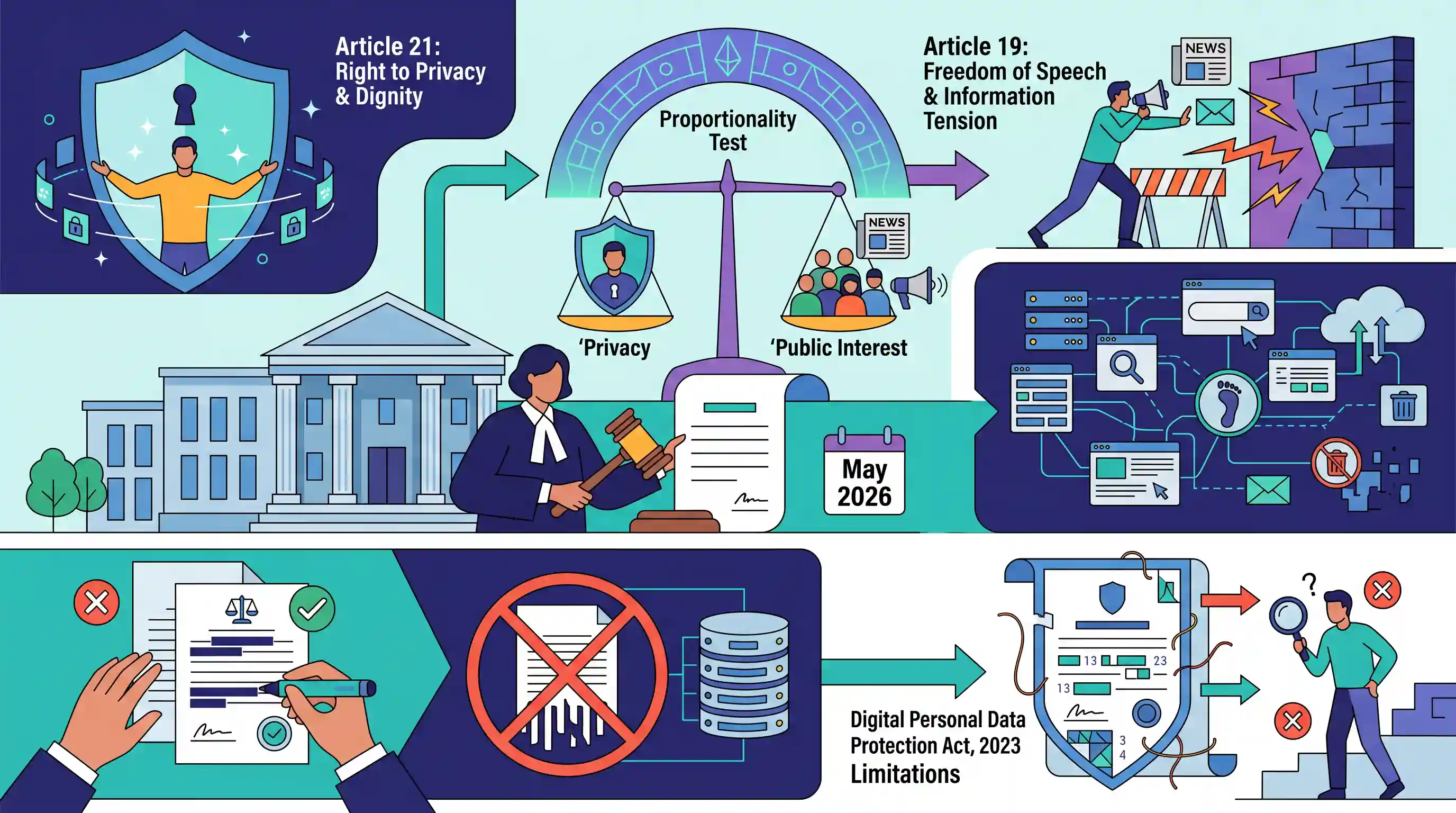
The article explains the 'Right to be Forgotten' (RTBF) in India following a significant May 2026 ruling by the Delhi High Court in Laksh Vir Singh Yadav v. Union of India. The court ruled that RTBF is a fundamental facet of informational privacy and dignity under Article 21 of the Indian Constitution. It established a proportionality test to balance privacy against public interest, emphasizing that legal databases should mask/redact names instead of completely erasing cases. The piece examines the constitutional tension between RTBF and freedom of speech (Article 19), practical implementation challenges in the digital ecosystem, and the limitations of the Digital Personal Data Protection (DPDP) Act, 2023 in addressing this right.
Key Points
- Concept & Origin: The 'Right to be Forgotten' (RTBF) permits individuals to demand the deletion or de-indexing of personal data from the internet when its retention serves no public interest and causes disproportionate harm. It originates globally from the 2014 European Court of Justice ruling (Mario Costeja González case) and is codified under Article 17 of the EU's GDPR.
- Constitutional Status: In India, the Supreme Court's landmark K.S. Puttaswamy judgment (2017) recognized the Right to Privacy, including informational privacy, as a fundamental right under Article 21. Since then, various High Courts have had divergent views on applying RTBF to judicial and public records.
- Delhi HC Ruling (May 2026): In Laksh Vir Singh Yadav v. Union of India, the Delhi High Court firmly anchored RTBF within Article 21's rights of dignity and informational privacy. It established a structured 'proportionality test' to balance private harm against public interest, mandating that legal databases mask or redact names within two weeks while keeping the facts of the cases intact (the 'least intrusive means' principle).
- Constitutional Conflicts: RTBF sits in direct tension with the Right to Freedom of Speech and Expression (Article 19(1)(a)), the public's right to information, and the principle of 'open justice' which demands transparency in judicial trials.
- Practical and Legal Hurdles: Key challenges include the 'shadow of crime' (where search engines highlight historical, cleared allegations over current status), mirror websites, lack of technical enforcement mechanisms, and the limited scope of the DPDP Act, 2023 (Section 12), which provides a right to erasure but does not explicitly cover public archives or court records.
- Proposed Way Forward: Experts advocate for a tiered resolution mechanism starting with direct requests to the data-hosting platforms, escalating to the Data Protection Board (DPB) once fully functional, and utilizing the judicial route primarily for court records.
Important Terms
Digital Personal Data Protection Act, 2023

India's primary framework regulating the collection and processing of digital personal data, outlining the rights of data owners (principals) and responsibilities of processors (fiduciaries).
UPSC context
GS Paper II & III. Tests Indian regulatory regimes, digital governance, and privacy rights under the Constitution.
General Data Protection Regulation
The European Union's comprehensive data privacy and security regulation, which codified the "Right to Erasure" (or Right to be Forgotten) under Article 17.
UPSC context
GS Paper II (Comparison of Constitutions/Laws). Tests international privacy frameworks and their impact on global tech policies.
Data Protection Board of India
A statutory adjudicatory body established under Section 18 of the DPDP Act, 2023, responsible for monitoring compliance, investigating data breaches, and imposing penalties.
UPSC context
GS Paper II (Regulatory Bodies). Tests statutory mechanisms for safeguarding digital rights and grievance redressal in India.
Delhi High Court
The premier state judiciary of Delhi, which ruled in Laksh Vir Singh Yadav v. Union of India (2026), balancing the Right to be Forgotten with the Open Justice principle.
UPSC context
GS Paper II (Judiciary). Tests judicial activism, interpreting fundamental rights, and formatting balanced legal remedies for privacy.
Supreme Court of India
The apex court of India that laid the foundation for digital privacy by recognizing informational privacy as a fundamental right under Article 21 in the Puttaswamy judgment (2017).
UPSC context
GS Paper II (Fundamental Rights). Tests judicial jurisprudence, Article 21, and its evolution to include new-age digital rights.
European Court of Justice
The EU's highest judicial authority, which created the global precedent for the Right to be Forgotten in the landmark 2014 Google Spain case.
UPSC context
GS Paper II (International Laws). Tests global comparative law and the judicial origin of worldwide digital privacy standards.
Prelims Trap
The Digital Personal Data Protection Act, 2023 explicitly codifies the 'Right to be Forgotten' as an absolute right over all public archives.
The DPDP Act, 2023 only refers to the 'Right to Erasure' (Section 12), not 'Right to be Forgotten'. Furthermore, courts order 'masking' and 'de-indexing', not complete deletion of official court archives.
Static Concepts Connected
What is the Doctrine of Proportionality under the Indian Constitution?
- Definition and origin: Originating from European jurisprudence, it acts as a judicial standard to ensure state limitations on fundamental rights are not arbitrary or excessive.
- Four-fold Puttaswamy test: Requires a legitimate state aim, a rational connection to the objective, the least intrusive means, and a fair balance between rights and social interest.
- Judicial application: Courts use it to balance competing rights, such as individual privacy (Article 21) versus public right to know (Article 19).
What is the principle of 'Open Justice' in Indian law?
- Core definition: The rule that court proceedings and records must be accessible to the public to ensure transparency and prevent arbitrary judicial abuse.
- Constitutional basis: Derives from Article 19(1)(a)'s right to know and report, alongside the status of High Courts and Supreme Court as 'Courts of Record'.
- Permissible exceptions: In-camera trials for matrimonial disputes, sexual assault cases, and national security matters serve as recognized exceptions to protect vulnerable parties.
Cross-Topic Patterns
E-Courts digitisation vs. Informational privacy
Analyzes how the e-Courts mission’s push for public digital accessibility conflicts with Article 21 protections, requiring a delicate balance between transparency and the right to a clean slate.
GDPR standards vs. Indian DPDP architecture
Highlights how India's DPDP Act relies on a fiduciary-consent model, whereas EU’s GDPR provides a stronger, rights-based architecture that explicitly codifies the right to erasure.

Mains 2026 is highly likely to contrast the DPDP Act’s Right to Erasure with Article 21's Right to be Forgotten regarding public archives.
Linked PYQs · 5
Linked PYQs · 5
- 2024PrelimsGS1
Under which of the following Articles of the Constitution of India, has the Supreme Court of India placed the Right to Privacy ?
- 2021PrelimsGS1
'Right to Privacy' is protected under which Article of the Constitution of India?
- 2017MainsGS2
Examine the scope of Fundamental Rights in the light of the latest judgement of the Supreme Court on Right to Privacy.
- 2024MainsGS2
Right to privacy is intrinsic to life and personal liberty and is inherently protected under Article 21 of the constitution. Explain. In this reference discuss the law relating to D.N.A. testing of child in the womb to establish its paternity.
- 2024MainsGS3
Describe the context and salient features of the Digital Personal Data Protection Act, 2023.
