Biochar as a Sustainable Tool for Carbon Sequestration and Soil Health
Source:The Hindu ↗
Why It Matters
Biochar offers a multi-pronged solution to critical environmental and agricultural challenges in India, including stubble burning, soil degradation, and greenhouse gas emissions. Understanding its potential and the regulatory needs for its scaling is essential for topics related to climate change mitigation (like CCUS and carbon markets) and sustainable agriculture in GS Paper 3.
Summary
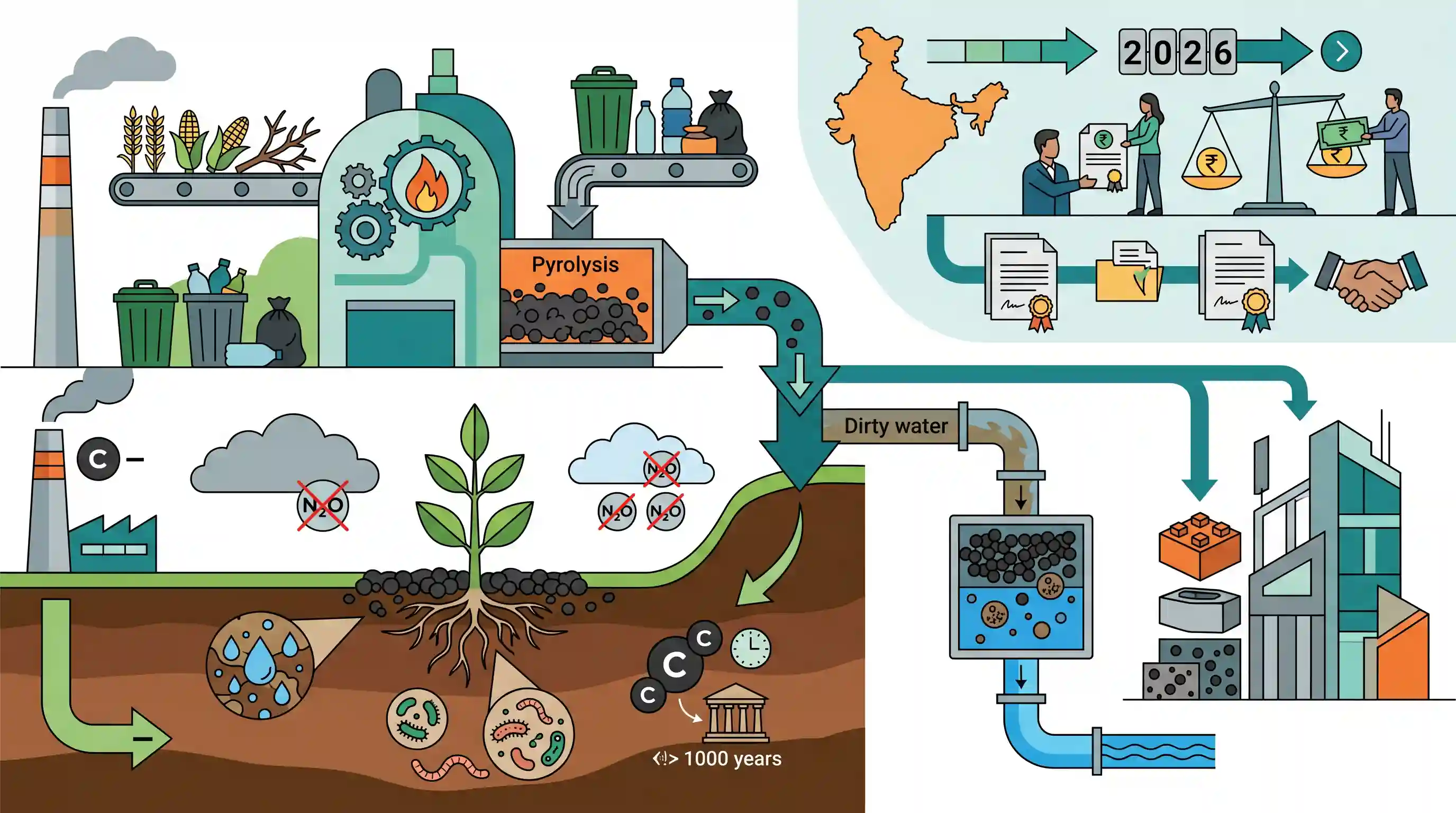
Biochar is a carbon-rich substance produced by the pyrolysis of agricultural residue and municipal solid waste. It is increasingly recognized for its potential as a long-term carbon sink, capable of sequestering carbon in soil for up to a millennium. In addition to its role in climate change mitigation as a negative emissions technology, biochar improves soil health, enhances water retention, and reduces nitrous oxide emissions in agriculture. Its applications are also expanding into construction and wastewater treatment. However, to fully realize its potential in India, biochar needs standardized methodologies, market development, and formal integration into India's upcoming domestic carbon market, which is slated to launch in 2026.
Key Points
- Biochar is a highly stable, carbon-rich charcoal produced by heating biomass (like agricultural residue and municipal solid waste) in an oxygen-limited environment, a process known as pyrolysis.
- It serves as a powerful negative emissions technology, acting as a long-term carbon sink capable of storing carbon in soil for 100 to 1,000 years.
- In agriculture, biochar amendments help restore degraded soils, improve water retention, and abate emissions of nitrous oxide, a potent greenhouse gas.
- Beyond farming, biochar is increasingly being explored for use in the construction sector (to reduce the carbon footprint and improve the strength of concrete) and for wastewater treatment.
- For biochar to scale in India, it needs to be integrated into the upcoming domestic carbon credit market (set to launch in 2026) with standardized methodologies for carbon accounting and quality control.
Important Terms
Biochar

A carbon-rich, stable solid produced by heating organic biomass (like crop residues or waste) in an oxygen-limited environment.
UPSC context
GS III (Environment & Agriculture); relevant for soil health, waste-to-wealth, and climate mitigation.
Indian Carbon Market (ICM)
A national framework, operationalized via the Carbon Credit Trading Scheme (CCTS), allowing entities to trade carbon credits to meet emission targets.
UPSC context
GS III (Economy & Environment); critical for India’s Net Zero 2070 targets and climate finance.
Pyrolysis
The chemical decomposition of organic materials through the application of heat in the absence or near-absence of oxygen.
UPSC context
GS III (Science & Technology); a core process for waste management and bioenergy production.
Negative Emissions Technology (NET)
Methods or technologies, such as BECCS or Biochar, that actively remove CO2 from the atmosphere for long-term storage.
UPSC context
GS III (Environment); essential for meeting Paris Agreement goals and offsetting hard-to-abate sectors.
Carbon Sequestration
The process of capturing and storing atmospheric carbon dioxide in natural (forests/soil) or artificial reservoirs to mitigate global warming.
UPSC context
GS III (Environment); fundamental for understanding India’s Nationally Determined Contributions (NDCs).
Prelims Trap
Produced by burning agricultural waste in the open presence of abundant oxygen.
Biochar is produced via pyrolysis—heating biomass in an oxygen-limited or oxygen-free environment. Open burning creates ash and releases CO2, whereas pyrolysis locks carbon.
Static Concepts Connected
How do Pyrolysis, Gasification, and Incineration differ in waste treatment?
- Pyrolysis: Heating biomass in the complete absence or extreme lack of oxygen to produce biochar, bio-oil, and syngas.
- Gasification: Heating organic material with a strictly controlled, limited amount of oxygen to produce combustible syngas.
- Incineration: Complete combustion of waste material in the presence of excess oxygen, leaving behind ash and heat.
What is the statutory framework for India's Carbon Credit Trading Scheme (CCTS)?
- Statutory backing: The Energy Conservation (Amendment) Act, 2022 empowers the central government to specify a domestic carbon credit trading scheme.
- Administrator: The Bureau of Energy Efficiency (BEE) acts as the overall administrator for the domestic carbon market.
- Regulator: The Central Electricity Regulatory Commission (CERC) regulates the trading of carbon credit certificates on power exchanges.
Cross-Topic Patterns
Biochar as Stubble Burning Solution
Converting paddy residue in North India to biochar offers a circular economy alternative to open burning, yielding marketable carbon credits while addressing severe regional air pollution.
Decarbonizing the Construction Sector
Biochar's emerging use as a concrete additive links agricultural waste management to urban infrastructure, directly addressing the massive carbon footprint of the traditional cement industry.

Biochar's triple utility (carbon sink, soil amendment, concrete additive) + Pyrolysis makes it a high-probability multi-statement MCQ in 2026.
Linked PYQs · 3
Linked PYQs · 3
- 2020PrelimsGS1
What is the use of biochar in farming? 1. Biochar can be used as a part of the growing medium in vertical farming. 2. When biochar is a part of the growing medium, it promotes the growth of nitrogen-fixing microorganisms. 3. When biochar is a part of the growing medium, it enables the growing medium to retain water for longer time. Which of the statements given above is/are correct?
- 2023PrelimsGS1
Consider the following activities: 1. Spreading finely ground basalt rock on farmlands extensively 2. Increasing the alkalinity of oceans by adding lime 3. Capturing carbon dioxide released by various industries and pumping it into abandoned subterranean mines in the form of carbonated waters How many of the above activities are often considered and discussed for carbon capture and sequestration?
- 2025MainsGS3
What is Carbon Capture, Utilization and Storage (CCUS)? What is the potential role of CCUS in tackling climate change?
