International Law and Legality of US Military Strikes on Iran
Source:The Hindu ↗
Why It Matters
Understanding the legal justifications for military interventions is crucial for UPSC aspirants, as it touches upon core concepts of the UN Charter, international law, and state sovereignty. The geopolitical fallout of U.S.-Iran tensions directly impacts India's strategic interests in West Asia, including energy security, diaspora safety, and connectivity projects.
Summary
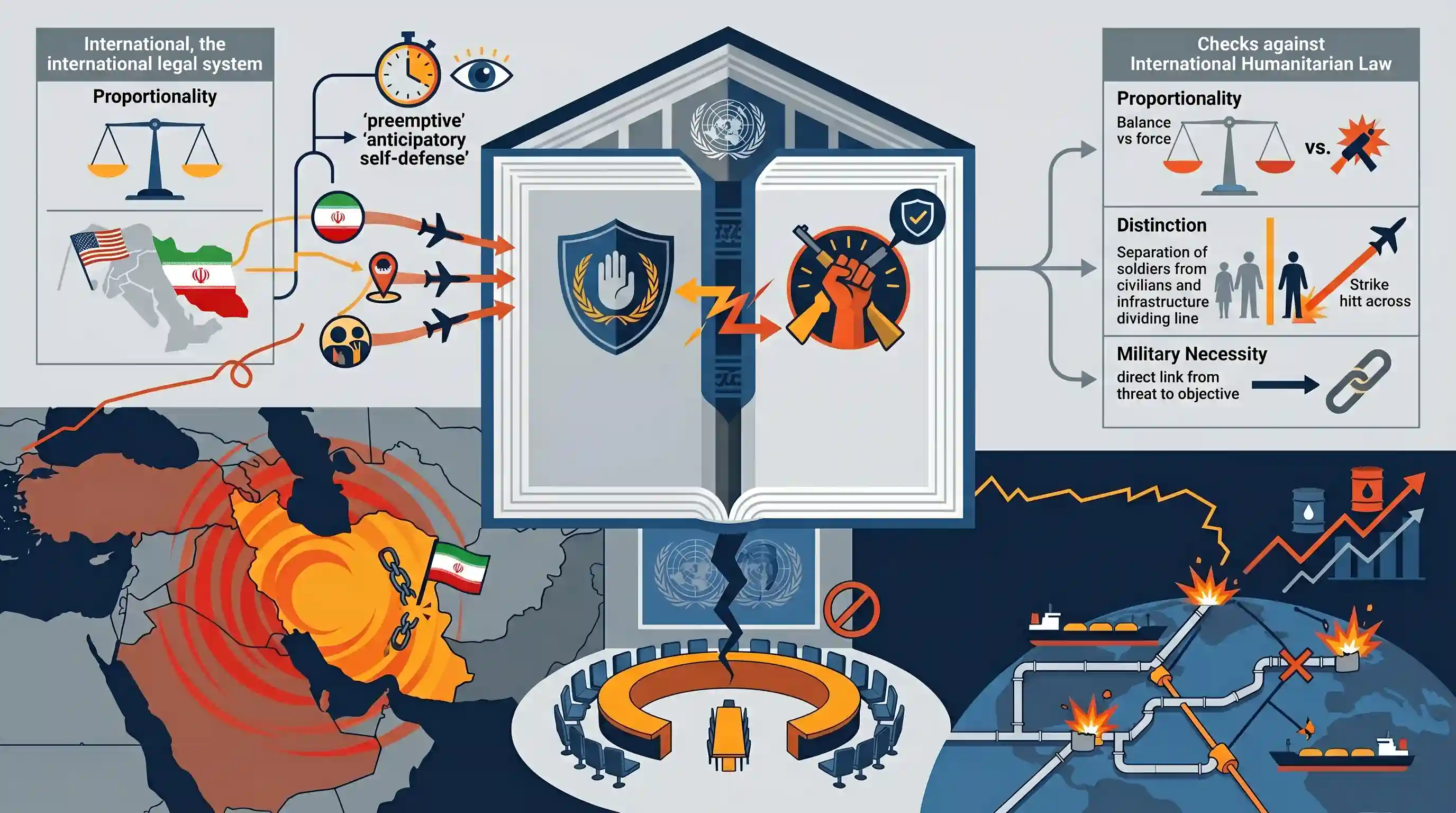
The article examines the international legal framework governing U.S. military strikes on Iran and its affiliated proxy forces in the Middle East. It analyzes the inherent tension between the general prohibition on the use of force under Article 2(4) of the UN Charter and the right to self-defense enshrined in Article 51. The U.S. justification of preemptive or anticipatory self-defense is scrutinized against the core principles of international humanitarian law—namely proportionality, distinction, and military necessity. Additionally, the piece highlights how unilateral strikes that bypass UN Security Council authorization affect state sovereignty, exacerbate geopolitical instability in West Asia, and threaten global energy security.
Key Points
- Article 2(4) of the UN Charter strictly prohibits the threat or use of force against the territorial integrity or political independence of any sovereign state.
- Article 51 of the UN Charter provides a critical exception, allowing for the inherent right of individual or collective self-defense in the event of an armed attack.
- The U.S. frequently invokes the controversial doctrine of anticipatory or preemptive self-defense to justify military strikes against Iran-backed proxies.
- Any legal use of force must comply with customary international humanitarian law principles, including proportionality, distinction between combatants and civilians, and military necessity.
- Unilateral military actions without UN Security Council authorization raise significant concerns regarding the violation of state sovereignty and the erosion of international legal norms.
- Escalating U.S.-Iran tensions in West Asia pose severe risks to global energy security, supply chain stability, and maritime choke points like the Strait of Hormuz.
Important Terms
Article 2(4) of UN Charter

A core 1945 UN Charter provision prohibiting member states from using or threatening force against the territorial integrity or political independence of any sovereign state.
UPSC context
GS Paper II (International Relations); central to discussions on global security, sovereignty violations, and the legality of military interventions.
Article 51 of UN Charter
Recognizes the "inherent right" of individual or collective self-defense if an armed attack occurs against a member state, provided the Security Council is immediately notified.
UPSC context
GS Paper II (International Relations); critical for assessing the legality of unilateral strikes and exceptions to the prohibition of force.
UN Security Council (UNSC)
A principal UN organ responsible for maintaining global peace, holding the authority to authorize military action, impose sanctions, and issue binding resolutions.
UPSC context
GS Paper II (International Institutions); relevant for questions on global governance, UN reforms, and India’s permanent membership quest.
International Humanitarian Law (IHL)
International rules (the 'laws of war') aimed at limiting conflict effects by protecting non-combatants and restricting methods of warfare, emphasizing proportionality and distinction.
UPSC context
GS Paper II and IV; tests understanding of the legal and ethical boundaries of armed conflict and conduct during hostilities.
West Asia
A strategically critical region for India comprising key energy suppliers and a massive diaspora; central to India's "Look West" or "Link West" policy.
UPSC context
GS Paper II (Regional Groupings); essential for India’s energy security, trade interests, and regional stability.
Preemptive Self-Defense
A contested legal doctrine where a state uses force to thwart a perceived imminent threat before an actual armed attack occurs.
UPSC context
GS Paper II (International Law); important for analyzing modern security doctrines and their impact on global legal norms.
Prelims Trap
Article 51 of the UN Charter explicitly allows for preemptive or anticipatory self-defense against imminent threats.
Article 51 only explicitly permits self-defense "if an armed attack occurs." Anticipatory or preemptive self-defense is a contested customary doctrine, not a codified UN Charter right.
Static Concepts Connected
What are the only two legal exceptions to the prohibition of force under the UN Charter?
- Self-Defense: Article 51 explicitly permits the inherent right of individual or collective self-defense if an armed attack occurs, until the UNSC intervenes.
- UNSC Authorization: Under Chapter VII (specifically Article 42), the UN Security Council can authorize military force to maintain or restore international peace and security.
What makes the Strait of Hormuz a critical geographical chokepoint?
- Geographic Link: It connects the Persian Gulf to the Gulf of Oman and the broader Arabian Sea.
- Bordering Nations: It is flanked by Iran to the north, and Oman and the United Arab Emirates (UAE) to the south.
- Trade Volume: It is a highly vulnerable transit route that processes over 20% of global daily oil consumption and a massive volume of liquefied natural gas (LNG).
Cross-Topic Patterns
Strait of Hormuz + Energy Security
Escalation in West Asia threatens the Strait of Hormuz, highlighting the imperative for India to rapidly expand its Strategic Petroleum Reserves (SPRs) and diversify its crude import sources away from the Middle East.
Proxy Warfare + IHL Distinction Limits
The use of non-state armed proxies by state actors deeply complicates the International Humanitarian Law (IHL) principle of "distinction," muddying the waters for state accountability and legal justification for retaliatory strikes.

Map-based matching of West Asian maritime chokepoints (Hormuz, Bab-el-Mandeb) with adjacent proxy conflicts is highly probable for 2026.
Linked PYQs · 4
Linked PYQs · 4
- 2025MainsGS2
"Energy security constitutes the dominant kingpin of India's foreign policy, and is linked with India's overarching influence in Middle Eastern countries.” How would you integrate energy security with India's foreign policy trajectories in the coming years?
- 2017MainsGS2
The question of India's Energy Security constitutes the most important part of India's economic progress. Analyze India's energy policy cooperation with West Asian countries.
- 2022PrelimsGS1
The term "Levant" often heard in the news roughly corresponds to which of the following regions?
- 2015PrelimsGS1
The area known as 'Golan Heights' sometimes appears in the news in the context of the events related to
