Critical Minerals Reform and Mining Amendment Act Impact
Source:The Hindu ↗
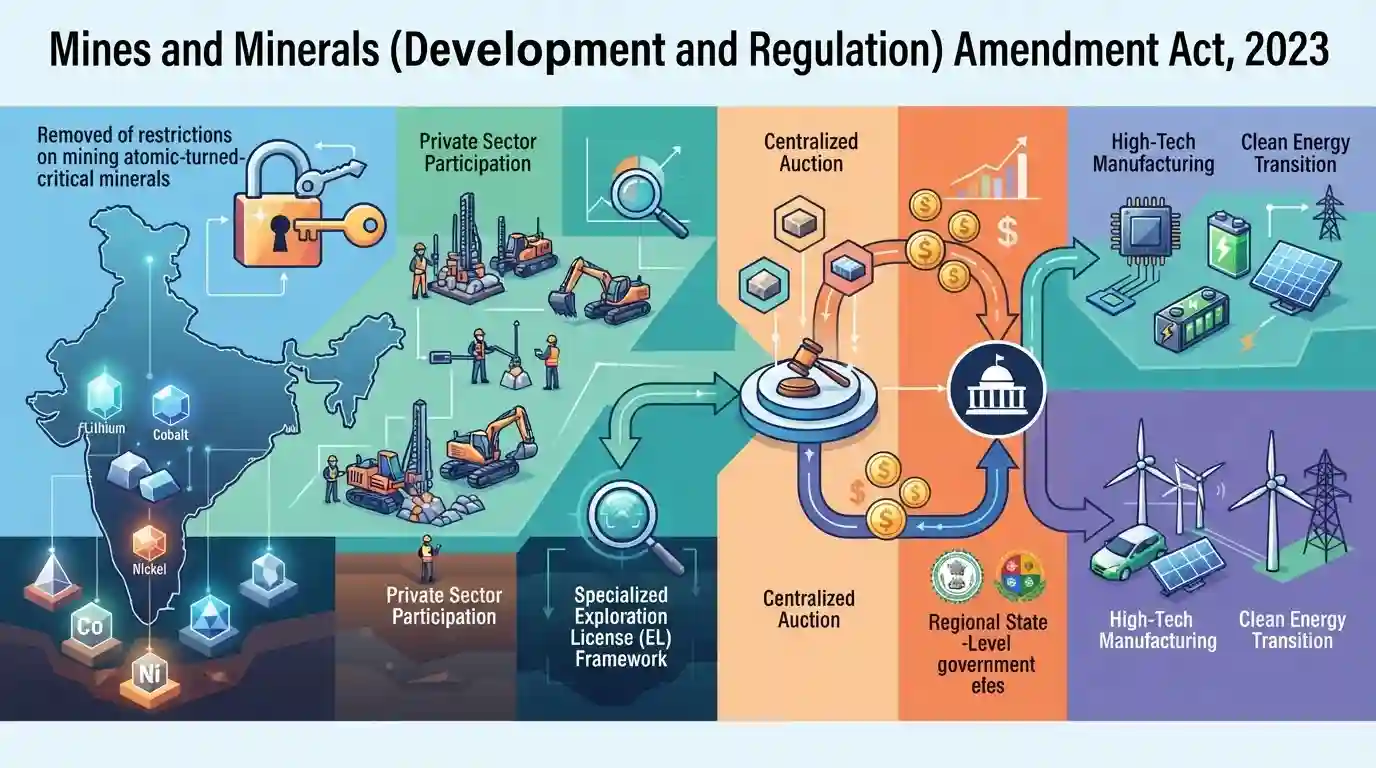
কেন এটি গুরুত্বপূর্ণ
Securing a resilient domestic supply chain of critical minerals like Lithium and Rare Earth Elements is a strategic priority for India's clean energy goals, domestic semiconductor ambitions, and defense manufacturing. Understanding the legislative updates under the MMDR Act, 1957, is vital for questions relating to resource geography, center-state federal dynamics, and overall industrial growth.
সারসংক্ষেপ
This article analyzes the structural reforms introduced by the Mines and Minerals (Development and Regulation) Amendment Act, 2023. By allowing private sector participation in the mining of atomic-turned-critical minerals (such as lithium) and introducing a specialized Exploration License (EL) framework for deep-seated deposits, the amendment addresses India's high import dependency on technology-critical elements. It also centralizes the auctioning of strategic critical minerals while preserving state government revenues, aiming to catalyze a robust domestic supply chain for high-tech manufacturing and the clean energy transition.
মূল বিষয়
- Atomic Minerals Delisting: The amendment omits six critical minerals (including Lithium, Titanium, Beryllium, Niobium, Tantalum, and Zirconium) from the 'atomic minerals' list, thereby allowing the private sector to explore and mine these elements.
- Exploration License (EL) Framework: It introduces a new concession category called the 'Exploration License' for 29 deep-seated and critical minerals. This allows private entities to bring in advanced technology for deep exploration through a reverse-bidding auction process.
- Centralized Auctions for Critical Minerals: It empowers the Central Government to exclusively auction composite licenses and mining leases for critical minerals, which aims to expedite strategic mineral allocation.
- Federal Revenue Distribution: Despite the central auction mechanism, the auction premiums and royalty revenues from critical minerals will continue to accrue entirely to the respective State Governments, maintaining fiscal federalism.
- Import Substitution & Clean Energy Transition: By expanding domestic exploration, the act seeks to secure the supply chains for key green-transition technologies (like EV batteries, semiconductors, and solar panels) and decrease heavy import dependence on countries like China.
গুরুত্বপূর্ণ শব্দ
Mines and Minerals (Development and Regulation) Amendment Act, 2023

A 2023 legislative update removing six minerals, including lithium, from the restricted atomic list to allow private exploration. It empowers the central government to exclusively auction mining licenses for critical and deep-seated minerals.
UPSC context
GS Paper 3 (Economy/Resources). Tested in questions on private sector mining participation, regulatory reforms, and supply chain security.
Mines and Minerals (Development and Regulation) Act, 1957
The primary central legislation governing India's mining sector. It regulates the development, exploration, and extraction of minerals across states, establishing federal oversight to ensure systematic resource allocation and conservation.
UPSC context
GS Paper 2 and 3. Forms the foundational legal framework tested in questions about mineral rights, state vs. central powers, and resource governance.
National Critical Mineral Mission (NCMM)
A central initiative launched in 2025 to secure India's critical mineral supply chain. It funds domestic exploration, overseas acquisitions, and recycling frameworks to support clean energy transitions and reduce import dependencies.
UPSC context
GS Paper 3 (Energy Security). Vital for answering questions on India's net-zero targets, EV manufacturing, and strategic resource self-reliance.
Minerals Security Partnership (MSP)
A US-led alliance of 14 nations and the EU aimed at securing global critical mineral supply chains. Joined by India in 2023, it catalyzes investments to reduce geopolitical dependencies in clean energy technologies.
UPSC context
GS Paper 2 (International Relations). Important for topics on resource geopolitics, global alliances, and countering monopolistic supply chains in critical minerals.
প্রিলিমস ফাঁদ
The auction premiums and royalties from the 24 centrally-auctioned critical minerals accrue to the Union Government to fund green transition initiatives.
Under the 2023 Amendment, while the Central Government conducts the auctions to fast-track security, 100% of the auction premiums and royalties continue to accrue entirely to the State Governments.
সংযুক্ত স্থির ধারণা
How does the MMDR Act divide regulatory powers between Centre and States?
- Minor Minerals Regulation: State Governments are fully empowered to frame rules, grant concessions, and collect royalties for minor minerals (e.g., sand, gravel, clay) under Section 15.
- Major Minerals Regulation: The Central Government regulates major minerals, though State Governments execute the actual leases and collect the revenue.
What is a Composite License in Indian mining law?
- Definition & Stage: Introduced in 2015, it is a single two-stage concession combining a Prospecting License (PL) and a Mining Lease (ML).
- Purpose: It allows a single bidder to transition seamlessly from exploring a resource-indicated area to active commercial extraction without needing separate bidding.
আন্তঃবিষয় প্যাটার্ন
Critical Minerals & Clean Energy Transition
Securing lithium and cobalt domestic supply chains directly underpins India's 2070 Net-Zero target, impacting EV adoption and domestic semiconductor/solar manufacturing.
Asymmetric Federalism in Resource Governance
Centralized auctioning combined with 100% state revenue accrual illustrates a pragmatic cooperative federalism balancing national strategic security with state fiscal rights.

Expect a multi-statement question testing the split between Central auction authority and 100% State revenue retention under the 2023 Act.
সংযুক্ত PYQ · 3
সংযুক্ত PYQ · 3
- 2025PrelimsGS1
Consider the following statements : I. India has joined the Minerals Security Partnership as a member. II. India is a resource-rich country in all the 30 critical minerals that it has identified. III. The Parliament in 2023 has amended the Mines and Minerals (Development and Regulation) Act, 1957 empowering the Central Government to exclusively auction mining lease and composite license for certain critical minerals. Which of the statements given above are correct?
- 2026PrelimsGS1
Which of the following statements about Rare Earth Elements (REEs) and Critical Minerals is/are correct ? 1. Modern technological innovations including Artificial Intelligence, robotics and space exploration extensively utilise Rare Earth Elements (REEs). 2. China has the highest share in mining of REEs followed by India. 3. The Government of India launched the National Critical Mineral Mission (NCMM) in 2025 to establish a robust framework for self-reliance in the critical mineral sector. 4. Rare Earth Elements are a set of 13 metallic elements. Select the answer using the code given below :
- 2025MainsGS3
Mineral resources are fundamental to the country's economy and these are exploited by mining. Why is mining considered an environmental hazard? Explain the remedial measures required to reduce the environmental hazard due to mining.
