UN Loss and Damage Fund Payout and Climate Justice
Source:The Hindu ↗
ఇది ఎందుకు ముఖ్యం
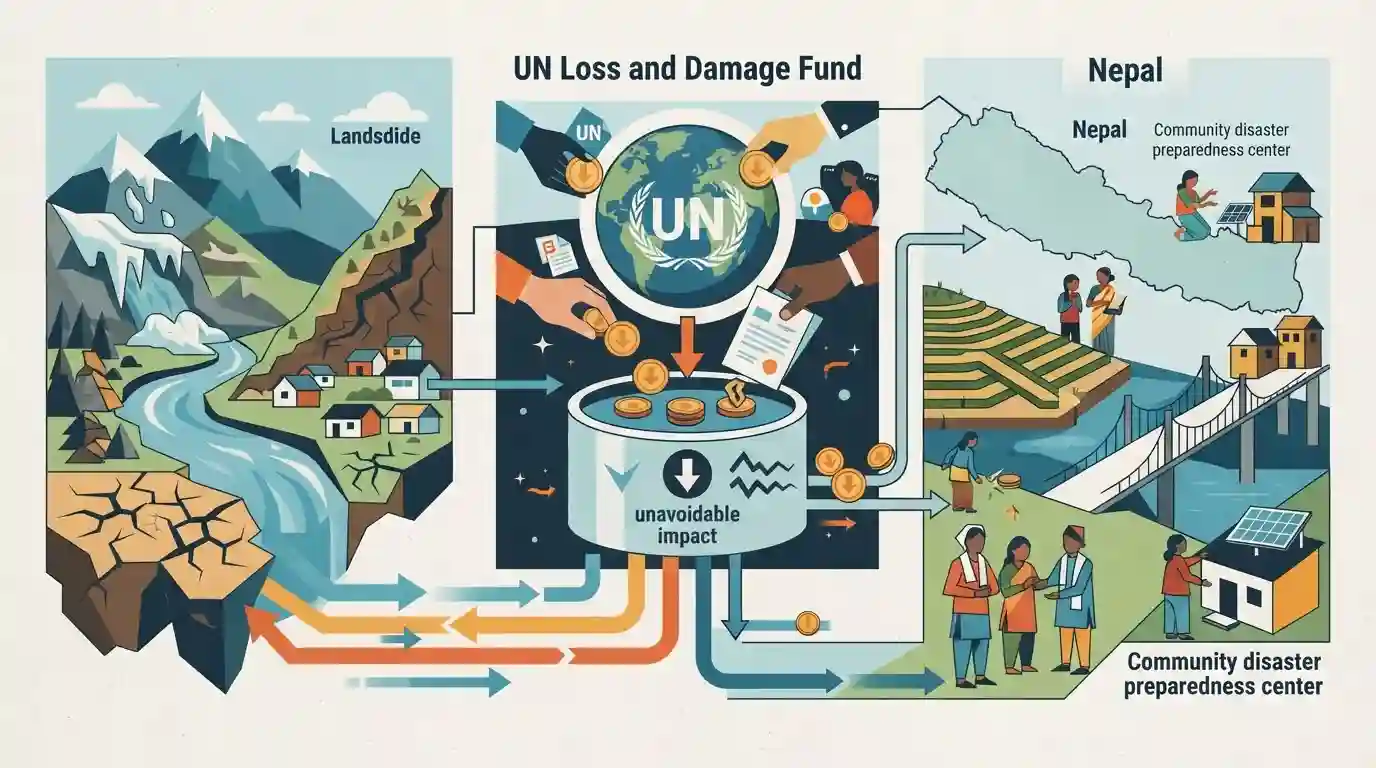
It highlights the practical execution and operationalisation of the Loss and Damage Fund agreed upon at UN climate summits, offering key insights into international climate justice, mountain ecosystem vulnerabilities (like Nepal's), and global climate finance architecture relevant to GS Paper III.
సారాంశం
An explanation of the significance of the UN Loss and Damage Fund's first payout to Nepal, highlighting its role in addressing unavoidable climate change impacts, vulnerabilities of mountain ecosystems like the Himalayas, and the broader context of global climate justice and finance.
ముఖ్య అంశాలు
- The UN Loss and Damage Fund made its historic first payout to Nepal, marking a critical milestone for climate finance directed toward addressing unavoidable climate impacts.
- Nepal faces severe climate vulnerabilities, including glacial lake outburst floods (GLOFs), erratic monsoons, and extreme weather events despite contributing minimally to global greenhouse gas emissions.
- The operationalisation of the Loss and Damage Fund addresses historical demands by developing and climate-vulnerable nations for financial compensation and support for loss and damage distinct from mitigation and adaptation funds.
- Challenges remain regarding the scale of funding, accessibility for local communities, and the long-term sustainability of resources provided by developed historical emitters.
ముఖ్యమైన పదాలు
UN Loss and Damage Fund

A specialized international financial mechanism established under UN climate talks to provide financial assistance to developing countries particularly vulnerable to the adverse effects of climate change, helping them recover from unavoidable economic and non-economic losses.
UPSC context
Important for GS Paper 3 (Environment and Climate Change, International Climate Finance). Tests understanding of global equity and climate justice mechanisms.
Paris Agreement
A landmark international treaty adopted in 2015 under the UNFCCC framework, aiming to limit global warming to well below 2°C and pursue efforts to keep it to 1.5°C above pre-industrial levels.
UPSC context
Crucial for GS Paper 3 (Environment and Biodiversity). Tests knowledge of global climate architecture, INDCs, mitigation, and adaptation frameworks.
UNFCCC
An international environmental treaty adopted in 1992 to stabilize greenhouse gas concentrations in the atmosphere, serving as the foundational parent treaty for annual Conferences of the Parties (COP).
UPSC context
Core concept for GS Paper 3 (Environmental Pollution and Degradation). Evaluates understanding of international environmental conventions and institutional frameworks.
ప్రిలిమ్స్ ఉచ్చు
The Loss and Damage Fund finances pre-emptive adaptation projects like seawalls and drought-resistant crops to prevent climate disasters.
Aspirants often confuse the Loss and Damage Fund with adaptation or mitigation funds. L&D specifically targets unavoidable impacts and ex-post reconstruction, not preventive measures.
అనుసంధానమైన స్థిర భావనలు
What are the key financial pillars and institutional mechanisms under the UNFCCC framework?
- Green Climate Fund (GCF):: Established at COP16, it serves as the main operating entity of the UNFCCC financial mechanism to assist developing nations in mitigation and adaptation.
- Adaptation Fund:: Created under the Kyoto Protocol and later linked to the Paris Agreement, it funds concrete adaptation projects in developing countries most vulnerable to climate change.
- Loss & Damage Fund:: Operationalised at COP28 to provide financial and technical assistance to developing countries suffering from unavoidable climate change impacts and extreme events.
అంతర-అంశ నమూనాలు
Himalayan Ecosystems + Transboundary Water Governance
Himalayan climate vulnerability (GLOFs, retreating glaciers) links mountain ecosystem security directly to India's transboundary water diplomacy and internal disaster management strategies.
Climate Justice + UNFCCC Financial Architecture
The L&D Fund operationalises the 'polluter pays' principle in international climate law, shifting discussions from voluntary aid to reparative climate justice under UNFCCC.

Loss & Damage Fund governance (COP27/28 origins, World Bank interim host, distinct from GCF/Adaptation Fund) is high-yield for Prelims.
అనుసంధాన PYQలు · 2
అనుసంధాన PYQలు · 2
- 2021MainsGS3
Describe the major outcomes of the 26th session of the Conference of the Parties (COP) to the United Nations Framework Convention on Climate Change (UNFCCC). What are the commitments made by India in this conference?
- 2025MainsGS3
Write a review on India's climate commitments under the Paris Agreement (2015) and mention how these have been further strengthened in COP26 (2021). In this direction, how has the first Nationally Determined Contribution intended by India been updated in 2022?
