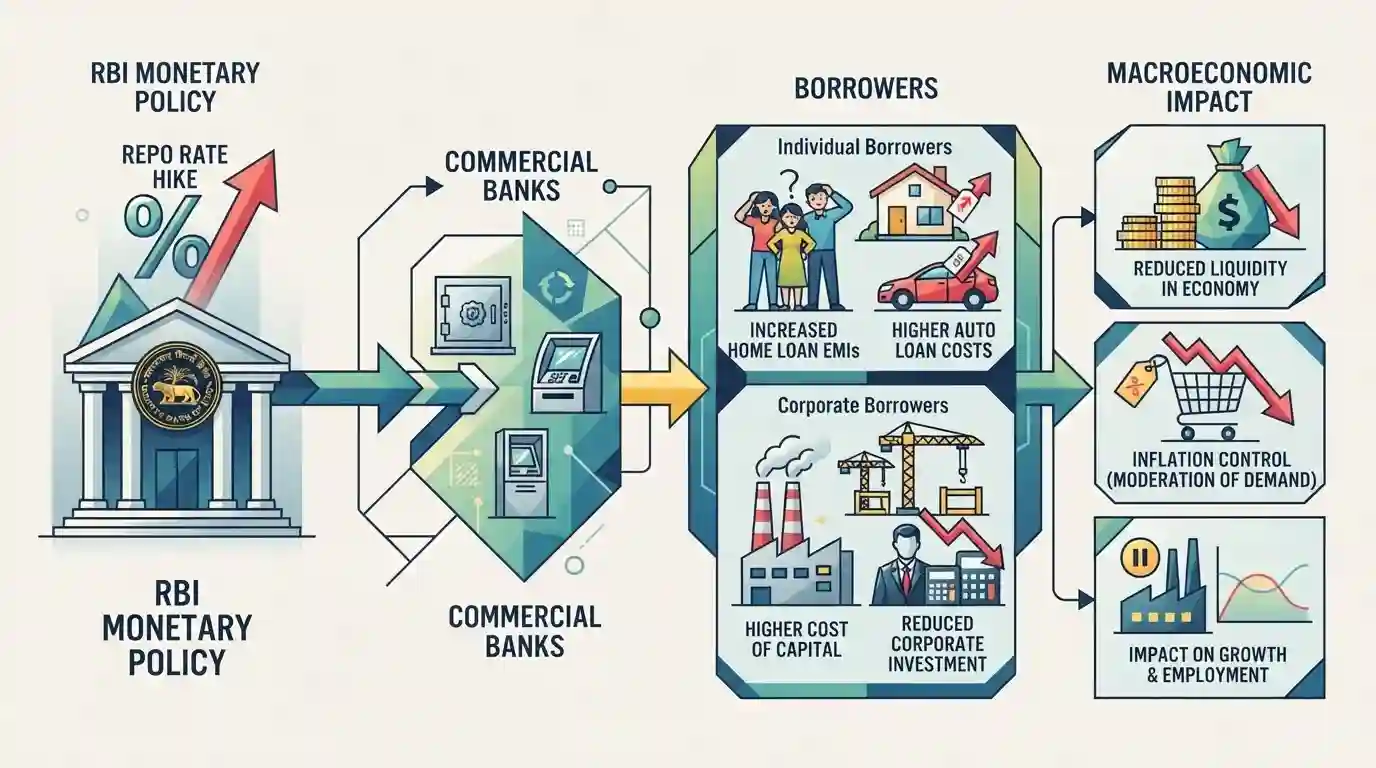
Reserve Bank Repo Rate Hike Transmission and Borrowers Impact
Source:The Hindu ↗
हे का महत्त्वाचे आहे
Understanding how repo rate adjustments affect retail borrowers and the wider economy is fundamental for aspirants studying monetary policy transmission, inflation targeting, and central banking in India.
सारांश
The article explains the transmission mechanism of a repo rate hike by the Reserve Bank of India on individual and corporate borrowers, detailing how changes in policy rates translate to higher borrowing costs, increased EMIs, and broader impacts on macroeconomic liquidity and inflation management.
मुख्य मुद्दे
- A repo rate hike directly impacts borrowers by increasing the cost of loans linked to external benchmarks or marginal cost of funds-based lending rate (MCLR).
- Higher repo rates are deployed by the central bank to rein in liquidity and counter inflationary pressures in the economy.
- Existing borrowers face higher EMIs or extended loan tenures, which can dampen consumer demand and private investment.
महत्त्वाच्या संज्ञा
Reserve Bank of India

India's central banking institution that controls the monetary policy of the Indian rupee, regulates the banking system, and acts as a lender of last resort.
UPSC context
UPSC Prelims & Mains (GS III): Core institution for monetary management, banking regulation, and macro-financial stability in India.
Monetary Policy Committee
A statutory body headed by the RBI Governor responsible for fixing the benchmark interest rate (repo rate) to contain inflation within targeted limits.
UPSC context
UPSC Prelims & Mains (GS III): Tests understanding of inflation-targeting framework, institutional monetary governance, and interest rate decisions.
पूर्वपरीक्षा सापळा
A repo rate hike immediately increases the interest rate for every existing borrower across all lending rate structures without exception.
A repo rate hike automatically and instantly raises interest rates for all existing borrowers. In reality, legacy MCLR-linked loans experience transmission lags, whereas EBLR-linked loans adjust much faster.
संबंधित स्थिर संकल्पना
What are the key instruments of monetary policy used by the Reserve Bank of India?
- Policy Rates: Operates through instruments like repo rate, reverse repo rate, standing deposit facility (SDF), and marginal standing facility (MSF) to manage overnight liquidity.
- Reserve Ratios: Includes Cash Reserve Ratio (CRR) and Statutory Liquidity Ratio (SLR) which mandate banks to maintain a specified share of deposits in liquid assets or with RBI.
- Open Market Operations: Involves outright purchase or sale of government securities (G-secs) to infuse or absorb durable systemic liquidity.
आंतर-विषय नमुने
Monetary Policy vs. Fiscal Deficit Trade-offs
RBI's inflation-targeting mandate (4% +/- 2%) directly interacts with fiscal deficit targets and government borrowing costs, creating a delicate policy trade-off during high growth phases.
EBLR Transmission and Bank Asset Quality
Faster monetary transmission via External Benchmark Lending Rates (EBLR) impacts retail loan books of Public Sector Banks, directly influencing banking sector asset quality and NPA cycles.

Expect an assertion-reasoning question on monetary transmission lags and the structural difference between EBLR and MCLR mechanisms.
संबंधित PYQ · 2
संबंधित PYQ · 2
- 2024MainsGS3
What are the causes of persistent high food inflation in India? Comment on the effectiveness of the monetary policy of the RBI to control this type of inflation.
- 2022PrelimsGS1
With reference to the Indian economy, consider the following statements: 1. If the inflation is too high, Reserve Bank of India (RBI) is likely to buy government securities. 2. If the rupee is rapidly depreciating, RBI is likely to sell dollars in the market. 3. If interest rates in the USA or European Union were to fall, that is likely to induce RBI to buy dollars. Which of the statements given above are correct?
