Election Commission Form 7 Controversy and Electoral Roll Deletions
Source:The Hindu ↗
Why It Matters
The management and purity of electoral rolls are foundational to free and fair elections. The misuse of Form 7 for bulk voter deletions demonstrates practical vulnerabilities in election administration and is highly relevant for GS Paper 2 questions on electoral reforms, the functioning of the Election Commission, and the Representation of the People Act.
Summary
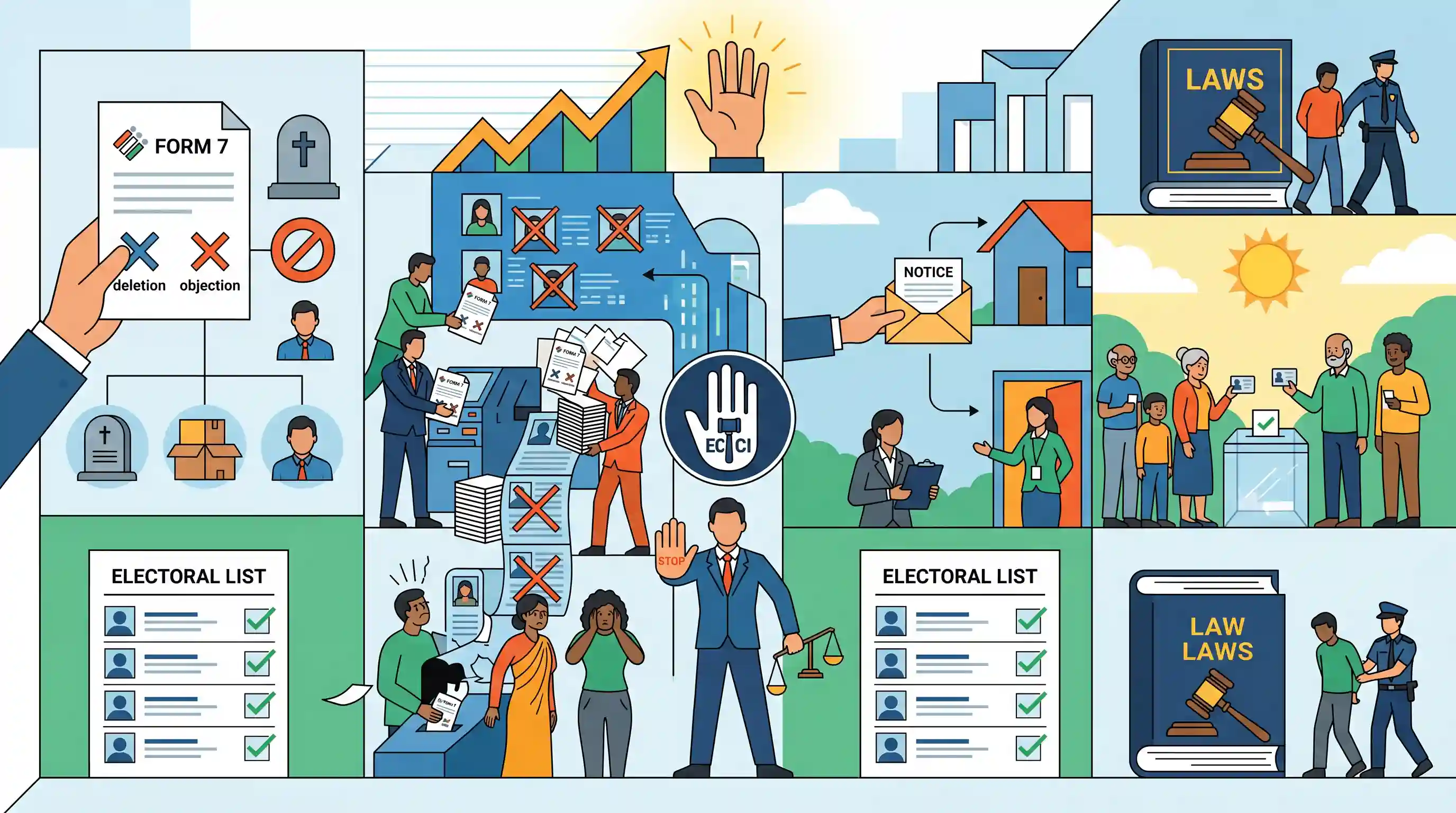
Form 7 of the Election Commission of India (ECI) is used by citizens to seek the deletion or object to the inclusion of a name in the electoral roll (such as in cases of death, shifting, or duplicate entries). Recently, a major controversy emerged in states like Andhra Pradesh, where bulk Form 7 applications were allegedly filed by political parties to mass-delete the names of voters sympathetic to rival parties. This sparked concerns over electoral manipulation and the disenfranchisement of legitimate voters. The ECI and state Chief Electoral Officers intervened, asserting that strict verification protocols—including issuing notices to the affected individuals and conducting field verifications—must be followed before any deletions are made. The controversy highlights vulnerabilities in electoral roll management and the potential misuse of digital electoral services, emphasizing the necessity of stringent penal actions under the Representation of the People Act, 1950, to protect free and fair elections.
Key Points
- Form 7 is a statutory form provided by the Election Commission of India (ECI) for citizens to object to the inclusion of a name or seek the deletion of an existing name in the electoral roll.
- Political controversies erupted in states like Andhra Pradesh when thousands of bulk Form 7 applications were filed online, allegedly by political parties attempting to disenfranchise rival supporters ahead of elections.
- In response to the surge in deletion requests, state Chief Electoral Officers (CEOs) clarified that no voter can be deleted arbitrarily; Electoral Registration Officers (EROs) must issue a notice and conduct a field verification.
- Filing false Form 7 applications attracts penal provisions under Section 31 of the Representation of the People Act, 1950, which deals with making false declarations in connection with the preparation of electoral rolls.
- The incident highlights the challenges in maintaining the purity of electoral rolls and the need for robust systemic safeguards against the digital misuse of electoral services.
Important Terms
Election Commission of India (ECI)

A permanent constitutional body (Article 324) responsible for the superintendence, direction, and control of elections to Parliament, State Legislatures, and the offices of President and Vice-President.
UPSC context
GS-II: Constitutional Bodies. Core for understanding free and fair elections and administrative oversight of the democratic process.
Representation of the People Act, 1950
Legislation providing the legal framework for the allocation of seats, delimitation of constituencies, and the preparation and revision of electoral rolls in India.
UPSC context
GS-II: Polity. Distinguishes from RPA 1951; focuses on structural and administrative prerequisites for voter registration.
Form 7
An ECI-prescribed statutory form used to object to the inclusion of a name or request the deletion of an existing entry from the electoral roll.
UPSC context
GS-II: Electoral Reforms. Tests knowledge of procedural vulnerabilities and safeguards against mass disenfranchisement or electoral manipulation.
Form 6
The official application form used by citizens for fresh voter registration or for shifting their registration between different constituencies.
UPSC context
GS-II: Governance. Relevant for voter inclusion and the role of ECI in expanding the democratic franchise.
Form 8
A form used for correcting existing details in the electoral roll or for requesting a replacement Voter ID card (EPIC).
UPSC context
GS-II: Polity. Important for understanding voter database maintenance and Special Intensive Revision (SIR) processes.
Prelims Trap
"The Representation of the People Act, 1951 deals with the preparation, revision, and correction of electoral rolls."
The RPA 1950 governs electoral rolls, delimitation, and seat allocation. The RPA 1951 governs the actual conduct of elections, corrupt practices, and candidate disqualifications. Aspirants frequently mix these up.
Static Concepts Connected
What are the core differences between RPA 1950 and RPA 1951?
- RPA 1950: Governs the allocation of seats, delimitation of constituencies, and the preparation/revision of electoral rolls.
- RPA 1951: Governs the actual conduct of elections, qualifications/disqualifications of candidates, election offenses, and resolving election disputes.
- Civil Court Bar: Section 30 of the RPA 1950 explicitly bars civil courts from entertaining questions regarding electoral roll preparation or ERO actions.
How do the roles of Electoral Registration Officer (ERO) and Returning Officer (RO) differ?
- ERO: A statutory authority appointed under RPA 1950. Solely responsible for the preparation, revision, and correction of the electoral roll for a specific constituency.
- RO: Appointed under RPA 1951. Responsible for the actual conduct of the election in the constituency, including nomination scrutiny, polling supervision, and result declaration.
- Chief Electoral Officer: Supervises the election machinery at the state level, overseeing both the EROs (roll preparation) and ROs (election conduct) under the ECI's direction.
Cross-Topic Patterns
Aadhar-Voter ID linking & Privacy
The mass-deletion controversy connects to the Election Laws (Amendment) Act 2021 (Aadhar-Voter ID linking). Both highlight the tension between sanitizing electoral rolls and the risk of targeted digital disenfranchisement.
Article 324 and ECI's plenary powers
ECI's emergency directives to Electoral Registration Officers (EROs) requiring strict field verification invokes its plenary powers under Article 324 to ensure the 'purity of elections' when statutory rules are exploited.

Expect a multi-statement Prelims question testing the exact boundaries between RPA 1950 (rolls) and 1951 (conduct) alongside ERO/RO roles.
Linked PYQs · 5
Linked PYQs · 5
- 2017PrelimsGS1
For election to the Lok Sabha, a nomination paper can be filed by
- 2020PrelimsGS1
Consider the following statements: 1. According to the Constitution of India, a person who is eligible to vote can be made a minister in a State for six months even if he/she is not a member of the Legislature of that State. 2. According to the Representation of People Act, 1951, a person convicted of a criminal offence and sentenced to imprisonment for five years is permanently disqualified from contesting an election even after his release from prison. Which of the statements given above is/are correct?
- 2022MainsGS2
Discuss the procedures to decide the disputes arising out of the election of a Member of the Parliament or State Legislature under The Representation of the People Act, 1951. What are the grounds on which the election of any returned candidate may be declared void ? What remedy is available to the aggrieved party against the decision ? Refer to the case laws.
- 2017MainsGS2
To enhance the quality of democracy in India the Election Commission of India has proposed electoral reforms in 2016. What are the suggested reforms and how far are they significant to make democracy successful?
- 2020MainsGS2
There is a need for simplification of procedure for disqualification of persons found guilty of corrupt practices under the Representation of Peoples Act". Comment.
