Spinal Muscular Atrophy Drug Access and Health Policy Funding
Source:The Hindu ↗
ఇది ఎందుకు ముఖ్యం
It underscores the structural policy and financial dilemmas India faces in addressing rare diseases like Spinal Muscular Atrophy, balancing the constitutional right to health with fiscal constraints and equitable resource distribution.
సారాంశం
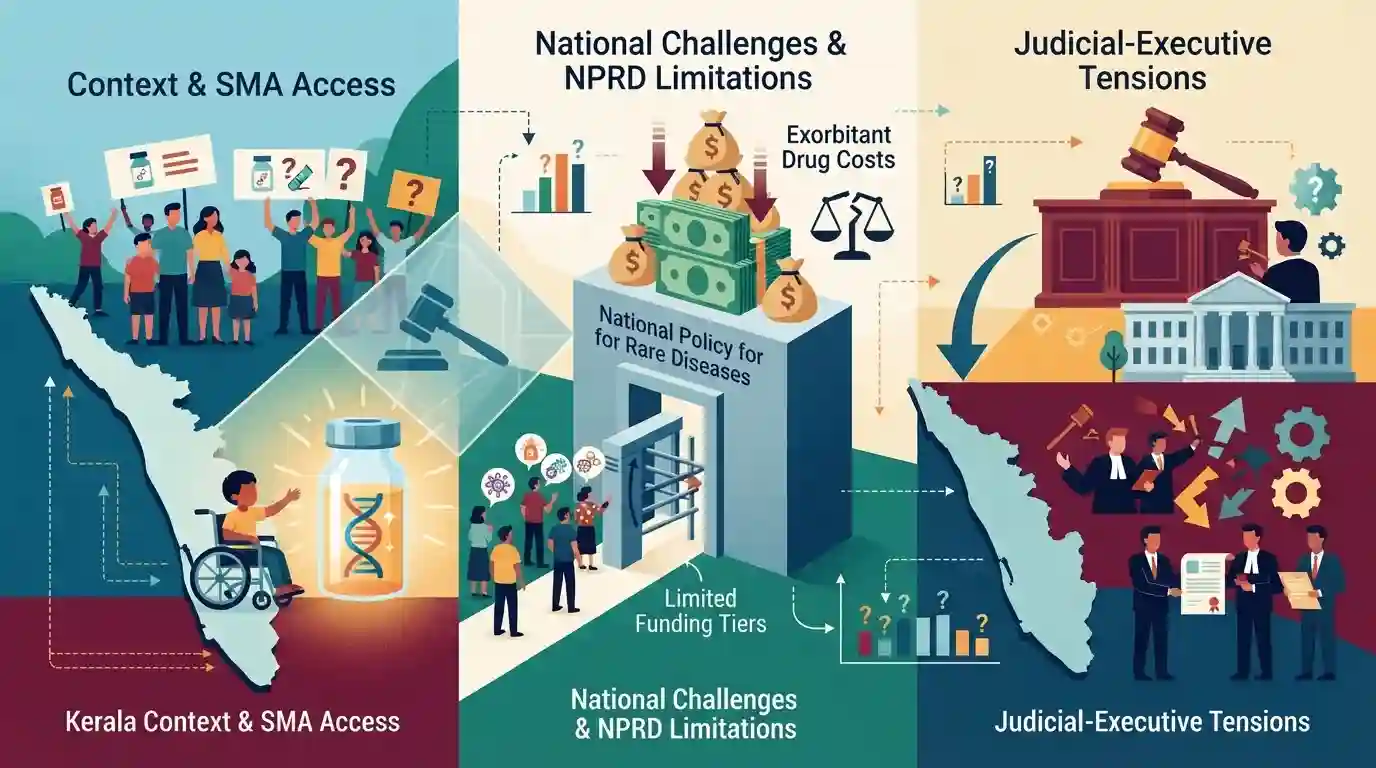
The article explains the controversy in Kerala surrounding the access and state funding for Spinal Muscular Atrophy (SMA) drugs, highlighting the broader national challenges of treating rare diseases, the limitations of the National Policy for Rare Diseases (NPRD), exorbitant drug costs, and the judicial-executive tensions over resource allocation for health equity.
ముఖ్య అంశాలు
- Spinal Muscular Atrophy (SMA) is a severe, rare genetic disorder affecting motor nerve cells, often requiring exceptionally expensive life-saving drugs like Risdiplam, Nusinersen, or Onasemnogene abeparvovec (Zolgensma).
- A major controversy erupted in Kerala regarding state funding, accessibility, and court interventions for children suffering from SMA seeking exorbitant medical treatment.
- The National Policy for Rare Diseases (NPRD) faces implementation hurdles, particularly regarding financial support, limited centers of excellence, and reliance on crowdfunding mechanisms which are often inadequate and slow for high-cost therapies.
- Healthcare equity, right to health under Article 21, and state obligations versus budgetary constraints form the core legal and ethical dimensions of the debate.
ముఖ్యమైన పదాలు
National Policy for Rare Diseases (NPRD)

A policy formulated by the Ministry of Health and Family Welfare to address the prevention and treatment of rare disorders, featuring patient categorisation and financial support structures.
UPSC context
Mains GS Paper II: Issues relating to development and management of Social Sector/Services relating to Health. Tests understanding of public health policy frameworks and resource constraints.
Crowdfunding for Rare Diseases portal
A dedicated digital platform established by the Union Ministry of Health to bridge funding gaps by facilitating voluntary donations and corporate contributions for rare disease patients.
UPSC context
Mains GS Paper II: Governance, transparency, and digital interventions in social welfare delivery systems. Tests alternate financing models for public health.
Spinal Muscular Atrophy (SMA)
A severe genetic disorder that leads to progressive muscle wasting and weakness due to the loss of motor neurons, requiring extremely expensive lifelong drug therapies.
UPSC context
Prelims/Mains GS Paper II: Health equity, rare diseases, and challenges in managing high-cost medical treatments under state healthcare frameworks.
అనుసంధానమైన స్థిర భావనలు
What are the key provisions and funding mechanisms under the National Policy for Rare Diseases (NPRD)?
- Financial Support: Classifies rare diseases into three groups, offering financial assistance of up to ₹50 lakh for patients under the Rashtriya Arogya Nidhi (RAN) scheme.
- Centres of Excellence: Establishes designated Centres of Excellence (CoEs) across India for diagnosis, prevention, and treatment of specified rare disorders.
- Crowdfunding Portal: Utilises digital crowdfunding portals to bridge the massive cost gap for ultra-orphan therapies through corporate and voluntary donations.
అంతర-అంశ నమూనాలు
Right to Health vs. Fiscal Federalism
Judicial orders directing state governments to procure multi-crore orphan drugs test the doctrine of separation of powers and the limits of enforceable socio-economic rights under the Indian Constitution.
State Welfare vs. Crowdfunding in Healthcare
The reliance on digital crowdfunding portals under the NPRD shifts the burden of life-saving care from state-guaranteed welfare to philanthropic uncertainties.

NPRD funding limits, Article 21 Right to Health, and rare disease policy bottlenecks will form a statement-based prelims question.
అనుసంధాన PYQలు · 2
అనుసంధాన PYQలు · 2
- 2024MainsGS2
In a crucial domain like the public healthcare system the Indian State should play a vital role to contain the adverse impact of marketisation of the system. Suggest some measures through which the State can enhance the reach of public healthcare at the grassroots level.
- 2018MainsGS2
Appropriate local community-level healthcare intervention is a prerequisite to achieve 'Health for All' in India. Explain.
