HECI Bill 2025: Overhauling Higher Education Regulation in India
Source:Indian Express ↗
Why It Matters
The establishment of HECI represents one of the most substantial structural shifts in India's higher education governance since independence. It shifts the paradigm from heavy-handed micromanagement to a modern, separated-powers model of governance. For UPSC aspirants, understanding this transition is crucial for questions on education reforms, regulatory bodies, and the ongoing implementation of the NEP 2020.
Summary
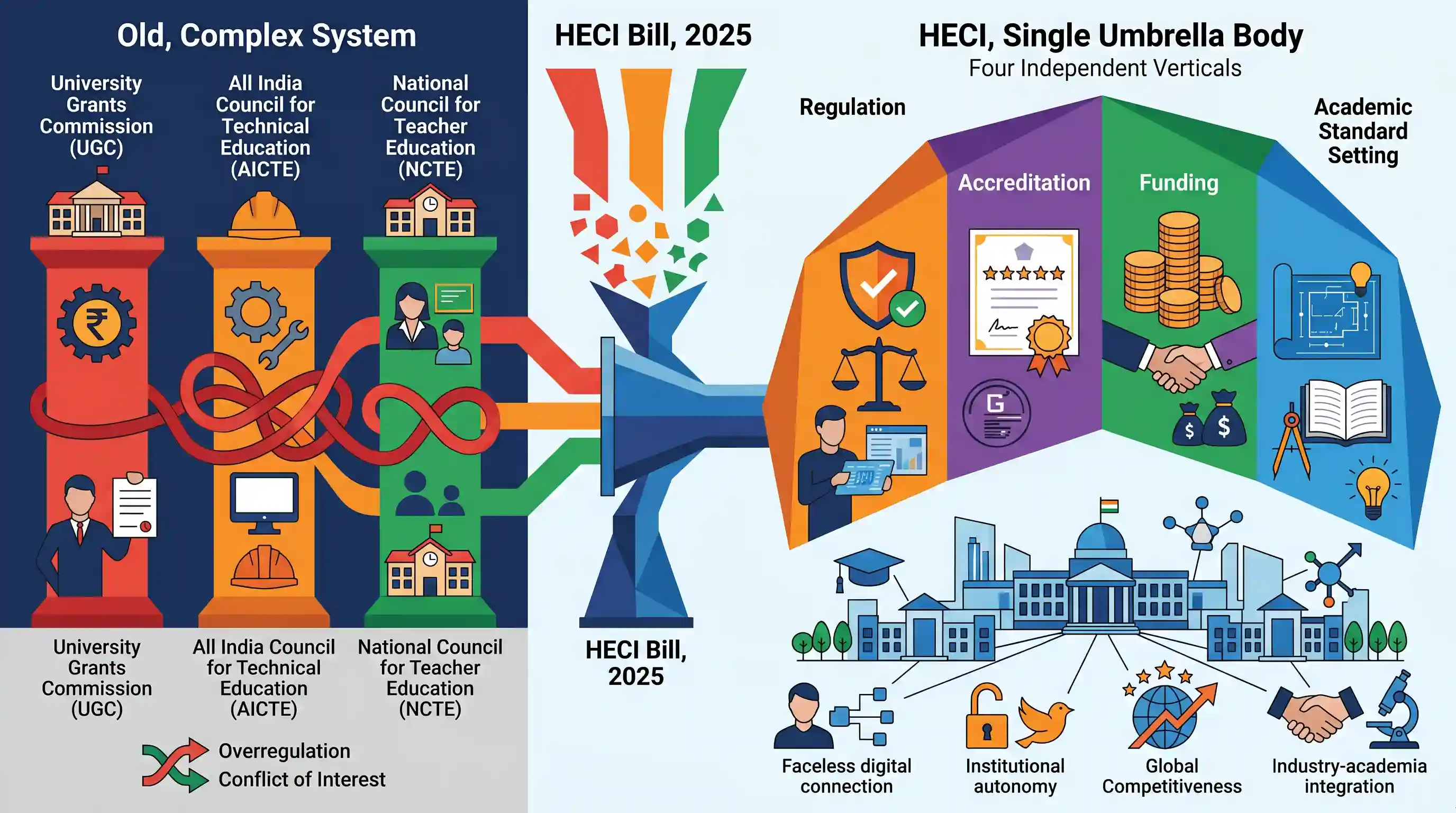
The Centre plans to introduce the Higher Education Commission of India (HECI) Bill, 2025 during the Winter Session of Parliament. A landmark reform rooted in the National Education Policy (NEP) 2020, the Bill seeks to dissolve existing regulatory bodies—such as the University Grants Commission (UGC), the All India Council for Technical Education (AICTE), and the National Council for Teacher Education (NCTE)—into one overarching umbrella body. The proposed HECI will function through four independent verticals handling regulation, accreditation, funding, and academic standard setting. By separating these distinct functions, the government aims to eliminate conflicts of interest, reduce overregulation, and improve the overall quality and global competitiveness of Indian higher education institutions.
Key Points
- The HECI Bill 2025 aims to dismantle the currently fragmented regulatory ecosystem in higher education by replacing the UGC, AICTE, and NCTE with a single overarching authority.
- The legislation implements a core recommendation of the National Education Policy (NEP) 2020 to introduce 'light but tight' regulation.
- HECI will be structured with four independent verticals to avoid conflicts of interest: NHERC (regulation), NAC (accreditation), HEGC (funding), and GEC (academic standard-setting).
- The separation of grant-giving (HEGC) from regulation (NHERC) resolves longstanding structural flaws present in the current UGC-led framework.
- The reform intends to boost institutional autonomy, improve the global competitiveness of Indian universities, and raise the standard of higher and technical education.
Important Terms
Higher Education Commission of India (HECI)

A proposed single overarching regulator for Indian higher education (excluding medical and legal), replacing bodies like UGC and AICTE to ensure "light but tight" regulation.
UPSC context
GS Paper II: Statutory/regulatory bodies. Tests knowledge of administrative reforms and federal challenges in education governance.
National Education Policy (NEP) 2020
A comprehensive framework launched in 2020 to transform India's education system by 2040, emphasizing multidisciplinary learning, flexibility, and the creation of a single regulator.
UPSC context
GS Paper II: Social Sector (Education). Tests understanding of long-term policy vision and structural changes in human resource development.
National Higher Education Regulatory Council (NHERC)
The first vertical of HECI responsible for unified regulation of all higher education institutions, focusing on transparent self-disclosure rather than traditional inspections.
UPSC context
GS Paper II: Governance. Tests knowledge of the 'separation of powers' principle applied to sector-specific regulation.
National Accreditation Council (NAC)
The second vertical of HECI designed as a 'meta-accreditor' to oversee the accreditation process of institutions through independent, high-quality agencies.
UPSC context
GS Paper II: Quality assurance in governance. Focuses on mechanisms to improve global rankings of Indian universities.
Higher Education Grants Council (HEGC)
The third vertical of HECI tasked with managing funding and grants for higher education institutions based on transparent, merit-linked criteria.
UPSC context
GS Paper II: Resource allocation. Tests understanding of fiscal autonomy versus regulatory control in public institutions.
General Education Council (GEC)
The fourth vertical of HECI responsible for setting academic standards and defining learning outcomes through the National Higher Education Qualification Framework (NHEQF).
UPSC context
GS Paper II: Education standards. Tests knowledge of curriculum-standardization and its impact on student employability.
University Grants Commission (UGC)
The statutory body established in 1956 for coordinating and maintaining standards in universities; it is slated for dissolution under the HECI Bill.
UPSC context
GS Paper II: Evolution of statutory bodies. Tests historical context of educational regulation and the rationale for its overhaul.
Prelims Trap
HECI acts as the sole regulator for all higher education in India, including medical and legal institutions.
HECI explicitly excludes medical and legal education. Bodies like the National Medical Commission (NMC) and Bar Council of India (BCI) retain their jurisdiction.
Static Concepts Connected
How is 'Education' distributed in the Seventh Schedule of the Indian Constitution?
- Concurrent List: Education was transferred to the Concurrent List (Entry 25) via the 42nd Constitutional Amendment in 1976.
- Union List: Entry 66 gives Parliament exclusive power over the coordination and determination of standards in institutions for higher education or research.
What structural flaws in the UGC model prompted the HECI reform?
- Conflict of Interest: UGC historically acted as both a grant-dispersing body and a regulator, leading to inherent conflicts and inefficiencies in governance.
- Overregulation: Panels like the Yashpal Committee (2009) noted that UGC micro-managed universities, functioning with a heavy hand that stifled institutional autonomy.
Cross-Topic Patterns
Modern Regulatory Governance
Separating regulation, accreditation, and funding mirrors structural reforms in financial governance. It prevents conflicts of interest, reflecting modern administrative best practices.
Federalism and the Concurrent List
Because education is on the Concurrent List, centralized overarching bodies like HECI often trigger debates about federal overreach and state university autonomy in GS2 Mains.

Expect a 2026 Prelims multi-statement question testing the specific functions of HECI's 4 verticals and its medical/legal exclusions.
Linked PYQs · 2
Linked PYQs · 2
- 2020MainsGS2
National Education Policy 2020 is in conformity with the Sustainable Development Goal-4 (2030). It intends to restructure and reorient education system in India. Critically examine the statement.
- 2015MainsGS2
The quality of higher education in India requires major improvements to make it internationally competitive. Do you think that the entry of foreign educational institutions would help improve the quality of higher and technical education in the country? Discuss.
