Baikonur cosmodrome history and strategic space exploration role
Source:The Hindu ↗
Why It Matters
Baikonur represents a foundational chapter in global and Indian space exploration. Its strategic geopolitical status (a Russian-operated facility in Kazakhstan) and historic role in launching India's first satellite and astronaut make it highly relevant for UPSC candidates studying the evolution of ISRO, space technology milestones, and India-Russia international cooperation.
Summary
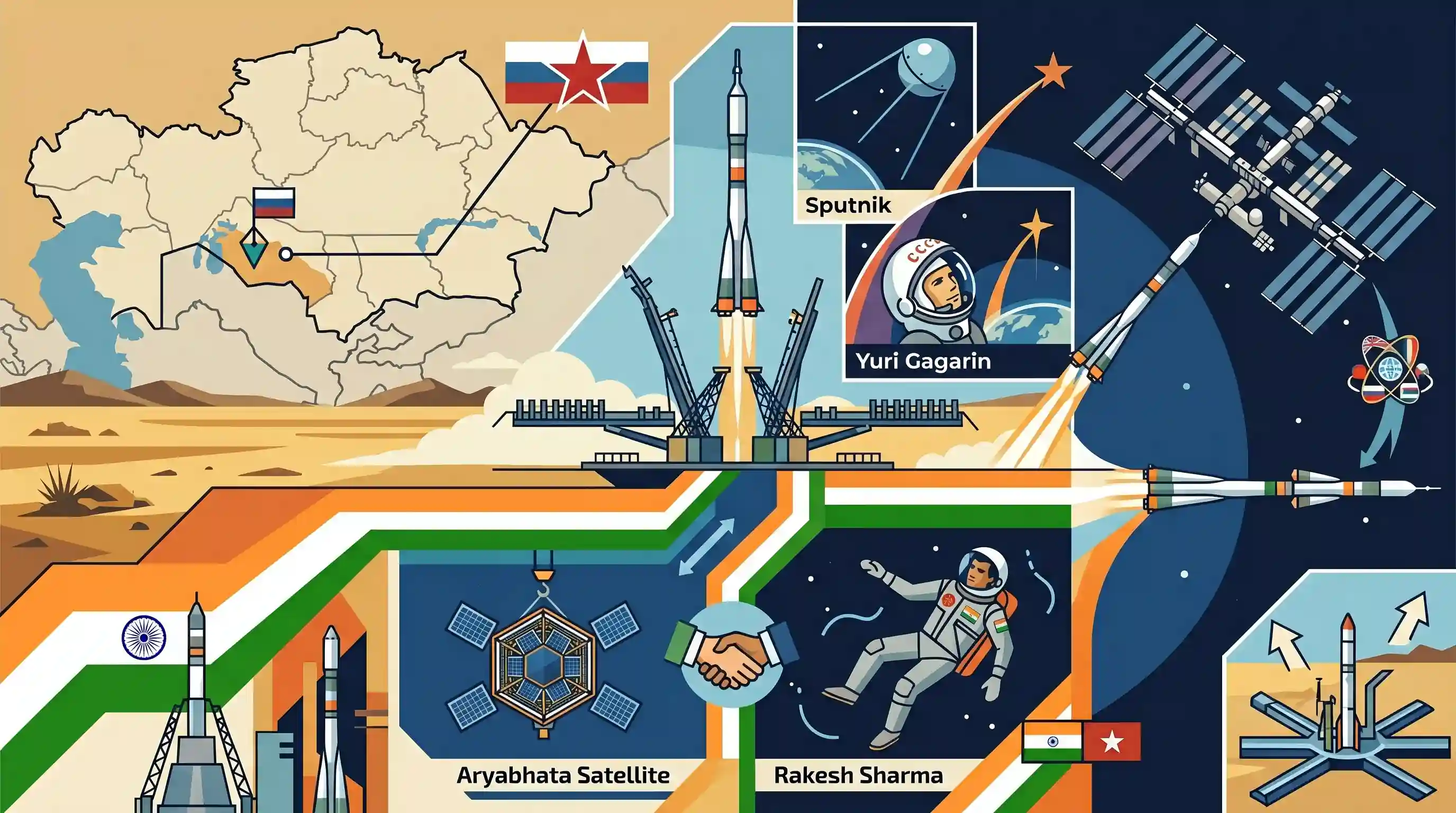
The article explores the Baikonur Cosmodrome, the world's premier and oldest space launch facility. Located in the desert steppes of Kazakhstan, it is currently leased and operated by Russia's Roscosmos. The spaceport is renowned for launching the first artificial satellite (Sputnik) and the first human in space (Yuri Gagarin). For India, it holds special significance as the launch site for its first satellite, Aryabhata, and for Rakesh Sharma's historic spaceflight. Today, despite Russia developing its own Vostochny Cosmodrome, Baikonur remains crucial for global space exploration, particularly for crewed missions to the International Space Station (ISS).
Key Points
- Baikonur Cosmodrome, located in Kazakhstan, is the world's first and largest operational space launch facility.
- Though situated in Kazakhstan, it is leased and operated by Russia (Roscosmos) under a long-term agreement valid until 2050.
- It is the birthplace of the Space Age, launching monumental milestones like Sputnik 1 (first artificial satellite) and Vostok 1 (carrying Yuri Gagarin, the first human in space).
- The cosmodrome has deep historic ties to India's space program, having launched India's first satellite, Aryabhata (1975), and carried Rakesh Sharma, the first Indian in space, aboard Soyuz T-11 in 1984.
- It continues to be a strategic asset for Russia, serving as the primary launch site for Soyuz spacecraft transporting crew and cargo to the International Space Station (ISS).
Important Terms
Baikonur Cosmodrome

The world’s first and largest operational spaceport, located in the Kazakh steppe. It is owned by Kazakhstan and leased to Russia until 2050 for its primary space activities.
UPSC context
GS I (Geography) and GS III (Space Tech); tests knowledge of strategic global space hubs and historic human spaceflight milestones.
Roscosmos
Russia’s state corporation for space activities. It manages Russia's space programs, including ISS operations, cosmonaut training, and satellite launches from Baikonur and Vostochny.
UPSC context
GS II (International Relations) and GS III (Space Tech); highlights the enduring aerospace partnership between India and Russia since the Soviet era.
Gaganyaan Mission
ISRO’s flagship mission to demonstrate indigenous human spaceflight capability by sending a three-member crew to a 400 km Low Earth Orbit for three days.
UPSC context
GS III (S&T Achievements); tests understanding of India's evolution toward self-reliant, human-rated space systems and deep-space exploration.
International Space Station (ISS)
A multinational, modular space station in Low Earth Orbit. It serves as a research laboratory for microgravity experiments involving NASA, Roscosmos, and other international partners.
UPSC context
GS III (Space Technology/Cooperation); represents the pinnacle of international scientific collaboration and is the primary destination for global crewed missions.
Aryabhata Satellite
India’s first satellite, launched in April 1975 using a Soviet rocket. It was built indigenously to study X-ray astronomy, aeronomy, and solar physics.
UPSC context
GS III (Indigenization of Tech); marks the foundational step in India's space journey and early reliance on foreign launch partners.
Vostochny Cosmodrome
A newer Russian spaceport located in the Amur Oblast of the Russian Far East, developed to reduce Russia's strategic dependency on the leased Baikonur facility.
UPSC context
GS III (Space Technology); relevant to the geopolitical shifts in global launch infrastructure and Russia’s modernization of its space industry.
Prelims Trap
Baikonur Cosmodrome, the world's oldest space launch facility, is located in the Russian Federation.
Baikonur is geographically located in Kazakhstan. Russia only leases and operates it (until 2050). UPSC often tests physical territorial location versus operational control.
Static Concepts Connected
Why are ideal spaceports usually located near the equator?
- Rotational boost: Earth's rotational speed is highest at the equator, providing rockets with a natural velocity boost and saving significant launch fuel.
- Eastward trajectory: Rockets launch eastward to ride Earth's rotation. Launching from the equator maximizes this effect, allowing for heavier payloads into orbit.
- The Baikonur exception: Unlike ideal equatorial or coastal spaceports (like Sriharikota), Baikonur was built far inland at high latitudes primarily to maintain strict Cold War military secrecy.
What defines the International Space Station (ISS) operational structure?
- Multinational collaboration: The ISS is not run by one country; it is a collaborative multinational effort involving NASA, Roscosmos, ESA, JAXA, and CSA.
- Russian modules: Russia controls specific modules (like Zvezda) essential for life support and navigation, relying heavily on Baikonur for crew and cargo launches via Soyuz spacecraft.
- Post-ISS transition: The aging ISS is set to be decommissioned by 2030, paving the way for singular national stations like China's Tiangong and India's proposed Bharatiya Antariksha Station.
Cross-Topic Patterns
Space diplomacy + Gaganyaan shift
Rakesh Sharma's 1984 flight aboard a Soviet Soyuz marks a stark contrast to India's upcoming Gaganyaan mission, highlighting ISRO's shift from Soviet reliance to indigenous human spaceflight capability.
Central Asia + Post-Soviet geography
Russia's lease of Baikonur from Kazakhstan illustrates complex post-Soviet dependencies, prompting Russia's strategic push to develop its own sovereign Vostochny Cosmodrome in the Amur region.

Expect a paired-matching question in 2026 mapping global spaceports (Baikonur, Vostochny, Kourou) to their host countries and agencies.
Linked PYQs · 3
Linked PYQs · 3
- 2016MainsGS3
Discuss India's achievements in the field of Space Science and Technology. How the application of this technology has helped India in its socio-economic development?
- 2018PrelimsGS1
With reference to India's satellite launch vehicles, consider the following statements: 1. PSLVs launch the satellites useful for Earth resources monitoring whereas GSLVs are designed mainly to launch communication satellites. 2. Satellites launched by PSLV appear to remain permanently fixed in the same position in the sky, as viewed from a particular location on Earth. 3. GSLV Mk III is a four-staged launch vehicle with the first and third stages using solid rocket motors; and the second and fourth stages using liquid rocket engines. Which of the statements given above is/are correct?
- 2024PrelimsGS1
The longest border between any two countries in the world is between :
