Thailand Political Amnesty Act and Monarchy Laws Debate
Source:The Hindu ↗
हे का महत्त्वाचे आहे
The Thai amnesty debate offers a comparative perspective on the tension between state security laws (like sedition or lèse-majesté) and fundamental democratic rights, such as freedom of speech and expression. It also impacts the political stability of Southeast Asia, which is crucial for India's Act East Policy.
सारांश
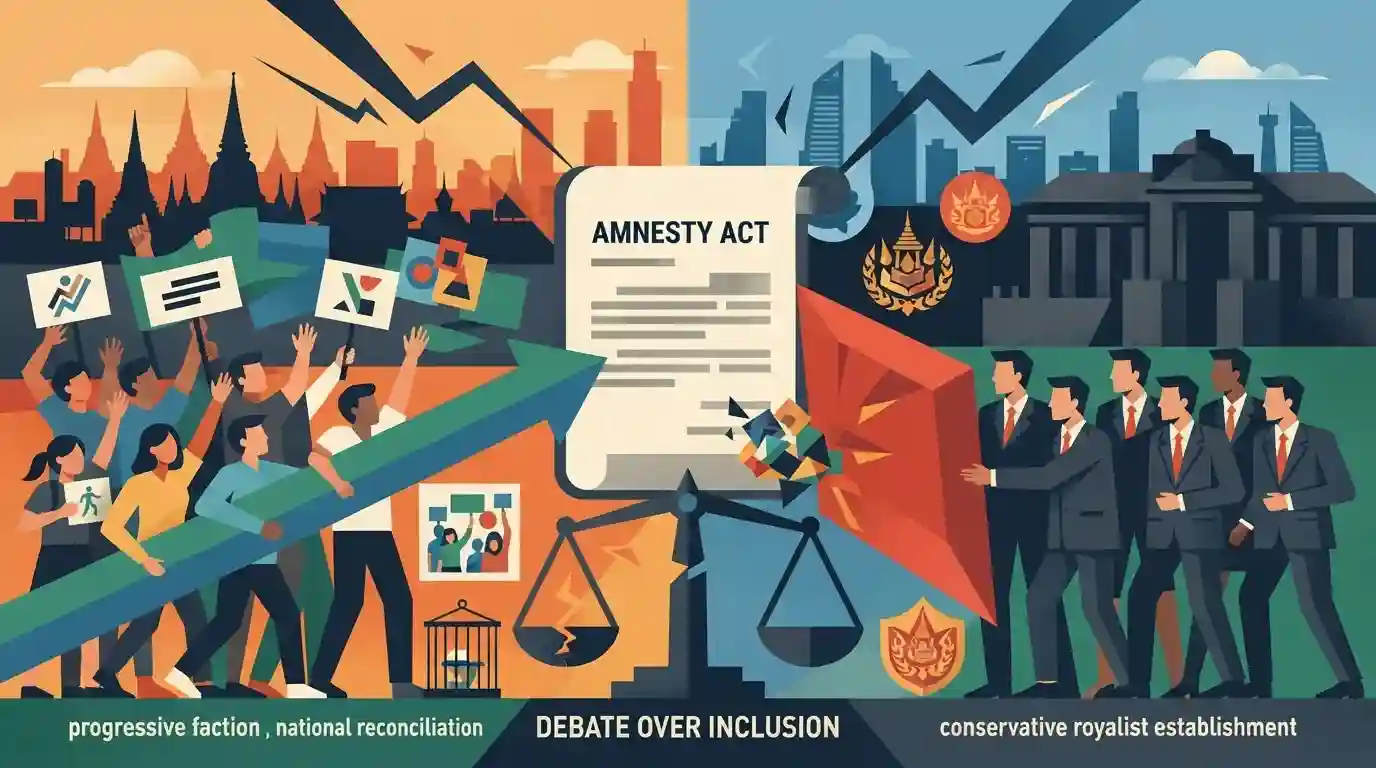
Thailand's political landscape is currently dominated by debates over a proposed Amnesty Act designed to pardon individuals involved in politically motivated offenses stemming from decades of political turmoil. The core debate centers on the potential inclusion of offenders charged under Section 112, Thailand's strict lèse-majesté law. While progressive factions argue that pardoning these individuals—many of whom are youth activists from recent pro-democracy protests—is essential for national reconciliation, the conservative royalist establishment firmly rejects any leniency regarding the monarchy, highlighting deep-seated ideological divides between democratic aspirations and traditional institutions in Thailand.
मुख्य मुद्दे
- Thailand is debating a new Amnesty Act aimed at granting clemency to individuals prosecuted for political offenses during the recurring cycles of protests and coups over the past two decades.
- The most contentious issue is whether the amnesty should cover individuals charged under Section 112 of the Thai Criminal Code, known as the lèse-majesté law, which criminalizes insulting the monarchy.
- Pro-democracy groups and progressive parties advocate for the inclusion of Section 112 to release political prisoners, primarily youth activists from the 2020-2021 protests.
- Conservative, military-aligned, and royalist factions strongly oppose amending or granting amnesty for lèse-majesté offenses, framing it as a threat to national security and the institution of the monarchy.
महत्त्वाच्या संज्ञा
Section 112 (Lèse-majesté law)

A provision in Thailand’s Criminal Code that penalizes defaming, insulting, or threatening the monarchy with prison terms of three to fifteen years per offense, often criticized for suppressing political dissent.
UPSC context
GS Paper II (Comparative Constitutions) — tests understanding of constitutional monarchies, civil liberties, and freedom of speech.
Constitutional Court of Thailand
Thailand’s highest judicial organ tasked with constitutional review. It wields immense political power, historically dissolving political parties and removing prime ministers, often viewed as a tool of the conservative establishment.
UPSC context
GS Paper II (Judiciary/Governance) — tests the role of judicial review and judicial activism in democratic systems globally.
People's Party (Thailand)
A progressive Thai political party formed in August 2024 as the successor to the dissolved Move Forward Party, advocating for democratic reforms, military decentralization, and structural economic changes.
UPSC context
GS Paper II (Political Systems/International Relations) — tests dynamics of pro-democracy movements versus entrenched political structures.
Move Forward Party
A progressive Thai political party that won the most seats in the 2023 general elections but was dissolved by the Constitutional Court in August 2024 for proposing reforms to the lèse-majesté law.
UPSC context
GS Paper II (Democracy and Elections) — highlights challenges faced by reformist electoral movements under hybrid authoritarian regimes.
Pheu Thai Party
A major populist, centre-right political party in Thailand founded by former Prime Minister Thaksin Shinawatra. Historically popular among rural voters, it recently entered coalitions with conservative and military-aligned factions.
UPSC context
GS Paper II (Political Parties/Governance) — examines the role of populist parties and political shifts in coalition governments globally.
संबंधित PYQ · 2
संबंधित PYQ · 2
- 2014MainsGS2
What do you understand by the concept "freedom of speech and expression"? Does it cover hate speech also ? Why do the films in India stand on a slightly different plane from other forms of expression ? Discuss.
- 2022MainsGS2
“Right of movement and residence throughout the territory of India are freely available to the Indian citizens, but these rights are not absolute.” Comment.
