Switzerland Neutrality Initiative and Its Foreign Policy Implications
Source:The Hindu ↗
ఇది ఎందుకు ముఖ్యం
Understanding how historical states redefine neutrality amidst modern geopolitical polarization (like Russia-Ukraine conflict and NATO expansion) provides essential perspective on international law, global governance, and diplomacy.
సారాంశం
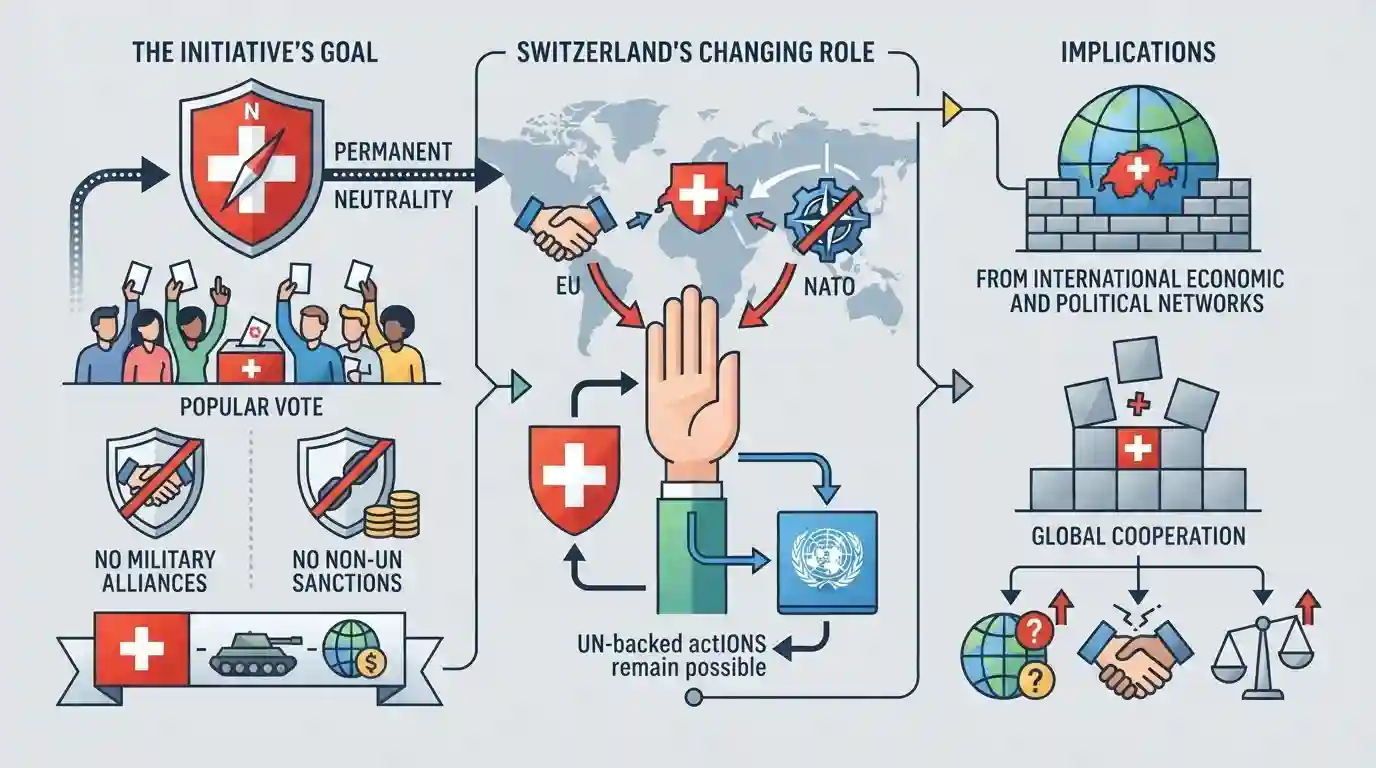
An explanation of Switzerland's 'neutrality initiative', a political movement led by the Swiss People's Party (SVP) seeking to constitutionalize strict and permanent neutrality, preventing participation in military alliances or non-UN sanctions, and its implications for Swiss foreign policy and international relations.
ముఖ్య అంశాలు
- Switzerland's 'neutrality initiative', pushed by the right-wing Swiss People's Party (SVP), seeks to enshrine a strict, permanent definition of neutrality directly into the Swiss Constitution.
- The initiative proposes prohibiting Switzerland from joining any military alliances (such as NATO) or participating in non-UN-backed economic sanctions, such as those imposed on Russia over the Ukraine conflict.
- Critics, including the Swiss government and parliament, argue that the initiative is too rigid, would harm Switzerland's international standing, diplomacy, and economy, and strips away necessary foreign policy flexibility.
- Switzerland's traditional neutrality has long served as a cornerstone for hosting international bodies and peace negotiations, making shifts in its policy globally significant.
ముఖ్యమైన పదాలు
Neutrality Initiative

A political movement led by the Swiss People's Party that sought to constitutionalize strict and permanent neutrality, barring non-UN sanctions and military alliance participation.
UPSC context
GS Paper II (International Relations): Tests understanding of evolving state foreign policies, sovereignty, and strategic autonomy models.
Swiss People's Party (SVP)
A conservative, right-wing political party in Switzerland that champions national sovereignty, strict neutrality, and anti-immigration policies.
UPSC context
GS Paper II (International Relations/Global Politics): Relevant for studying the rise of right-wing populism and domestic influences on foreign policy.
Swiss Federal Council
The seven-member executive council that constitutes the federal government and collective head of state of Switzerland, responsible for executive governance and foreign policy.
UPSC context
GS Paper II (Polity & Governance): Useful for comparative study of unique executive structures like Switzerland's collegiate federal council.
అనుసంధానమైన స్థిర భావనలు
What are the foundational principles of permanent neutrality under international law?
- Hague Conventions: Defined by the 1907 Hague Conventions (V and XIII), establishing the rights and duties of neutral powers in war.
- Core Obligations: Requires a state to abstain from participating in armed conflicts, providing equal treatment to belligerents regarding military supplies, and defending its own territory from use by warring parties.
- Armed Neutrality: Unlike disarmament, a neutral state must maintain an adequate military capability for self-defense (armed neutrality).
అంతర-అంశ నమూనాలు
Swiss Neutrality vs EU Foreign Policy Integration
Switzerland's departure from absolute neutrality by adopting EU sanctions against Russia mirrors Ireland and Austria navigating EU Common Foreign and Security Policy (CFSP) while maintaining military neutrality.

Expect a statement-based prelims question on Switzerland's neutrality, contrasting traditional perpetual neutrality with recent sanction alignments.
అనుసంధాన PYQలు · 1
అనుసంధాన PYQలు · 1
- 2025MainsGS2
"The reform process in the United Nations remains unresolved, because of the delicate imbalance of East and West and entanglement of the USA vs. Russo-Chinese alliance.” Examine and critically evaluate the East-West policy confrontations in this regard.
